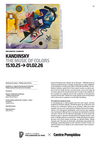
Kandinsky. The Music of Colors
Exhibition
October 15, 2025 – Fenruary 1, 2026
Musée de la musique - Philharmonie de Paris
Press release
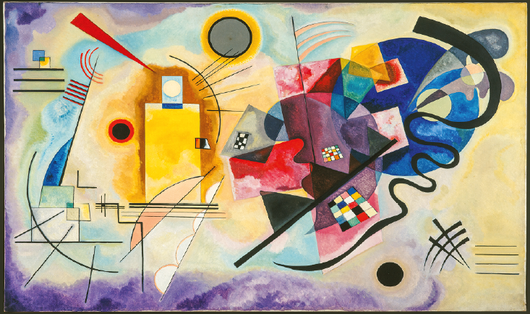
Collection Centre Pompidou, Paris - Musée national d’art moderne - Centre de création industrielle,
Donation by Mme Nina Kandinsky in 1976.
Centre Pompidou and Musée de la Musique - Philharmonie de Paris have joined forces to design and produce a major exhibition on the imagery of music in the work of Wassily Kandinsky. This exhibition features nearly 200 of the master’s works, as well as objects from his studio (scores, records, books, tools, and more), all of which express the fundamental role of music in his daily life, in his vocation as a painter and in the evolution of his practice towards abstraction. Rarely has music played such an important role in the work of a painter as for Wassily Kandinsky.
The abstract model of music
A contemporary of Mussorgsky and the new music schools inspired by Russian folklore, Kandinsky grew up in Moscow and Odessa in a cultivated family; as an amateur cellist and reed organist, he was soon captivated by Wagner. Beyond the expectations of his bourgeois upbringing, music had an eye-opening role. He himself affirmed that it nurtured and defined his artistic vocation. Above all, the abstract language of music gave the painter scope to question the principle of imitating nature, to the point of bringing about its dissolution. While refining his thoughts among such avant-garde musicians as Nikolai Kulbin, Sergei Taneyev and Thomas de Hartmann, Kandinsky reinvented the language of painting based on the abstract model of music, as demonstrated most clearly in his Improvisations and Compositions series.
The painter’s range of listening
Until now, no exhibition has placed the painter's output, from Russian landscapes to his last Compositions, in the context of the vibrant musical scene of his time. Yet there is no doubt that the compositions of Alexander Scriabin, Thomas de Hartmann, Arnold Schönberg and Igor Stravinsky defined the range of listening for pictorial modernity and abstraction. From the “Wagner shock” that Kandinsky experienced in 1896 in Moscow to his theatrical and choreographic experiments at the Bauhaus where he taught starting in 1922, the exhibition offers a fresh perspective on the painter’s works through subtle interplay between music, forms and colours during an immersive journey with a headset.
The studio of a music lover
As well as a hundred or so works and drawings from the collections of Centre Pompidou and major international institutions, the exhibition features an imaginary studio showing Kandinsky’s melomania. Sheet music he acquired, books and musical literature he collected, photos of his musician friends and his record collection, including the popular songs he was fond of, were essential parts of his artistic culture. At the heart of the studio is a collection of tools from Kandinsky’s own studio that questions the musicality of his creative process, particularly his work on the “sound” of colours and his visual studies of Beethoven’s fifth symphony.
Towards a synthesis of the arts
Kandinsky's pictorial production cannot be separated from his
reflection and experiences around the synthesis of the arts. In a unique way, the exhibition places paintings and drawings in conversation with his various projects for the stage, poems exploring the “pure sound” of words, and the Almanach du Blaue Reiter (Blue Rider), all of which create fundamental unity between the visual and auditory arts. Lastly, because in the eyes of Kandinsky music is also a performing art, the exhibition includes a recreation of multiple synaesthetic works, through interactive audiovisual
installations, such as the 1928 staging of Moussorgski’s Tableaux d’une exposition, or the Salon de musique that he designed for the 1931 Berlin Building Exhibition.
Audio and family tours
This exhibition differs from a traditional display by featuring original installations that offer visitors a sensory exploration of the painter's world. The exhibition offers an immersive audio experience, primarily musical, creating a dialogue between painting and music. This original creation, combining voice and sound, can be listened to on headphones, and is triggered by goelocation.
A family tour and an audio-descriptive tour complete the offering.
-
Téléchargez le dossier de presse
PDF - 3 pages - 5.2Mo
-
Download the press release
PDF - 829 Ko
Visuals of the exhibition are available by request
Press officer:
Céline Janvier
00 33 (0)1 44 78 43 82
celine.janvier@centrepompidou.fr
Communication and digital media department
Director
Geneviève Paire
Head of the press office
Dorothée Mireux