François Morellet
Exhibition
April 3 – September 28 2026
Centre Pompidou-Metz
Press releaase
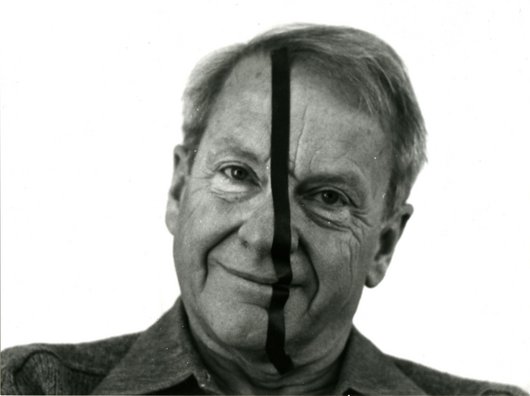
© Archives François Morellet / Adagp, Paris, 2025
For the centenary of François Morellet’s birth (1926-2016), Centre Pompidou-Metz presents a retrospective in 100 works from 1941 to 2016, the most comprehensive exhibition ever offered of his work.
Morellet is a unique figure in that he is both the main French representative of geometric abstraction and the person who contributed most decisively to destabilising the movement.
In the oblong space of nearly 1,200 m2 in Centre Pompidou-Metz’s Gallery 3, the exhibition offers the public the chance to experience and feel this ambivalence through two chronological circuits, starting with figurative paintings from the 1940s in the middle of the space. On one side is the Morellet who triumphs through the rules and glory of pictorial materialism. On the other is the Morellet of optical folly and Neo-Dadaist distance, the one who seemed to introduce a kind of Trojan horse into the kingdom of his master, Max Bill.
Just one of these two sides would have been sufficient to. establish Morellet's historic grandeur. In Metz, 2026 will offer visitors the chance to see the two sides of Morellet’s great reputation.
After discovering Max Bill’s work during his travels to Brazil in 1950 and 1951, Morellet decided to embark upon the path opened up by concrete art. In 1952, a visit to the Alhambra convinced him to abandon any notion of composition. From that point on, he adopted an elementary geometric vocabulary and developed creative methods that left no scope for subjectivity, using pre-established procedures applied in a neutral and precise manner. In reaction to the lyrical abstraction that was dominant at the time, he sought to remove all expressiveness and embraced a programmed and systematic art. Placing the figure of the inspired artist back in the closet, he sought to limit both his sensibility and the number of decisions to be made in the conception of works, which logically led him to return to chance. Over the decades, in a narrative that would lead him to dialogue with concrete art, then with minimalism, of which he was a precursor in many aspects, Morellet became gradually more interested in the painting as an object, placing it in relation with the wall and even the surrounding space. In this sense, he can be considered one of the main figures in a form of modernist classicism, a disciple of the power of rules, a partisan of a poetics of reason.
However, at the turn of the 1960s, Morellet realised that his creative plans sometimes led to optical aberrations. He got involved with the experimentations of G.R.A.V. (Visual Art Research Group), becoming one of the major representatives of op art (in fact, Vasarely was one of the first to acquire one of his paintings), an aesthetic that places emphasis on the destabilisation of the gaze and the instability of perception. Op art can be considered the baroque moment in the history of geometric abstraction. With Morellet, the op movement would find an unexpected ally in his Neo-Dadaist spirit, sustained in part by a long exchange with chance and its virtues. In his work, the proud, literalist neon light of minimalism and Dan Flavin would therefore often become the companion of the gaps that the artist himself would pleasantly associate with rococo. In other words, optical folly and derision are one of the dimensions making up Morellet’s art, as are rules. It would be highly reductive to see Morellet as the artist who simply introduced a little humour into the kingdom of concrete art. No, his work is completely founded on ambivalence.
A catalogue published by Éditions du Centre Pompidou accompanies the exhibition. Introduced by an essay from the curator, it specifically interrogates the international nature of Morellet’s career.
-
-
Press release - François Morellet 100 Per Cent
PDF - 240 Ko
-
Nota de prensa - François Morellet 100 por cien
PDF - 462 Ko
Press contact for the exhibition
Claudine Colin communication
– Une société de FINN Partners
Laurence Belon
+ 33 (0)7 61 95 78 69
laurence.belon@finnpartners.com
Communication and digital media department
Director
Geneviève Paire
Head of the press office
Dorothée Mireux