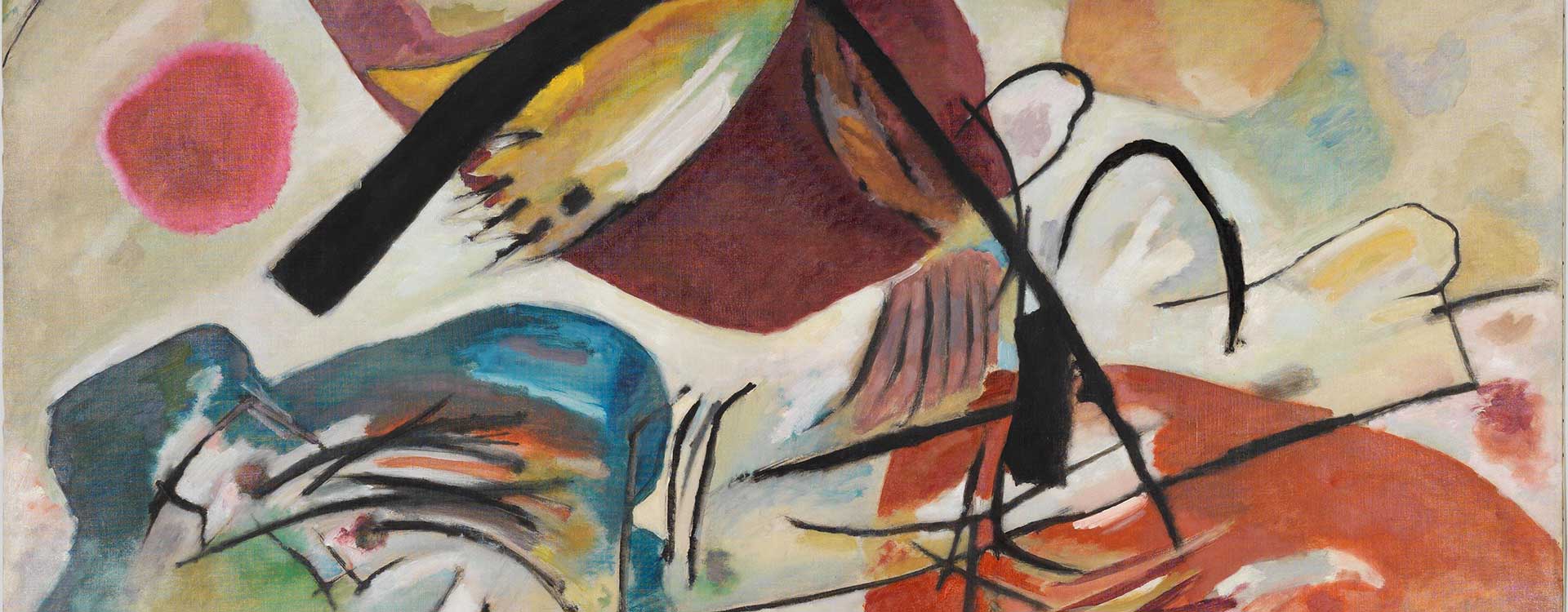
Focus on... “With the Black Arc” by Vassily Kandinsky
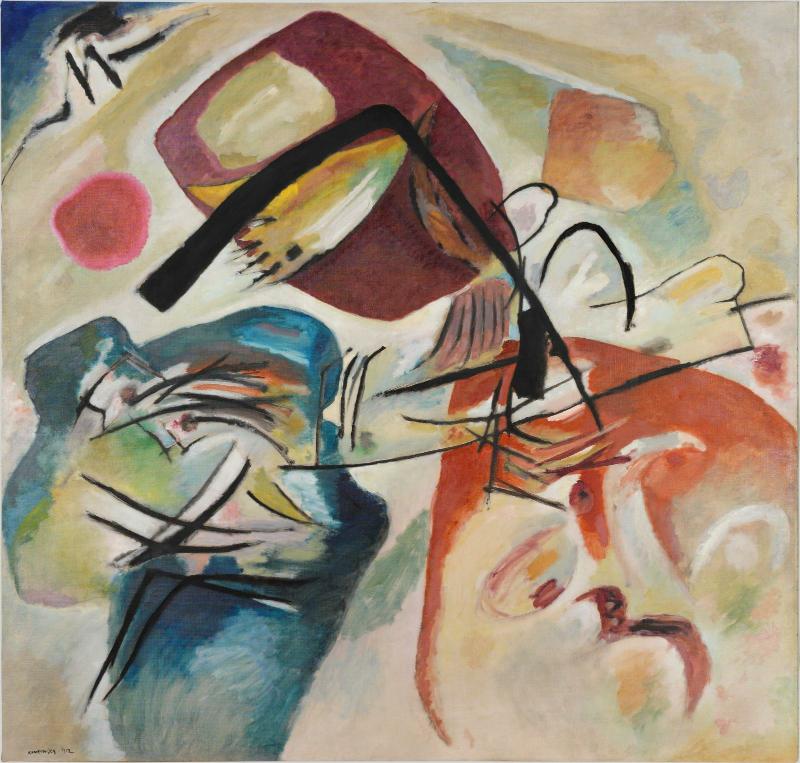
Just before the opening of his exhibition at the Der Sturm gallery in Berlin, in September 1912, Wassily Kandinsky (1866–1944) requested that a small painting be replaced with another, much larger and almost square in format, titled Mit dem schwarzen Bogen (With the Black Arc). In this expansive composition, which he had just completed, three blocks of colour — red, blue, and violet-burgundy — appear to collide. A thick black arc stretches above them. The composition radiates movement, animated by numerous black lines that slice through, connect, or score the fields of colour.
With the Black Arc emerged from an intense period of research during which Kandinsky pursued a constant aim: to give visible form to the expression of his inner feeling, and to find the artistic means capable of generating a force of emotion approaching ecstasy.
Ecstasy was something he had experienced himself — on several occasions — while watching the sun set over Moscow. “This Moscow, both internal and external, I see as the source of my inspiration as an artist. It is my painter’s tuning fork.”
He uses a musical term deliberately: he had understood that music could help him reach the deepest emotions and touch the soul. What he sought was a path between hearing and sight, between sound and vision.
He also turned to poetry. Since 1907, Kandinsky had been composing poems in which he chose words for their vibratory texture. He encouraged readers to listen to the resonance of the lines in order to feel the world resonate within themselves. Through poetry, he began shaping a process of abstraction that was inseparable from inner experience. He often accompanied his poems with prints in which forms evoking horses, lightning, trees, and more became lines of energy.
With the Black Arc is closely linked to this dynamic principle. The arc refers to the douga, a central piece of harness used in Russian troikas. This age-old form, unique to Russia, serves to hold the horses apart and prevent them from colliding. Kandinsky painted this arc precisely in the middle zone of the composition — at the point where the three blocks of colour clash.
Kandinsky quickly realised that he needed to establish correspondences between painting and music. He multiplied his contacts with musicians. On 2 January 1911, he attended a concert by Arnold Schoenberg, whose atonal music he was discovering for the first time. He reached out to the composer: “How I envy you! Your Theory of Harmony is already at the printers. Musicians are truly lucky (relatively speaking) to practise an art that has come so far. [...] How much longer must painting wait for such a moment?”
In fact, Kandinsky was already writing Concerning the Spiritual in Art, his essay on painting, which would be published in December 1911. In Schoenberg’s Theory of Harmony, the notion of a “melody of timbres” echoed Kandinsky’s own reflections on the physical and psychological effects of colour on the viewer.
Since 1907, Kandinsky had been composing poems in which he chose words for their vibratory substance. He encouraged listening to the sheer resonance of phrases in order to feel the world resonating within oneself. Through poetry, he began to establish a process of abstraction connected to an inner process.
The painter wrote: “When it is of medium strength, like cinnabar, red [...] is like a passion burning steadily, a self-assured force not easily subdued, but one that yields to blue, like red-hot iron to water.”
Blue, in his view, belonged to a completely different realm: it followed “a concentric movement (like a snail withdrawing into its shell) and receded from man.” Through the proximity of these two colours — which appear together in With the Black Arc — the painter sought to create a “spiritual contrast between them” and the most powerful possible harmony.
The third colour in the painting is a subtle mix of the two. According to him, violet lowers the active element of red and evokes the deep sounds of the cello. Violet, blue and red act and react freely, like living bodies that attract and repel one another.
Painting, as the living expression of an inner content, points to a third creative domain in Kandinsky’s work: the theatre. In plays he began writing as early as 1908, he aimed to link colour, line, sound and gesture through figures imbued with colour and human voices. He imagined these silhouettes moving in shifting light, to the rhythm of sound.
Although his plays were never staged — except for Yellow Sound — they strongly supported his pictorial investigations into an artistic expression that could engage all the senses.
Creating a vibratory, coloured atmosphere, he used light to unify the stage and the audience. The latter was meant to feel caught in a Whole that encompassed and transcended them. “For years, I sought a way to lead the viewer into the painting, to force them to merge into the painting and forget themselves.”
This feeling of belonging and of dissolving into the work can emerge when the work reaches a tragic dimension. In With the Black Arc, Kandinsky manages to seize the viewer, to draw them into a movement and dramatic tension through a construction based on the triangle.
This feeling of belonging and of dissolving into the work can emerge when the work reaches a tragic dimension. In With the Black Arc, Kandinsky manages to seize the viewer, to draw them into a movement and dramatic tension through a construction based on the triangle.
Described as “mystical”, the triangle was, for the artist, the most spiritual form for ordering the elements of a composition. Within it, this concert of colours, this dissolution of matter, this perpetual motion, this almost gestural expressiveness of forms, this rhythm of sound and silence, all fall into place.
Kandinsky succeeds in merging all art forms into a single space: a square of barely 4 m² — the culmination of more than four years of research, during which the artist aimed to reinvent art, to liberate each medium from the weight of tradition, while restoring its original purpose.◼
Related articles

In the calendar
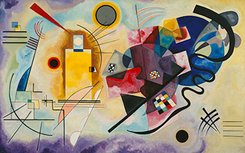
Vassily Kandinsky, Mit dem schwarzen Bogen (“With the Black Arc”), 1912
Oil on canvas, 189 × 198 cm
© Centre Pompidou, Mnam-CCI / Dist. Rmn-Grand Palais