Matisse, 1941 - 1954
Exhibition
March 24 – July 26, 2026
Grand Palais, Paris
Press release
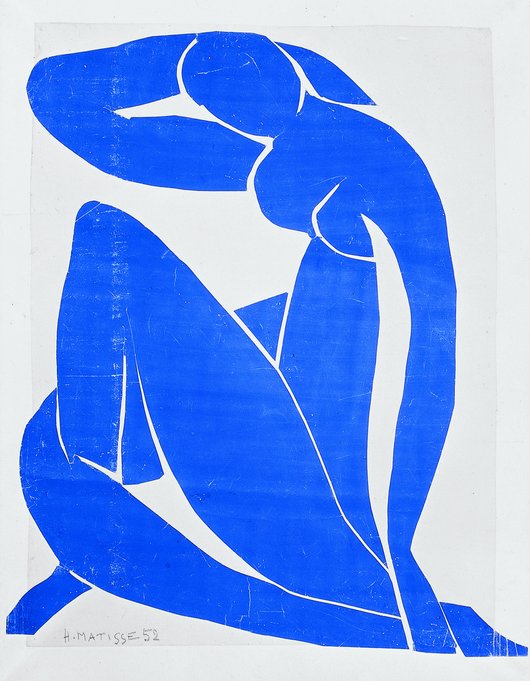
Public domain. Photography credit : Service de la documentation photographique du MNAM - Centre Pompidou, MNAM-CCI
“Matisse, 1941 — 1954” is an exhibition of unparalleled scale that highlights the artist’s final creative years: a season of synthesis, radicalness and formal invention. It brings together more than 300 works that testify to Matisse’s burst of unprecedented creativity during this particularly fertile period. At the age of nearly 80, he reinvented himself with gouache cut-outs through which he entirely renewed his visual vocabulary and afforded monumental scope to his art. The exhibition takes visitors into the heart of Matisse’s last large studio, where paintings, series of drawings, illustrated books, gouache cut-outs, textiles and even stained-glass windows reveal the different facets of this final moment of grace.
With over 300 works, many of which are shown for the first time in France, the exhibition is a unique opportunity to discover rarely seen ensembles. The already rich collection of Centre Pompidou is complemented by exceptional loans from private collections and such national and international institutions as the Hammer Museum, MoMA, the National Gallery of Art in Washington, the Barnes Foundation and Fondation Beyeler.
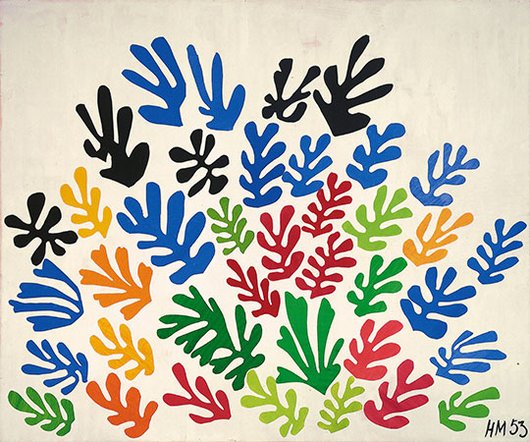
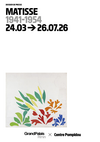
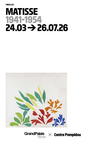
Charcoal and gouache paper cut-outs, pasted on paper mounted on canvas, 311.7 × 351.8 cm Riehen/Basel, Fondation Beyeler, Beyeler Collection /
© Photo: Robert Bayer Licenciée par Dist. GrandPalaisRmn / image LACMA
The circuit brings together over 180 works from the rich collection of Centre Pompidou, private collections and national and international institutions, including loans never or very rarely seen in France (Hammer Museum in Los Angeles, MoMA, the MET, National Gallery of Art in Washington, the Barnes Foundation, Fondation Beyeler, and more).
It features key ensembles of this period, including the masterful and final series of paintings titled Intérieurs de Vence from 1947-1948, and the Jazz album, a radically modern work inspired by music, which is one of the greatest examples of an artist’s book, and will be presented for comparison alongside its mock-up, which is conserved in the collection of the Musée National d’Art Moderne. The exhibition will also feature the Thèmes et variations series along with ink and brush drawings, the main pieces from the Chapelle de Vence, the monumental panels of La Gerbe and Acanthes, and the highlight of the exhibition, huge gouache cut-out figures exceptionally presented together, including La Tristesse du roi, Zulma, La Danseuse créole and the Nus bleus series.
This final creative period for Matisse was characterised by an ever-greater symbiosis between the space in the studio and the space in the work. Working directly on the walls in his Régina apartment, making the pieces mobile by their very nature, they contribute to the dynamic vegetalisation of the space: as in a bestiary, acrobats, swimmers, mascarons, and floral and vegetal motifs mix freely in fertile transports, one proceeding from the other as if by prolific cloning. The exhibition seeks to replicate this place in constant metamorphosis, giving visitors access to this “garden” by Matisse through a space that grows and expands as you move through each room.
Nocturnes Supplémentaires à partir du mercredi 27 mai 2026
Afin de permettre au plus grand nombre de voir l'exposition tout en maintenant un accueil dans les meilleures conditions, le Grand Palais et le Centre POmpidou proposent une Nocturne supplémentaire à partir du 27 mai 2026. Ainsi, en complément des Nocturnes des vendredis soirs, l'exposition Matisse 1941-1954 sera également ouverte en Nocturne tous les mercredis soirs jusqu'à 22h à partir du 27 mai prochain.
Dernière entrée 45 minutes avant la fermeture des expositions - Fermeture de la billeterie sur place 1h avant la fermeture de l'exposition.
À consulter en ligne
 Magazine en ligne
 Communiqué autour des éditions
Press officer
Céline Janvier
celine.janvier@centrepompidou.fr
International press officers
Inas Ananou
inas.ananou@centrepompidou.fr
Mia Fierberg
mia.fierberg@centrepompidou.fr
Communication and digital department, Media relations
Director
Geneviève Paire
Head of the press office
Dorothée Mireux