![[Translate to English:]](/fileadmin/user_upload/Calder-Josephine-bandeau.jpg "[Translate to English:]")
Focus on... "Joséphine Baker IV" by Alexander Calder
Settling in Paris in 1926, the American sculptor Alexander Calder began creating his first wire portraits there, including Joséphine Baker I and Boxeur nègre en haut-de-forme (Negro Boxer in a Top Hat), both now lost but reproduced as “Calder’s toys”. These works are contemporary with his explorations of Cirque figures, made from wire or brass and adorned with fabric, paper, and other eclectic materials.
The stand-alone sculptures of circus stars, music hall performers, or figures from the art world — produced between 1927 and 1930 — are crafted solely from wire, with no additional materials. Like drawings in space, they trace silhouettes or vacant faces with striking linear clarity.
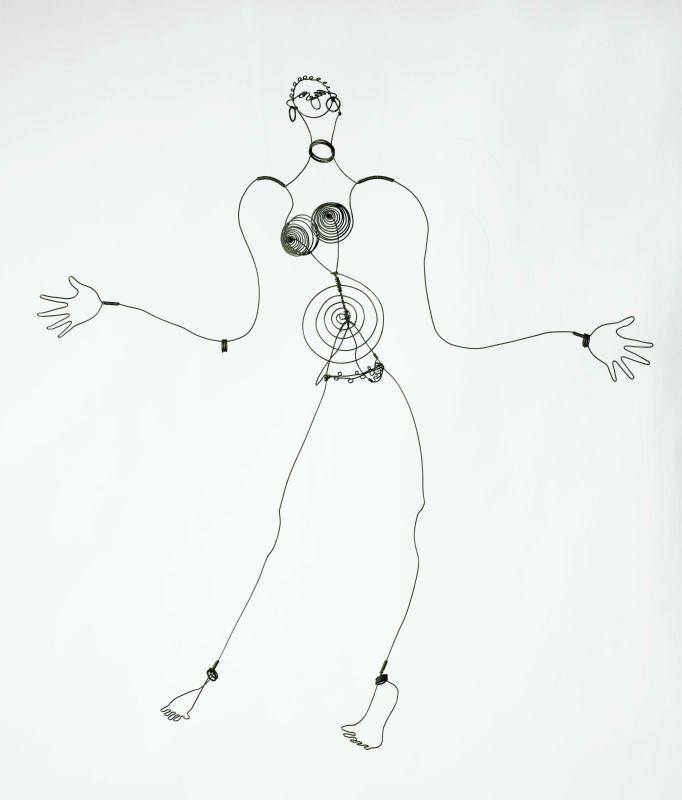
Between 1927 and 1929, without ever having seen her “wild dance” performance, Alexander Calder created a series of five sculptures dedicated to the American performer Joséphine Baker (1906–1975), the “Black star” of La Revue nègre at the Théâtre des Champs-Élysées.
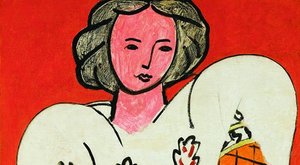
Renowned for her beauty and her electrifying act as a nude dancer adorned with a belt of feathers or bananas, Baker inspired other artists as well, including Matisse. The piece in the Centre Pompidou’s collection may be the fourth version in a group of silhouettes — similar in form but differing in posture and gesture — suspended in space by a wire.
Renowned for her beauty and her electrifying act as a nude dancer adorned with a belt of feathers or bananas, Baker inspired other artists as well, including Matisse.
The first version has been lost, as has the one known only through a photographic reproduction published in an issue of Acht Uhr Abendblatt (Berlin, 8 April 1929). The final sculpture, Aztec Joséphine Baker (1929, private collection), is the largest and most abstract of the series. An Anonymous Dancer, also lost, was featured in the special “Calder” issue of Paris Montparnasse on 15 June 1929. A four-legged reclining figure titled La Négresse (Joséphine Baker’s mother), created in 1928, completes the group. The malleability of iron lends this sculpture a supple, gangly silhouette, accentuated by spiralled breasts and waist, offering a vivid, at once caricatural and realistic image of the artist, celebrated for the provocative sensuality of her Charleston. ◼
* Extrait du catalogue Collection art moderne - La collection du Centre Pompidou, Musée national d’art moderne, sous la direction de Brigitte Leal, Paris, Centre Pompidou, 2007
![[Translate to English:] This powerful work by Jean-Michel Basquiat delves into themes of slavery, Black identity, and human commodification. On a dark, chaotic background accented with bright orange, electric blue, and white, a haloed skull, a striped figure, and a series of cartoonish faces emerge. The raw brushstrokes, drips, scribbles, and collages create a sense of controlled chaos, echoing the violent and fragmented history of African Americans. The painting evokes urgency, tension, and resistance, blending street art energy with symbolic and socio-political critique.](/fileadmin/user_upload/basquiat_slave-auction_vignette.jpg "[Translate to English:]")