![[Translate to English:] This powerful work by Jean-Michel Basquiat delves into themes of slavery, Black identity, and human commodification. On a dark, chaotic background accented with bright orange, electric blue, and white, a haloed skull, a striped figure, and a series of cartoonish faces emerge. The raw brushstrokes, drips, scribbles, and collages create a sense of controlled chaos, echoing the violent and fragmented history of African Americans. The painting evokes urgency, tension, and resistance, blending street art energy with symbolic and socio-political critique.](/fileadmin/user_upload/basquiat_slave-auction_bandeau.jpg "[Translate to English:]")
Focus on.. "Slave Auction" by Jean-Michel Basquiat
The year 1982 marked a turning point for Jean-Michel Basquiat: international recognition, prolific production, and a growing focus on the theme of oppressed minorities, powerfully synthesised in Slave Auction. The painting features the hallmarks of the oppressors—faces with menacing teeth—in stark contrast to the vacant expressions of the no teeth, the excluded, while the golden hue of the slave ship evokes the power of money.
The year 1982 marked a turning point for Jean-Michel Basquiat: international recognition, prolific production, and a growing focus on the theme of oppressed minorities, powerfully synthesised in Slave Auction.
On the right, a scarecrow-like figure emerges, its costume referencing New Orleans music hall traditions. Opposite, a skull topped with a crown of thorns alludes to the sacrifice of the Black people, and the insect symbolises the daily torment endured in the cotton fields. The dominant blue tone, often associated with the blues, suggests the ultimate refuge of the oppressed.
In the foreground, the football player represents one of the contemporary heroes of American society that inspired in Basquiat both fascination and ambivalence—yet one he managed to conquer, despite his untimely death at the age of 27.
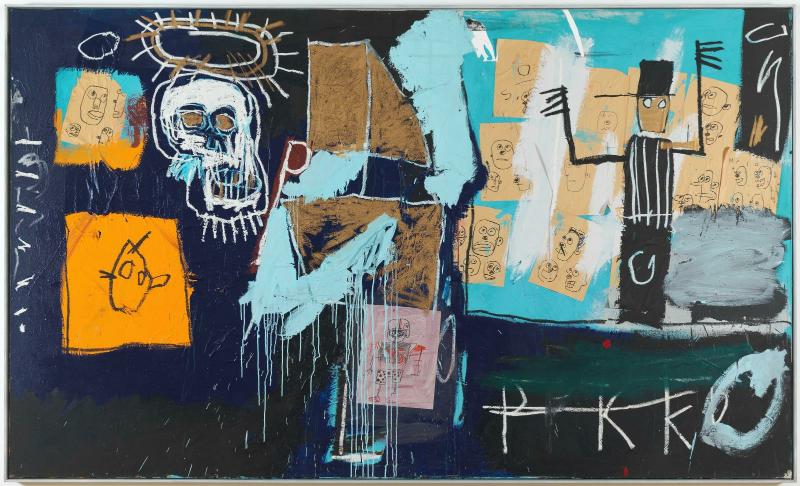
An African American artist of Puerto Rican and Haitian descent, born in 1960, Jean-Michel Basquiat absorbed this cultural fusion into a prolific and critical body of work that blends drawing, painting, and collage with a tormented, crossed-out, and deliberately awkward form of writing, much like a palimpsest. A mythical figure of the 1980s, he combined the elegance of Cy Twombly with the raw expressiveness of Jean Dubuffet or Jackson Pollock, drawing his subjects from popular culture, consumer society, and the history of the Black people. His themes are juxtaposed without hierarchy, as fragments to be apprehended all at once, echoing the urban chaos and the profusion of signs that accompany it.
In 1993, the Musée national d’Art moderne became the second French public institution to acquire a work by Basquiat, whose immense success remains evident to this day. Another of his works, a 1983 drawing, is also part of the collection. ◼
Related articles
![[Translate to English:]](/fileadmin/_processed_/f/3/csm_Calder-Josephine-vignette_511512214c.jpg "[Translate to English:]")



Jean-Michel Basquiat, Slave Auction (Vente aux enchères d'esclaves), 1982
Collage de papiers froissés, pastel gras et peinture acrylique sur toile, 183 × 305,5 cm
© Centre Pompidou
© Estate of Jean-Michel Basquiat, licensed by Artestar, New York