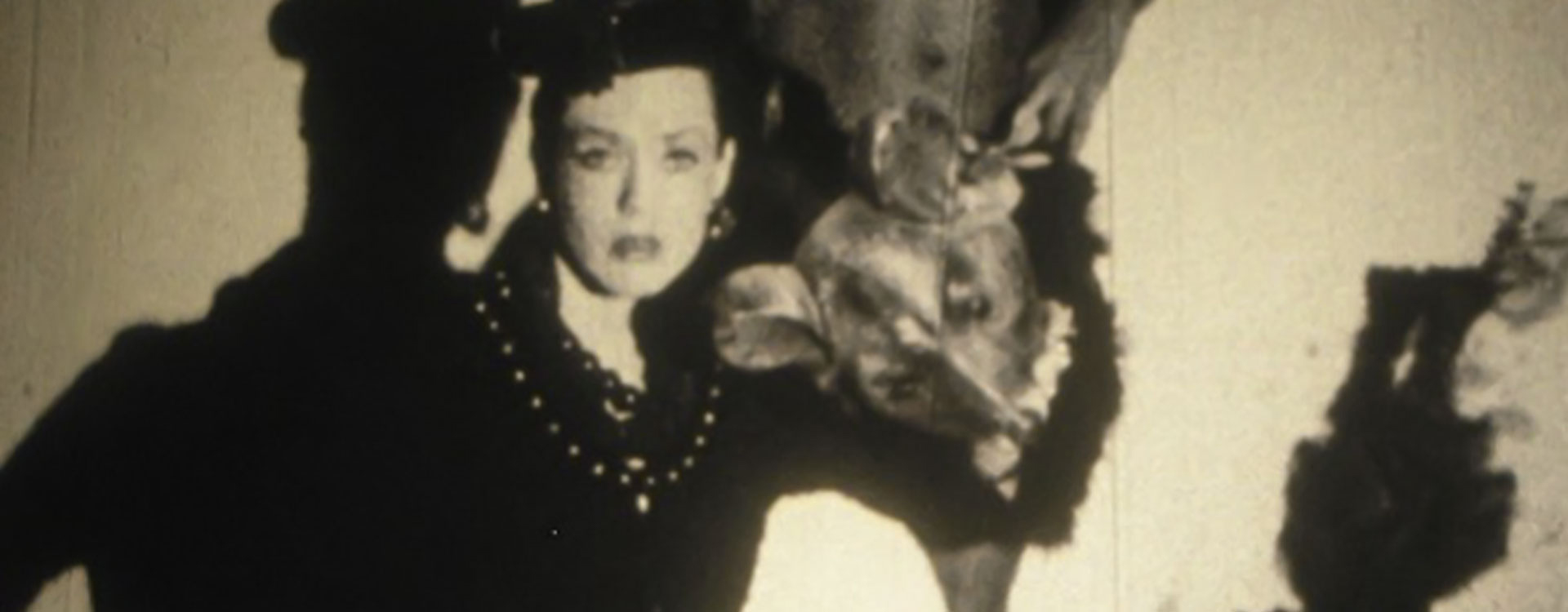
“No President!”: The Political Creatures of Jack Smith
What remains of a screening that never took place? No President (1967), by Jack Smith (1932–1989), was scheduled to be shown at the Centre Pompidou on Wednesday, 4 November 2020—just one day after the US presidential election, before the final results were even known. That same day, a new lockdown was announced, leading to the cancellation of all cultural programming. Film critic and historian J. Hoberman—an expert on Jack Smith’s work and the political imagination of American cinema—offers an in-depth reading of this now-iconic film.
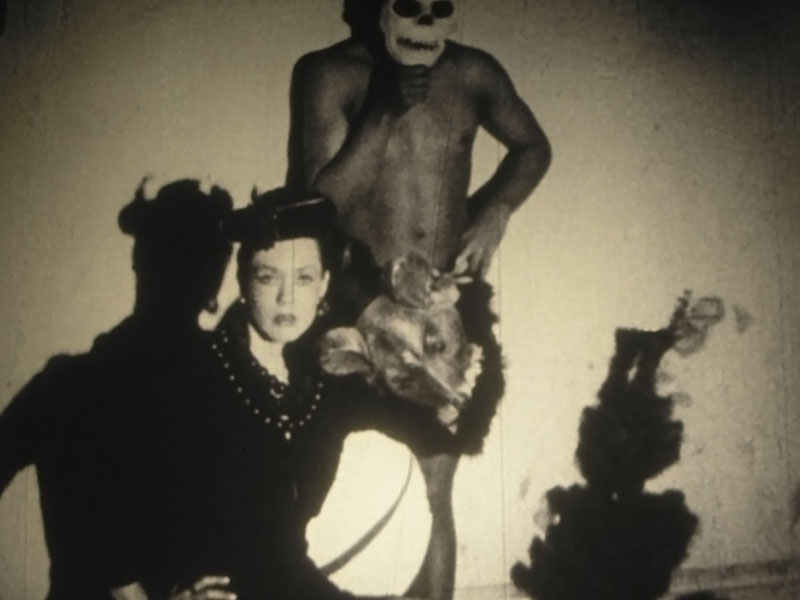
J. Hoberman — Its bluntly negative title resonating with additional force in the America of 2020, No President (1967–70) is the underground filmmaker Jack Smith’s response to the political tumult of the late 1960s as well as the legal travails that beset his first feature, Flaming Creatures (1962–63), a vision of anarchy in the absence or negation of the state’s ultimate authority.
Its bluntly negative title resonating with additional force in the America of 2020, No President (1967–70) is the underground filmmaker Jack Smith’s response to the political tumult of the late 1960s.
Like all of Smith’s post-Flaming Creatures films, No President is an unfixed work that, in all its iterations, was essentially performative. More an exercise in sensibility than craft, it evolved out of Smith’s late 1967 programme, Horror and Fantasy at Midnight, in which a number of individual titles (Reefers of Technicolor Island, Scrubwoman of Atlantis, Ratroppings of Uranus, Marshgas of Flatulandia, The Flake of Soot and Overstimulated) were shown to the accompaniment of a taped soundtrack by Angus MacLise’s Cineola Orchestra, the first drummer of the Velvet Underground.
No President is an unfixed work that, in all its iterations, was essentially performative.
Jonas Mekas’s review in The Village Voice (16 November 1967) describes a two-hour-plus presentation of three untitled films, each approximately 45 minutes long.
The first one starred a most beautiful marijuana plant, a gorgeous blooming white queen with her crown reaching towards the sky. In the second part we saw a gallery of Jack’s creatures, and there is no other name for them but to call them Jack Smith’s creatures. Although they are enacted by other talented and beautiful people, it’s Jack’s imagination that crowns them with those fantastic gowns and hats and plumes and colours. The third part is like a continuation of the second, but it’s in black and white, or more truly, in grey and white.
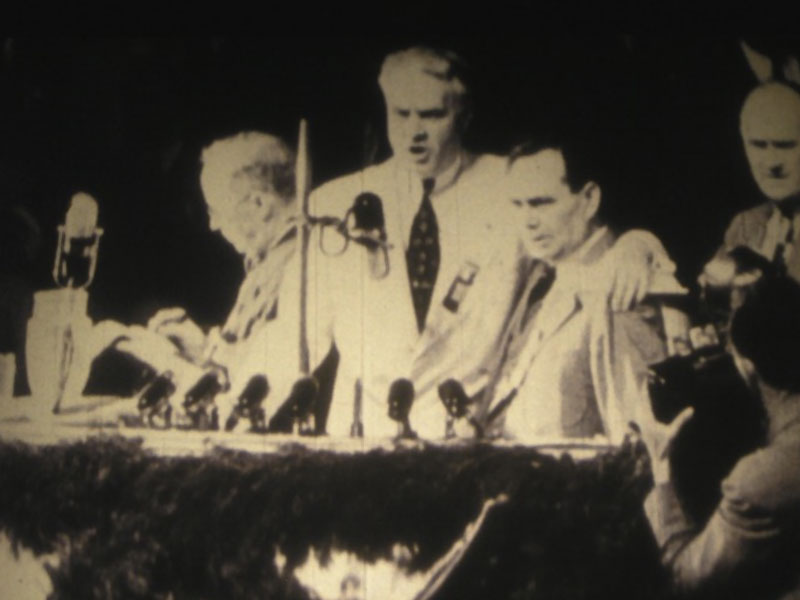
Like Ken Jacobs’s Star Spangled to Death, in which Smith appeared (and which, begun in the late 1950s, was shown as a work in progress for some 50 years), Horror and Fantasy at Midnight mixed original material with found footage. Another Village Voice critic, James Stoller, saw the programme after Mekas and found newsreels of the 1940 Republican Convention that nominated Wendell Willkie to run against Franklin D. Roosevelt, then seeking his third term. (Significantly, this footage was introduced around the time Senator Eugene McCarthy, a Democrat who opposed the Vietnam War, challenged the sitting Democratic president, Lyndon B. Johnson.)
“I don’t know what Wendell Willkie means to Jack Smith, but I was immoderately moved by this strange juxtaposition”, Stoller wrote. The Cineola Orchestra’s “haunting” musical accompaniment was now augmented by “a gummy Vietnam discourse” which Stoller recalled from Smith’s 1965 performance Rehearsal for the Destruction of Atlantis. These, he thought, invited the audience “to consider the footage of exotic beings, Christmas snow falling, etc. in a considerably wider context. And it’s not difficult to do”.
A third account of the programme, published by the psychoanalyst Joseph Aliaga in a short-lived arts journal, Medium, has it open with the same colour footage described by Mekas, accompanied by “tooty flutes” and “the ominous tom-tom of drums”. Then came images of “boys in drag” accompanied by the Vietnam tape.
"Seated and languidly swaying with a big fan in front of his-her face the top chief, called Lobster Man, jerks the exposed penis of a faceless naked man standing off to the side while a narrator appropriates touches, in diplomatic terms, on a corrupt official’s jerking off a nation, a people, a power and it’s funny."
The last shot, Aliaga wrote, was “a brilliant intuitive leap... a newsreel clip showing hundreds of civilians lined up on both sides of a street wildly cheering army recruits marching off into World War One”.
In January 1968 (around the time a print of Flaming Creatures was impounded by New York District Attorney Robert Morgenthau), Horror and Fantasy moved downtown for an extended run. The writer Irving Rosenthal was announced as the star. By late March, shortly before Johnson announced he would not seek re-election, this programme had coalesced into Kidnapping and Auctioning of Wendell Wilkie [sic] by the Love Bandit—an all black-and-white presentation starring Rosenthal, lipsticked and unshaven, as the infant Willkie abducted by a moustachio’d pirate (Doris Desmond) and sold on the block of a slave market modelled on the one in the 1942 Maria Montez vehicle, Arabian Nights.
This juxtaposition of Smith’s Baghdad and American electoral politics proved prophetic. In July 1968, Johnson nominated Supreme Court Justice Abe Fortas to replace retiring Chief Justice Earl Warren and, by way of drawing attention to the nominee’s liberal position on obscenity, the ranking Republican member of the Senate Judiciary Committee, Strom Thurmond of South Carolina, organised a “Fortas Film Festival”, including Flaming Creatures. Smith’s film was denounced in the Congressional Record and there was talk of screening it for the entire Senate before the Fortas nomination collapsed in September.
This juxtaposition of Smith’s Baghdad and American electoral politics proved prophetic.
Less than two weeks after Richard Nixon’s inauguration in January 1969, an hour-long version of No President was shown at the Elgin, a revival theatre in Chelsea which would later that year premiere the midnight movie El Topo: “Wendell Wilkie [sic]... More Famous Than Most Presidents—He Had Farms in Indiana, Vegatative Motility, and a Willingness to be President...” read the flyer, which also noted “If one knew what one expected of one’s president one wouldn’t need a president would one?”
The screening was an event. Andrew Sarris in Voice and the reviewer for The East Village Other both commented on the size of the crowds. Some, it would seem, were in a daze. Mekas reported, also in the Voice, that at least one viewer at the Elgin found No President “a remarkable first public screening of a film made 50 years ago.”
No President had a move-over run at Cinema 7, “a private club devoted to films for the male homosexual”. The same day, a conference on censorship and pornography held on the Notre Dame campus in South Bend, Illinois, was disrupted by sheriff’s deputies who maced students in breaking up a screening of Andrew Noren’s Kodak Ghost Poems which, along with Flaming Creatures (yanked from the projector after two scandalising minutes), had been banned by the administration.
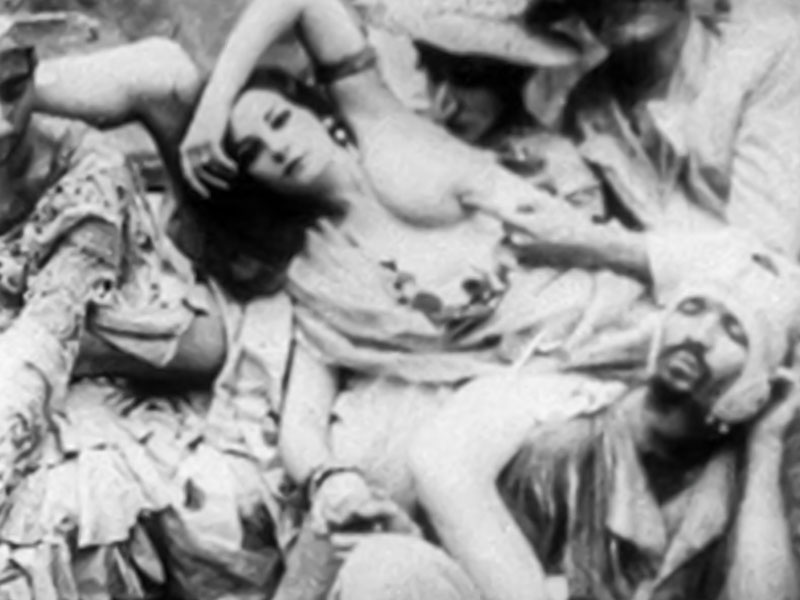
On Halloween 1969, two weeks after the Moratorium to End the War in Vietnam initiated demonstrations and teach-ins across the United States, and two weeks before the huge Moratorium March on Washington, DC, No President opened for a midnight run at the Bleecker Street Cinema. The film was shown once more a year later, on 12 October 1970, projected in the back room at Max’s Kansas City as part of the first New York Underground Film Festival. (A university student, I was present for this sparsely attended, haphazard screening.)
Alone in his praise, Jonas Mekas had already written to Smith to inform him that the Selection Committee for the newly established Anthology Film Archives voted to include both Flaming Creatures and No President in its canon of essential cinema. In his letter, Mekas stipulated the “original version” of No President “in the shape you projected it 15 months ago” at the Elgin in the bleak dawn of the Nixon presidency.
This did not happen and only one battered print was found after Smith died. The surviving version alternates scenes shot in Smith’s SoHo loft with found footage—including a Lowell Thomas travelogue of Sumatra, a clip from the late 1940s of an unidentified couple singing the sentimental hit “A Sunday Kind of Love”, and newsreel footage of candidate Willkie addressing the Republican convention and the Future Farmers of America. “Corniness” made is material; all is united under the sign of primitivism.
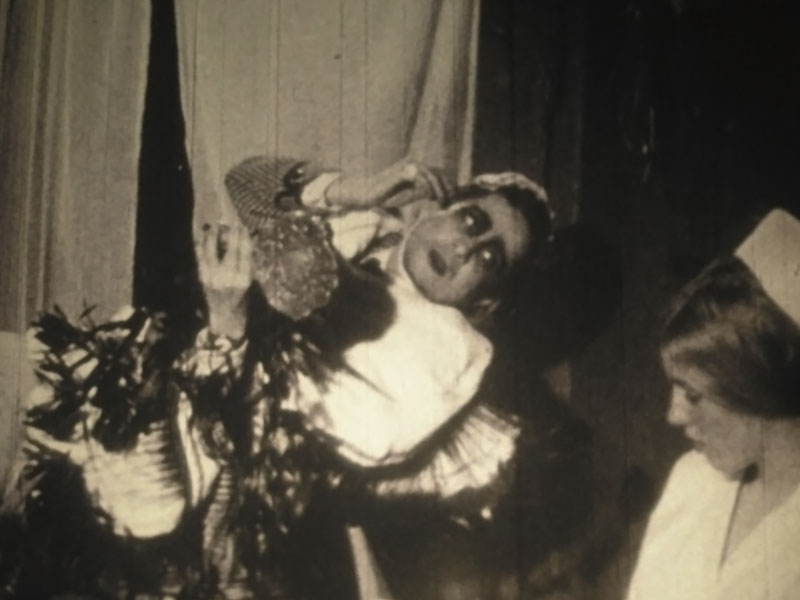
The narrative is structured around two tableaux, similar but more confrontationally crude than those in Flaming Creatures. In the first, the future presidential candidate (Irving Rosenthal), attended by a sleeping nurse, is abducted from his crib by a moustachioed pirate (Doris Desmond); in the second, which features a professional belly-dancer as well as the singer Tally Brown, Willkie is auctioned and perhaps sacrificed. This is followed by ecstatic footage of Willkie accepting his party’s nomination.
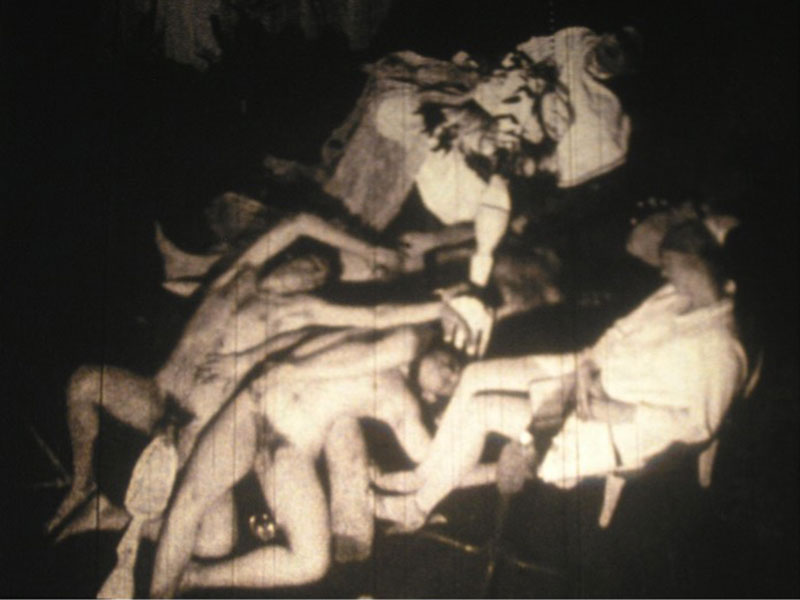
Smith’s hothouse childhood fantasies merge with entropic, harshly lit glamour scenes wherein the garishly costumed hobnob with the brazenly nude. As befits a political scenario, No President is rife with representations of the phallus—metaphoric and otherwise. Among other things, the movie literalises the idea of a champagne cocktail. Its critical vision might have been derived from the Hungarian psychoanalyst Geza Roheim, of whom it was said he “reduced politics to penis worship, warfare to the tantrums of a frustrate infant, and economics to a ritualistic exchange of faeces”.
Smith seldom screened No President after 1970. On those occasions, the footage was projected at silent speed to retard the speech and singing of the sound passages, with Smith playing records to accompany the silent footage. All screenings during Smith’s lifetime presupposed his presence. The movie’s posthumous form has an audiotape prepared by the filmmaker Jerry Tartaglia, who restored Smith’s oeuvre, that approximates Smith’s soundtrack using records from Smith’s collection.
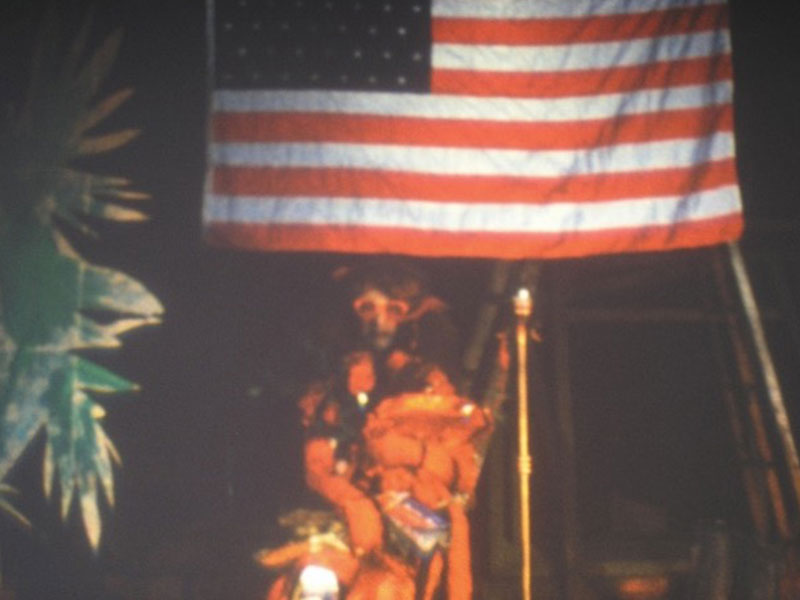
In an unpublished memoir, Professor Charles Bergengren recalls that the Elgin screening of No President was preceded by the colour short subject, Song for Rent. Here, Smith appeared as his red-wigged, plastic-jawed alter ego, Rose Courtyard, seated in a wheelchair amid detritus of his Greene Street loft. The film was accompanied by two renditions of Kate Smith singing “God Bless America”. Dressed in a red satin gown, clutching a bouquet of dead roses, Rose is finally moved to stand up and salute.
Indeed, the logic of No President suggests that it is precisely the jubilant absence of patriarchal authority that feeds the primal longing for a charismatic leader.
Shown together in the dismal morning after Nixon’s come to power, No President and Song for Rent were something like Smith’s “State of the Union”. Acknowledging defeat, Song for Rent presented a grotesque manifestation of the triumphantly decrepit status quo. No President was something else. As its title now suggested, No President harked back to a moment some 11 months earlier when Lyndon Johnson’s decision not to seek re-election prompted a brief feeling of widespread liberation akin to the spontaneous joy that broke out in many American cities with the announcement that Donald Trump had been defeated.
In February 1969, that liberation could only be seen as ancient history (“a film made 50 years ago”). Indeed, the logic of No President (harsher than the mock orgy of Flaming Creatures) suggests that it is precisely the jubilant absence of patriarchal authority that feeds the primal longing for a charismatic leader. ◼
J. Hoberman (1948–) is an American film critic. He began his career in the early 1970s writing for the Village Voice, where he remained until 2012. A specialist in American cultural and political history, his articles have appeared in The New York Times and Artforum. He is the author of numerous books, including The Magic Hour: Film at Fin de Siècle (Capricci, 2009), Film After Film (Or, What Became of 21st Century Cinema?) (Verso, 2012), and, more recently, Make My Day: Movie Culture in the Age of Reagan (The New Press, 2019).
Related articles


In the calendar
© Jack Smith Archive
Avec l’aimable autorisation de la Gladstone Gallery, New York et Bruxelles