Cameron Jamie: Tracing the Elusive Between Fiction and Reality
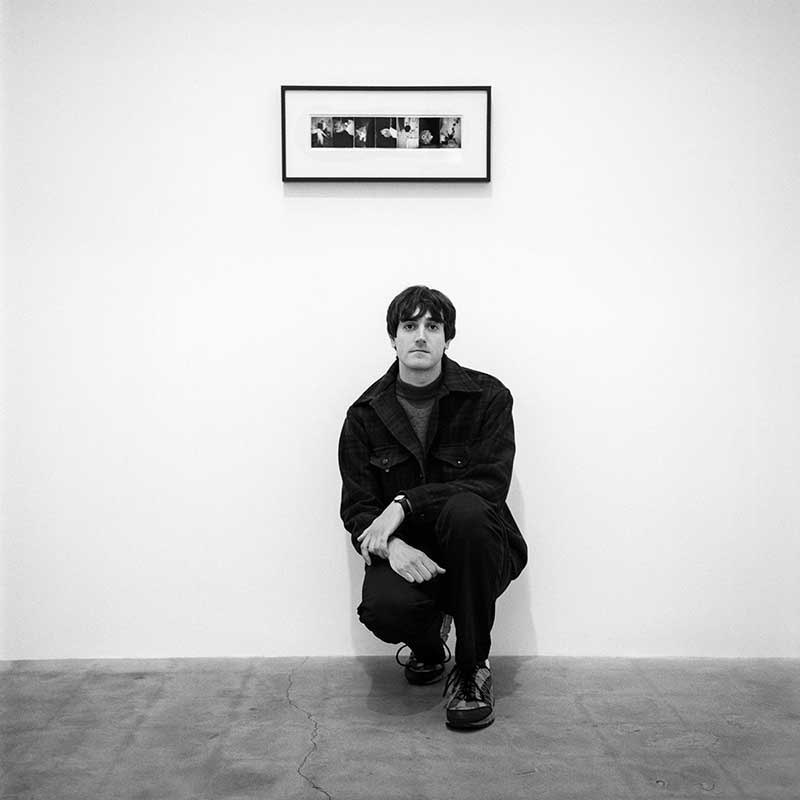
American artist Cameron Jamie, born in Los Angeles in 1969, has been developing a unique body of work since the 1990s at the intersection of drawing, artist books, music, painting, performance, photography, sculpture, film and video. His work has explored and analyzed how the mythological and ritual structures of popular and vernacular cultures are shaped and transmitted, as well as their role in the creation of identities and fictional worlds of individuals. Like an artist-anthropologist, he explores cultural territories where the boundaries between past and present, folklore and modernity, the private sphere and political construction become blurred.
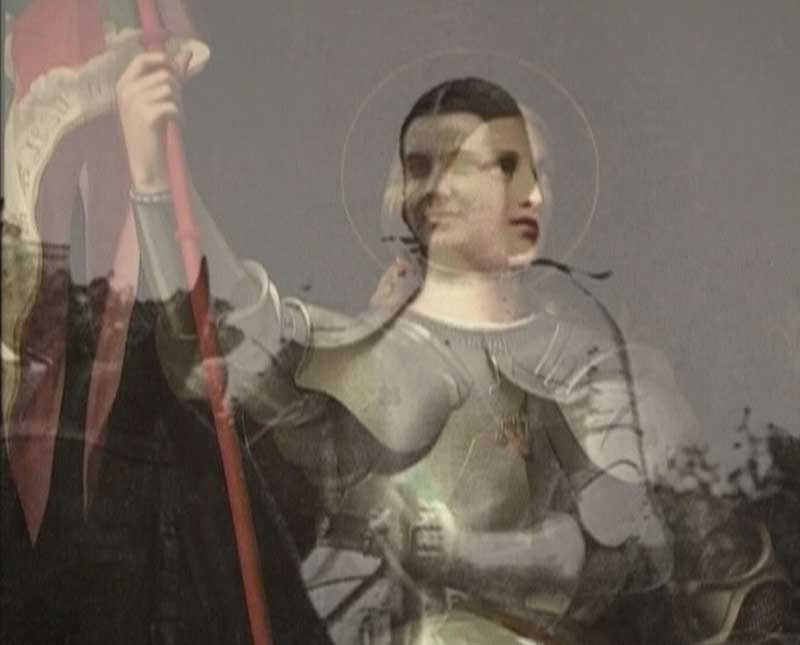
Silent black & white and color video, 41 min
Soundtrack by Keiji Haino
© Courtesy the artist and Evidence Films
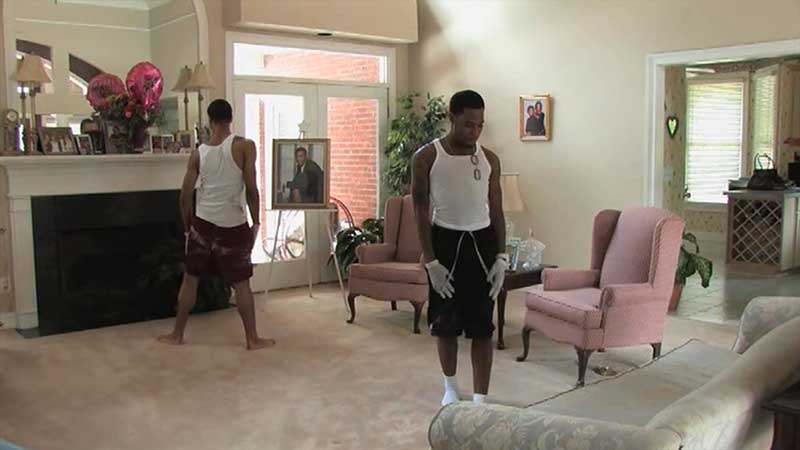
Soundtrack by Sonic Youth
© Courtesy the artist and Evidence Films.
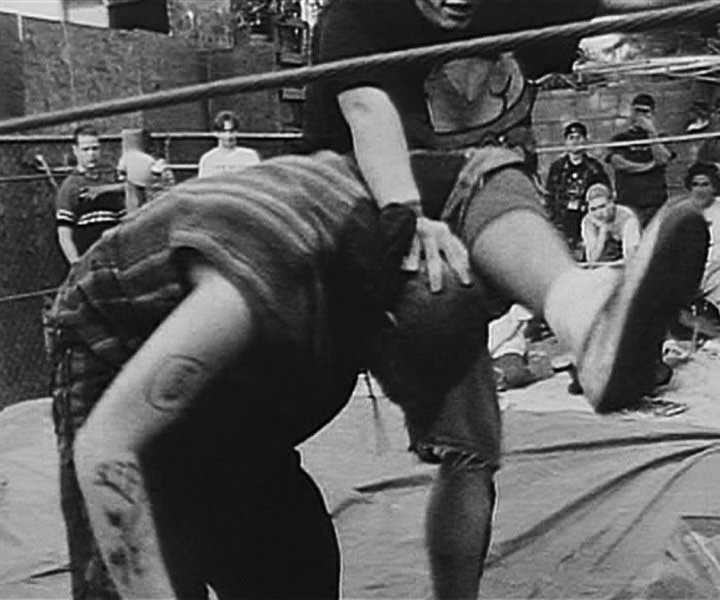
Black and white Super 8 film transferred to 35mm film, 18 min 20s
Soundtrack by The Melvins
© Courtesy the artist and Evidence Films
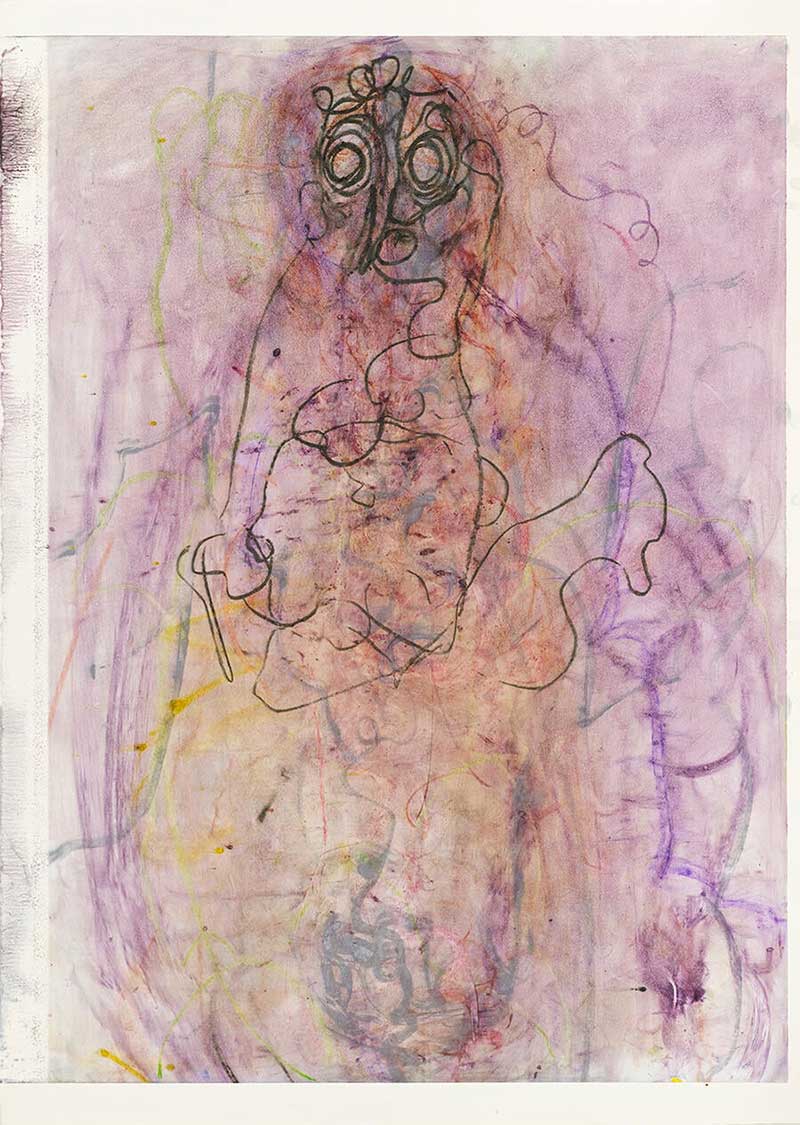
Monotype, 71 × 50,5 cm
© Courtesy the artist
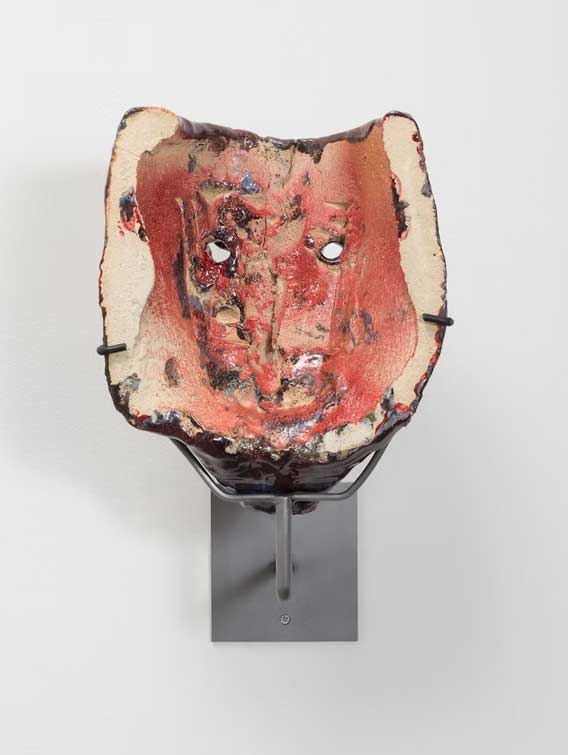
Glazed ceramic, steel, 32 x 20 x 22 cm
© Courtesy the artist
- Jo (copie 1)
- massage (copie 1)
- 3 (copie 11)
- sugar plum (copie 1)
- Dear Red (copie 1)
Nicolas Ballet — Your work lies at the intersection of drawing, artist’s books, music, painting, performance, photography, sculpture, but also film and video. At what point did moving images become a central medium for you, and what do they allow you to capture that other forms do not?
Cameron Jamie — During my formative years as an artist, I worked across all of those mediums as parallel universes, but moving images gradually became more central as I became interested in capturing moments in real time. My approach to film and video often comes down to having the equipment with me at the right moment, allowing me to respond instinctively to my surroundings. It’s an unscripted organic process, where ideas develop over time and are then confronted and articulated on the spot through the camera. Film and video allow me to bring together elements that other mediums cannot fully contain on their own, particularly with sound, music, movement, and narrative. They give me the ability to explore choreography and the temporal flow of images, creating a more immersive and fluid way of expressing my thoughts and meanings.
A recurring element in your films is your absence, or rather, the way you withdraw to make space for observation. This mode of observation allows you to bring to light states and questions that would otherwise remain invisible. As you’ve said, “I just developed over the years a way of documenting where I could be there and not really be noticed.” Does this approach – which might be linked to the figure of the artist-anthropologist – enable you to reveal phenomena of belonging to groups and ritual that are implicitly present in everyday life?
CJ — I think one aspect of my practice comes from this very unorthodox way of filming and from how I’ve learned to respond to the different environments I’ve encountered over time. There’s a particular kind of alchemy in the act of looking through the camera, something that happens between myself and the people I’m filming, where observation and experience begin to blur. For me, the camera isn’t a way of creating distance. It’s a way of being more present, of entering a state of attention where certain meanings can emerge. Even if I don’t belong to the groups I’m filming, I try to respond immediately, to find a position within their space without interrupting it. In that sense, it’s about being there, but not imposing. And in that quiet space, forms of belonging, gestures, and rituals that are usually implicit in everyday life can begin to reveal themselves.
You became interested in subcultures and alternative music scenes very early on – your first job was working at a local second-hand store, helping out for their annual 10 cent vinyl LP sale. You’ve also collaborated with artists with very distinct sonic universes for your films and videos, such as the Melvins, Keiji Haino, and Sonic Youth. How do you manage to create a dialogue between these different musical approaches and your own images?
CJ — Sometimes a sound can dictate images, and other times the images can dictate a particular sound, it can go either way. Each film I’ve made in collaboration with those musicians and bands involved a different process, shaped both by the visual subjects and by the kind of soundscape I felt drawn to for each work. The soundtrack for JO, created with Keiji Haino, was recorded live during the first film performance premiere at the opera house in Graz, Austria in 2004. Haino improvised the music entirely, responding intuitively to the images as they unfolded. That first live recording ultimately became the cinematic version of the film. At the same time, each live performance of JO with Haino was approached differently, with his musical response shifting to react what he felt in the moment. I’ve always approached the use of sound in my films as something reactive, a tension that engages with the moving image rather than as a simple musical accompaniment.
Your work is deeply rooted in American popular culture, yet always straddles the line between reality and fiction – from Michael Jackson to the Hollywood Wax Museum, and the horrific transformations of bodies and dwellings during Halloween. You also mention formative experiences, such as watching an El Santo science fiction / horror B-movie on Mexican TV and then attending a wrestling match of the real El Santo the next day at the Grand Olympic Auditorium in Los Angeles. How have these cultural forms shaped the way you think about images, particularly in their ability to blur different levels of reality?
CJ — I believe it comes down to a certain consciousness, a way of seeing that seeks the other layer of meaning, and of understanding what experiences and images mean to oneself. I grew up in the television generation, where the TV screen was both a window and a wall, a place where we watched characters over time become modern myths or gods in our everyday lives. Seeing one of these characters in person, performing the same acts I had only seen on the tv screen, suddenly made me question the myth more deeply. Today, with AI and the way we experience the world through our phones and computers, that relationship has shifted. We are immersed in a constant stream of moving images and endless clips of the world like a continuous freak show where the boundaries of fantasy have blurred, and the sense of wonder that once accompanied myth now feels harder to grasp.
Ray Harryhausen, a pioneer of early stop-motion special effects, once said something that has always stayed with me. He observed that when technology tries to make fantasy appear as realistic as possible, it can strip away the very magic and fantastical realm that gives it life. The handcrafted, low-fi special effects with all their imperfections, carry a certain sense of wonder that perfect realism can sometimes erase. I feel there is a deep truth that the imagination often thrives in the space between illusion and reality.
In several of your works, you bring together very different temporalities and image regimes, producing forms of anachronism. Is this a way of questioning the very idea of modernity, and of showing that archaic forms of ritual or belief persist in the present?
CJ — I think, in a way, my work is very much about tracing the threads of the past in the present. Even as we live in a world shaped by modernity, technology, screens, speed, there are gestures, rituals, and ways of being that feel almost archaic, almost timeless. They persist quietly beneath the surface in the way people move, interact, or perform. What has always interested me is this tension with the old and the new existing together. In filming, I often look for those moments where something ancient seems to peek through the everyday - a ritual, a repetition, a myth that has survived in subtle ways. It’s a reminder that modern life is never fully divorced from its histories, and that the fantastical, the sacred, or the communal can still surface in the most ordinary spaces. ◼
Related articles
In the calendar
Artist Cameron Jamie (2013)
Photo © Silvio Waser