![[Translate to English:]](/fileadmin/user_upload/Christo-dessin-arc-de-triomphe-2019-wolgang-volz-bandeau.jpg "[Translate to English:]")
Christo: “My Projects Can Be Built Without Me”
N
ew York, SoHo, late March 2020. In a shuttered metropolis living under the threat of Covid-19, Christo was isolating alone in the vast building at 45 Howard Street that had also served as his studio for the past fifty-six years. The artist was still working tirelessly, even as the pandemic brought many of his plans to a halt — most notably his major exhibition at the Centre Pompidou, originally scheduled to open that spring (it would eventually take place in the summer of 2020 and prove a tremendous success, editor’s note). Soon, the wrapping of the Arc de Triomphe, initially planned for autumn 2020, would also be postponed until October 2021. Reached by telephone for an extended conversation, Christo, then 84, nonetheless remained as enthusiastic and eloquent as ever. In a word: alive.
Can one speak of the ephemeral in relation to your works?
Christo – I do not like the word ‘ephemeral’ to describe my work. My exhibitions are temporary. Ephemeral suggests something unstable. Even if they remain in place for only three weekends, every project Jeanne-Claude and I made is built to last. We cannot obtain permission to leave our works in public space indefinitely, but we build them as though they were going to stay forever.
I have always liked the comparison with nomadic tribes. They build their tents, their homes, and move across the desert. Their tents are very strong because they must resist the wind and the forces of nature. Like the tents of a nomadic tribe, fabric is the primary material of our work.
It would be very simplistic to think that our projects are merely wrappings. They are much more than that! The Gates, The Umbrellas, Valley Curtain, Running Fence – this is not simply wrapping. Anyone who goes to see our projects should read them the way one reads a book. The work must be understood as the expression of a total irrational freedom, free of any justification.
And because the works are linked to freedom, no-one can buy them, no-one can own them. No-one can sell tickets to see them, no-one can commercialise them. It is very important to understand this clearly. That is what makes these works so unique. They happen only once. That is why we realised 23 projects, while at the same time trying to obtain permission for 47 others.
I do not like the word “ephemeral” to describe my work. My exhibitions are temporary. Ephemeral suggests something unstable.
Christo
For example, when we realised the Wrapped Reichstag project in the centre of Berlin, we not only rented the Reichstag itself, but also the entire perimeter around the building for 500 metres, to ensure that no company could use the space for commercial purposes during the project. We even went before Germany’s highest court to stop them, and the project succeeded.
For The Gates, we paid the City of New York $3 million in rent so that nobody could come and shoot Hollywood films or any other commercial productions in Central Park during that period. The marathon was allowed, but no commercial enterprise.
What I really love are the two distinct periods of each of our projects: the immaterial period and the material period. The immaterial period is when the work does not exist. It exists only in the minds of the people trying to help us obtain permission, and in the minds of the people trying to stop us. During that time, the project acquires its identity.
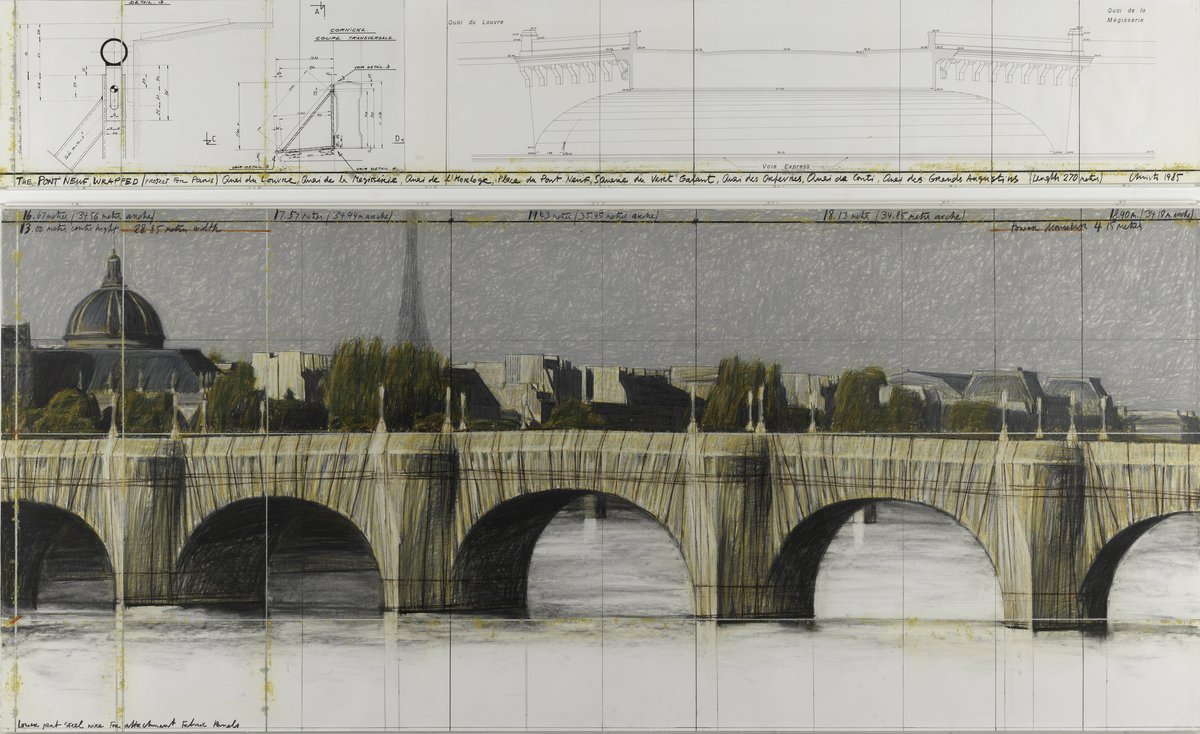
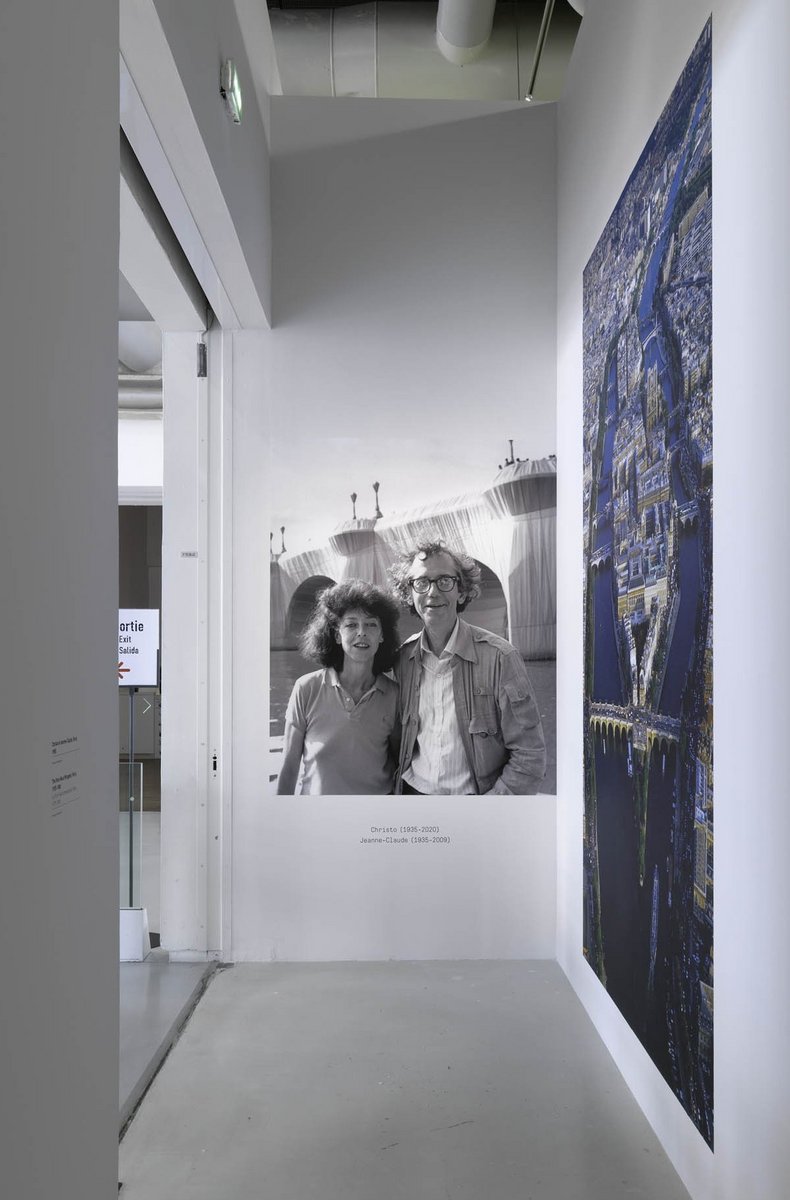
It would be absurd to tell you that I knew what the Reichstag project would look like in 1972, 25 years before it was realised. I discovered the nature of the Pont-Neuf project at the moment permission was granted. Obtaining permission is the most important part of a project. It is the energy and the soul of the work.

How do you finance these colossal works?
Christo – All the artworks we sell in order to finance the installations are made with my own hands. I do not have assistants – I never have! I have always been directly involved in preparing the projects. In fact, I use the capitalist system! Jeanne-Claude and I always tried to secure support from banks and obtain credit. Sometimes we had to pay interest. That is why we never sell our works below their value. If we sell them to dealers and private collectors, it is because nobody wanted to represent us in 1964. That is why we sell our own works directly. We are the largest collectors of our own work, and we use it as collateral with banks to maintain cash flow and avoid selling works at a loss.
If everything revolves around freedom, it is because I escaped alone simply to make art. My art. I take enormous pleasure in making art.
Christo
The exhibition period is the most expensive part of a project. We must pay an enormous number of people. To give you an idea, The Umbrellas was the most expensive project we ever realised. In 1990, it cost us $26 million, which would be around $80 million today. We were paying around $650,000 in salaries every day! Security, police… The exhibition period is by far the most expensive phase of our projects.
How are the projects conceived?
Christo – Each project has its own story and its own timetable. Some projects are urban, others rural. It is important to understand that these projects are often conceived for specific places.
When we realised The Gates in Central Park, mayors from cities all over the world wrote asking us to do the same project in their cities. It was completely absurd! The Gates was not conceived for just any park – it was conceived specifically for Central Park. We did the project there because Jeanne-Claude and I truly loved that place.
All projects depend on the interest people take in my artworks. It is very natural. Dialectical. Marxist. Things have a natural relationship with the people interested in my work.
Recently, a French magazine wondered why I wrapped the Reichstag. They could not understand because I am not German, I do not speak the language, and I have nothing to do with Germany. But you know, I escaped during the Cold War. Every project is very biographical. I was stateless. I no longer had a nationality. I refused Bulgarian citizenship for 17 years. I had a temporary visa in France.
In the 1970s, the atomic bomb threatened at any moment to destroy the world. The world was divided between East and West. All this came out of the catastrophe of the Second World War. After Germany’s defeat, Berlin was divided into four sectors. The Reichstag stood two-thirds in the British sector and one-third in the Soviet sector. I think the only place where East and West met physically in Berlin was the Reichstag. The eastern side of the Reichstag lay in the Soviet military sector. That is why I wanted to wrap the Reichstag.
All projects depend on the interest people take in my artworks. It is very natural. Dialectical. Marxist.
Christo
Among the projects we proposed, some remained very close to our hearts. Others simply stopped interesting us. In 1975, for example, we wanted to wrap the Christopher Columbus Column — the monument celebrating Columbus crossing the Atlantic from Europe to America — in Barcelona. We began working on the permits; it was still the Cold War. Two years later, the mayor of Barcelona was assassinated. Then, in 1981, another mayor came in, but he became ill.
Finally there was a third mayor, Pasqual Maragall. In 1982 or 1983, he sent us a telegram: “Dear Christo and Jeanne-Claude, come to Barcelona, I give you permission to wrap the Christopher Columbus Column.” And we answered: “We do not want to do it anymore!” For some works, we had to search for the right place. That was the case with Valley Curtain in Colorado and The Umbrellas in Japan and California. Around 1972, we were very young and living in Manhattan. We met an Argentine art historian who loved what we had done on the Australian coast. He said to us: “Come to Argentina!” So we developed the proposal for Floating Piers in the Río de la Plata delta in Argentina. We were thinking about calm waters. The delta is immense, like the sea. We would not have had any difficulty installing Floating Piers there, but we never obtained permission.
Many of our projects are born from journeys we make to visit friends. We tried to install Floating Piers in Tokyo Bay in 1996. We worked very hard to obtain permission. At the last moment, however, we had a huge conflict with the mayor of Tokyo. We disagreed about the conditions and the restrictions. So we simply left. Jeanne-Claude and I loved that project, but it never happened. Then, after Jeanne-Claude died, I became even more determined to realize it. And so Floating Piers finally came to life on Lake Iseo in Italy.
Water is a recurring theme throughout your work…
Christo – When people look at our projects, many of them see water. That is true of Wrapped Coast in Australia, and Running Fence in California… Water – its fluidity in contrast with the solidity of the land – is present in many of our projects. There is real energy there. We are somehow attracted to it because we human beings are made up of 75% water. That is enormous!
I think there is a kind of instinctive pleasure in our relationship to water. I cannot explain why. It is very visible in the way we think about projects. And it is not only about water itself, but also about the place where land and water meet. The coastline, the islands, the foundations of the Pont-Neuf – they are all in the water.
You know, after the Rue Visconti work, the first proposal to wrap a bridge in Paris was not the Pont Alexandre III but the Pont-Neuf. This was at the beginning of the 1970s. We abandoned the proposal very quickly because that bridge does not stand in the water. The energy is in the dynamism of the materials and in their ability to translate it.
We use very strong materials, but the fabric is always moving. That is where the incredible pleasure lies. Fabric can translate the wind. You can see the wind. When the fabric was installed on Running Fence and Valley Curtain, you could see the wind. The wind is invisible. But you could see it in the incredible movement of the fabric. We saw this again in Wrapped Trees, the trees we wrapped in Switzerland in 1999.
What is the story behind your desire to wrap the Arc de Triomphe?
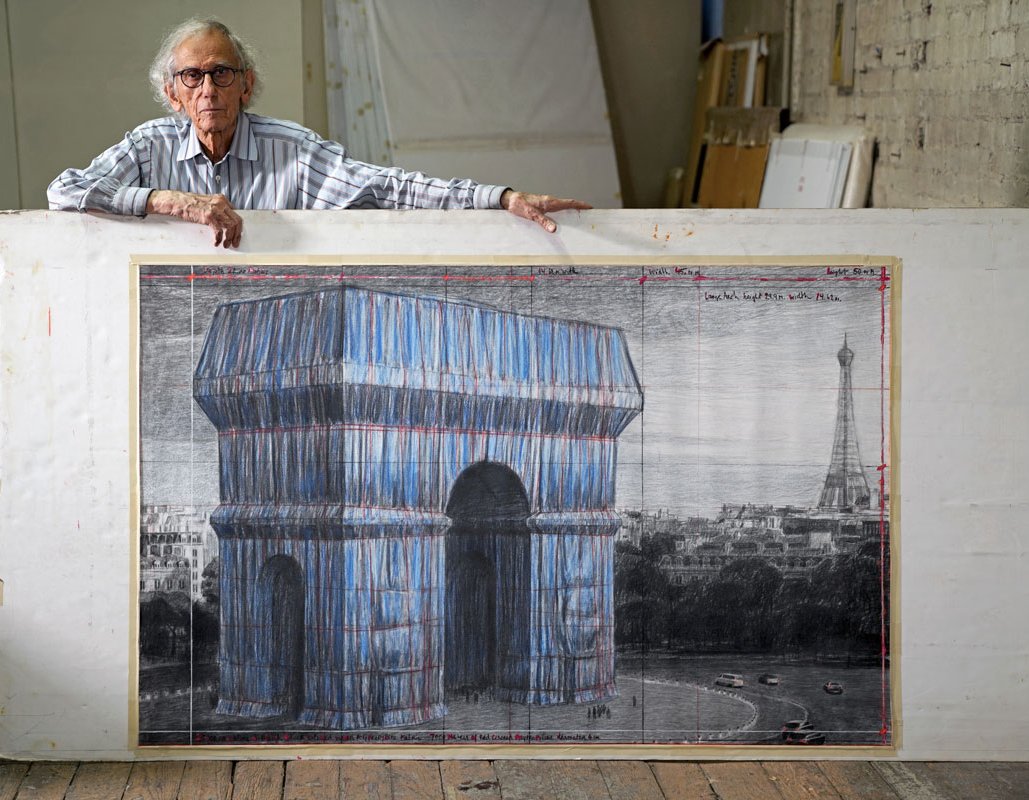
Christo – The wrapping of the Arc de Triomphe is very particular. Everything came together rather suddenly. The proposal dates back to 1962 of course, but the permission came suddenly. I never imagined this would happen. I had barely a year and a half to study and prepare everything, and to create the artworks whose sale would finance the wrapping itself.
We had ten years for the Pont-Neuf. We had 25 years for the Reichstag because it was refused three times. We waited 26 years for The Gates after endless refusals. It is NOT patience! Jeanne-Claude always said: passion!
We had ten years for the Pont-Neuf. It is NOT patience! Jeanne-Claude always said: passion!
Christo
In the 1960s, I made several editions that we even sold to finance other projects. At the end of the 1980s, I made a very elaborate collage edition with fabric because we thought the Arc de Triomphe project would never happen. Honestly, it is strange how suddenly everything became possible.
About two years ago, I was leaving the Centre Pompidou with Bernard Blistène, the director of the Musée national d’art moderne. He told me that artists who are given a major exhibition at the Centre Pompidou are usually invited to create something outdoors around the institution. I answered: ‘Bernard, I will never do anything here! If I do something here, it will be wrapping the Arc de Triomphe – nothing else!’
But when I told him that, I never believed it could actually happen one day. Then later I returned to Paris and had a meeting with a very well-connected gentleman… He had seen the Pont-Neuf project and knew our work very well. He is the one who made everything possible. He told me he was going to see the President the following week and that he would speak to him about it…
Usually these projects are financed through the artworks I make in my studio. But I had no works or materials to sell for the Arc de Triomphe. I do not make project drawings once the project is already underway. I always make them beforehand. They reflect the evolution of the project aesthetically, technically, and so on. We always have to build a large-scale model. The final appearance of the project is never decided in my studio.
The entire world is on standby. It is a terrible disease, you know. So many people my age are dying from it. But I want you to know that many of these projects can be built without me.
Christo
I need a great deal of time to make drawings, sketches, and models that then must be sold in a very short period of time. And with the current lockdown, isolated and cut off from everything, I truly have time to draw. It completely occupies me right now.
I love going outside for fresh air, but because of the pandemic I cannot leave my studio. Nobody knows if the world will remain paralysed like this for months and months. If that happens, the project will not happen, or it will have to be postponed until the following year.
The entire world is on standby. It is a terrible disease, you know. So many people my age are dying from it. But I want you to know that many of these projects can be built without me. Everything is already there.
Is everything ready for the wrapping of the Arc de Triomphe?
Christo – Near Gentilly, outside Paris, there is a huge site where they are able to build half of the Arc de Triomphe. We can test the stability and the efficiency of all the elements there with our equipment and ropes. The people doing the wrapping are the same people who usually work on wind turbines.
It will also be the same construction company we used for the Pont-Neuf project. It is funny actually, because this same company supplied the protective materials used to cover monuments when the German army was approaching Paris.
How did you choose the colour of the fabric?
Christo – We chose a colour in harmony with the French flag. A thick blue fibre is woven into the fabric. Underneath, there is a deep blue. It is a very heavy industrial textile, almost like a carpet.
The fabric is woven crosswise and has a special metallic quality created through a technique developed by a German company. They spray aluminium onto the fabric. Because the fabric is woven, and because the fibres are round, you can see the blue shining through the folds. Then there is the silver, and the red. Again, it is not a flat blue. It shimmers through the silver surface. It is almost like radiation. Like metal.
The contrast between light and shadow is very strong. This Arc de Triomphe will not be a sculpture. It will move enormously! We had to do wind-tunnel tests. The arch was built on a hill. You cannot imagine the wind passing through the arches. Constantly! Huge winds.
This will not be a normal architectural object, but a living object, something that never stops moving. In a way, it is almost as if we are enlarging the Arc de Triomphe. We are extending the dimensions in order to give the fabric flexibility. We do not touch any architectural element. Everything is done through an incredible scaffolding system underneath.
When it was built in the nineteenth century, the Arc de Triomphe was a very powerful symbol. A symbol of the relationship between France and Germany and the rest of Europe during those turbulent years.
In the past, the Arc de Triomphe had already been covered with fabric. The largest gathering ever held in front of the monument took place during Victor Hugo’s funeral. They placed a black veil of fabric over part of the Arc de Triomphe. There are also extraordinary photographs of the Arc during the German Occupation.
By coincidence, I also once lived in a tiny maid’s room overlooking the Arc de Triomphe… So every interpretation is legitimate. The work reveals itself to us. It contains enormous human richness. It is engaged.
Nobody thinks about a painter’s painting before the painting is painted. The same is true of sculpture. All our projects are discussed before they exist because they are not ordinary works of art. They also belong to architecture and urban planning. ‘Our works are a disturbance in space,’ as Jeanne-Claude used to say.
In an interview given several decades ago, Jeanne-Claude said that she became an artist because she fell in love with you – and that had you been a dentist, she probably would have become a dentist too…
Christo – It is true, that is what she used to say. What I loved very much about Jeanne-Claude – and what I miss enormously – was her critical mind. If you do not know it, you should watch the film Albert and David Maysles made about us. We are debating all the time. We also argue a lot in the Pont-Neuf film, on the boat. We spent our lives debating with enormous intensity. She was critical all the time! We were both Geminis, born on the same day. ‘A ménage à quatre,’ as she used to say.
The exhibition at the Centre Pompidou is not a retrospective…
Christo – I do not like retrospectives. I like making new things. I take enormous pleasure in challenges, in launching new projects, with all the disappointments and successes that come with them. I cannot waste my time thinking about what I should have done. I will do that when I am dead.
I have not mentioned this yet, but it is important to understand that these projects last only two weeks each time, sometimes 16 days. That is what makes them precious. But we keep extremely rigorous records for every project. Each of these large works of art has its own exhibition, and those exhibitions are also immense. Jeanne-Claude and I are very conscious of the legacy of these projects.
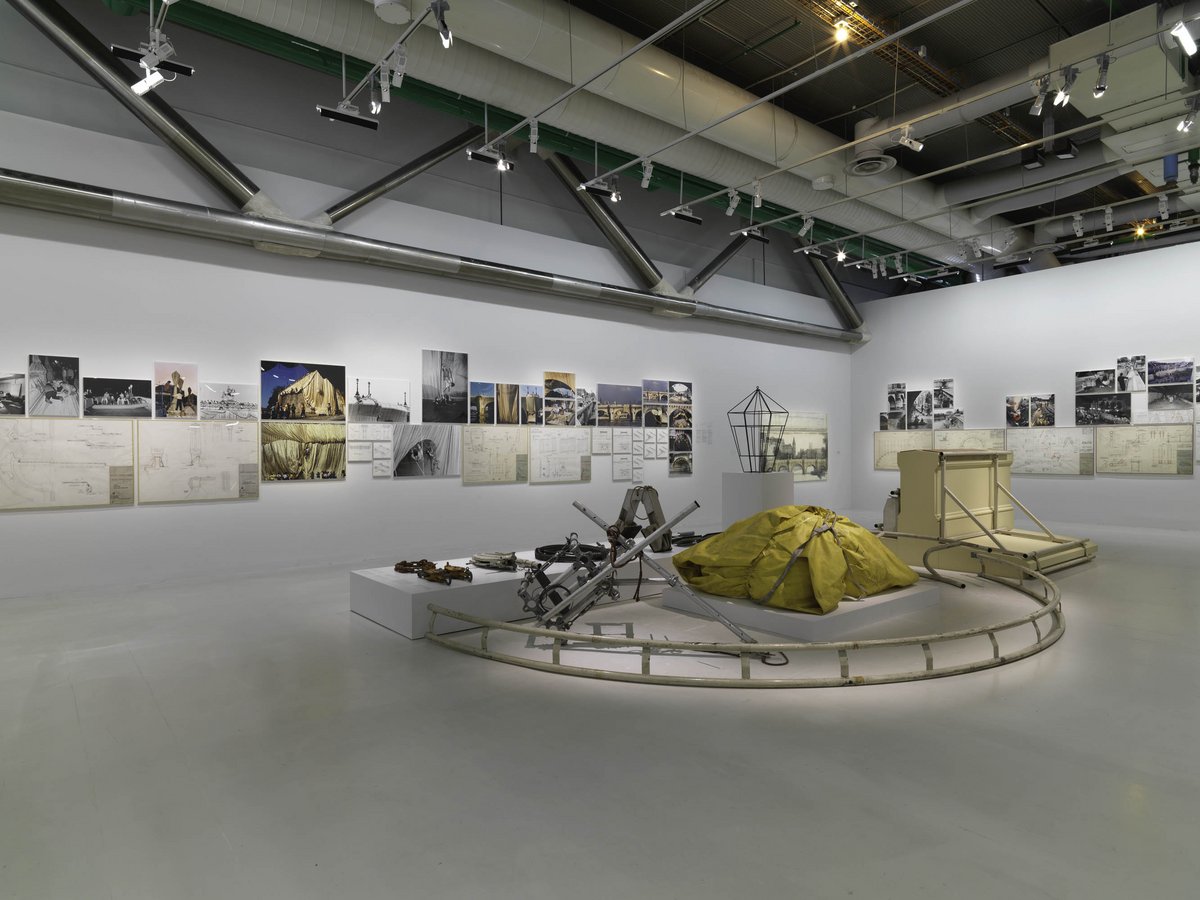
For every project, all the stages of realisation are meticulously photographed and filmed. In every documentation exhibition, we have all the technical drawings, the fabrics, the construction elements, the equipment, the details. All this documentation that we exhibit belongs to us. Since I never had a gallery dealer, we are the largest collectors of our own work.
I do not like retrospectives. I like making new things. I take enormous pleasure in challenges, in launching new projects, with all the disappointments and successes that come with them.
Christo
We have many works, and our main storage facility is in Basel, Switzerland. From Wrapped Coast in Australia until today, each project has its own exhibition with more than 300 objects. We kept the actual umbrellas, for example.
We often use these exhibitions to create awareness around new projects. Before she died, Jeanne-Claude cared deeply about finding places for all these exhibitions. We managed to sell the Running Fence documentation exhibition to the Smithsonian in Washington, DC. They own it now. While working on Floating Piers, we succeeded in selling the Wrapped Reichstag documentation exhibition to a German foundation. It is now installed on the second floor of the Reichstag itself.
The Pont-Neuf exhibition had never been shown in France. That is where everything began! When Bernard Blistène proposed it to me, I thought it was an opportunity for a new generation in France to see what we had done.
In light of everything you have lived through, what would the older Christo of today say to the young Christo who arrived in Paris decades ago, coming from Geneva and Bulgaria?
Christo – I cannot tell him anything. But I must admit that I was lucky when I was young. I was studying at the Academy of Fine Arts, but I felt so suffocated by the Soviet regime. I am happy that circumstances allowed me to escape. It was a miracle! It could very easily never have happened.
I escaped alone. No cousins, no family, no-one. I will never return to Bulgaria. Never! I never studied French. I never studied English. I had no money to go to school. I earned barely enough to survive. I struggled to sell my first works in Paris. I was so poor, and I spoke French very badly.
I believe in my work. I am not religious. I believe in my art. Art is everything to me.
Christo
Then one summer day, American collectors came to Paris, and I met someone who spoke French and became very interested in my work. His name was Leo Castelli. When we made Iron Curtain, rue Visconti in Paris in 1962, Leo was there too. In 1963, Jeanne-Claude wrote to Leo saying that we wanted to come to America, and they prepared our arrival. Leo reserved a room for us at the Chelsea Hotel, where I made Store Front.
If none of this had happened, obviously I would not be in the United States today.
So in the end, is everything simply a matter of luck?
Christo – You also create your own luck. I came here on a three-month tourist visa, and then I lived for three years as an undocumented refugee. An illegal foreigner. When I crossed the border, I was extremely frightened. I was too young to understand what could happen.
I think all this belongs to historical circumstances. It happened, and it will never happen again. And now I believe in my work. I am not religious. I believe in my art. Art is everything to me. ◼
Related articles
In the calendar
Christo in his New York studio with a preparatory drawing for "L’Arc de Triomphe, Wrapped",
20 September 2019
Photo © Wolfgang Volz
© Christo and Jeanne-Claude Foundation, 2019