Louise Nevelson: Sculpting in Black
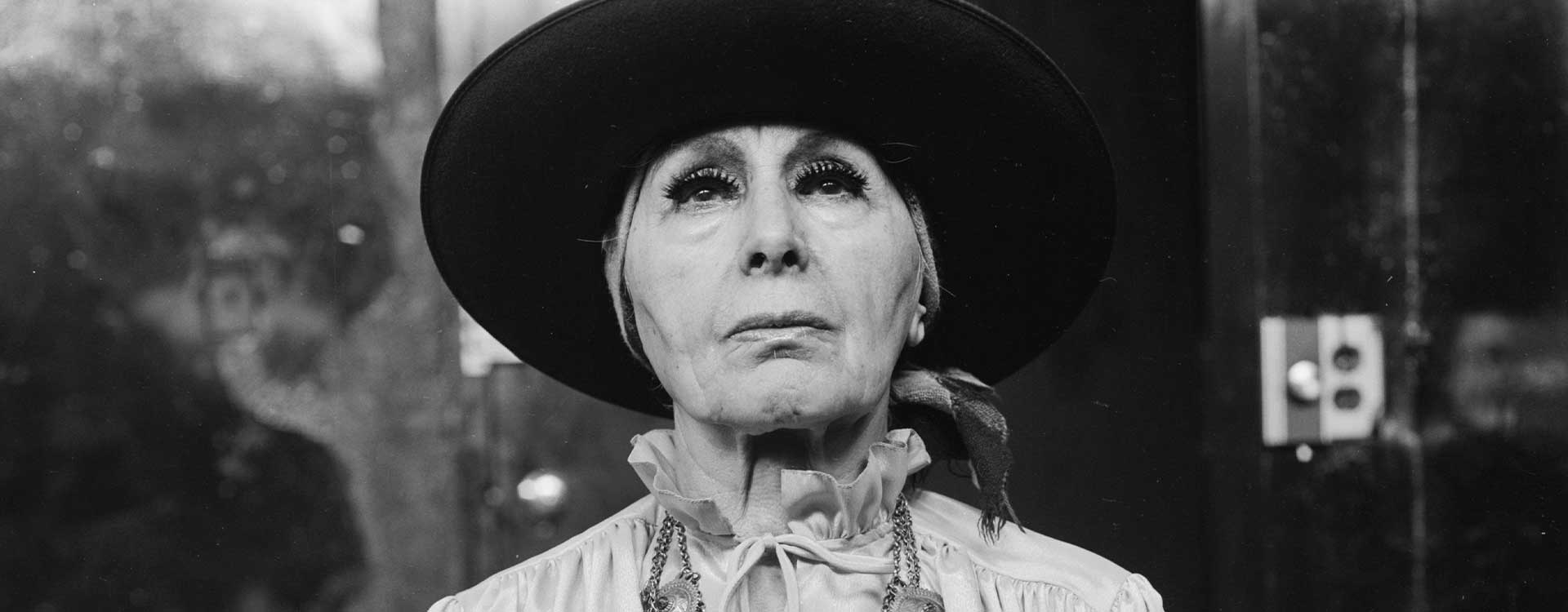
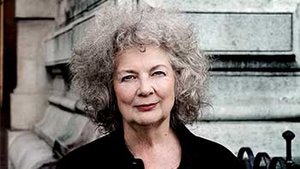
In photographs, Louise Nevelson cuts a striking figure, her direct gaze deepened by the dramatic sweep of her thick mink false eyelashes. She confronts the camera – and not merely for effect. As her granddaughter Maria Nevelson recalls in the exhibition catalogue: “If you dared meet her fluttering dark-brown eyes, she would fix you with a stare that could stop you in your tracks, without the slightest concern that it might make you uncomfortable.” And yet, behind the façade, one might almost detect a glimmer of sadness in the faraway gaze of the woman neighbourhood children simply called “Mrs N”.
An original figure – one who would later inspire designers such as Marc Jacobs – she cultivated an exuberant personal style. At times, Maria Nevelson continues, this meant “orthopaedic shoes sprayed with gold paint that might be paired with a colourful Indian tunic from Knobkerry [a fashionable East Village boutique], embroidered and studded with tiny glittering mirrors.”.
Most often, she wrapped her hair in a scarf tied at the back. Her close friend, the playwright Edward Albee, who paid tribute to her in his 2002 play Occupant, once observed that Louise Nevelson “dressed so spectacularly in public […] that some people misunderstood the seriousness of her work because of her theatrical persona; they sometimes confused the two. But when she worked, she did not dress extravagantly.”
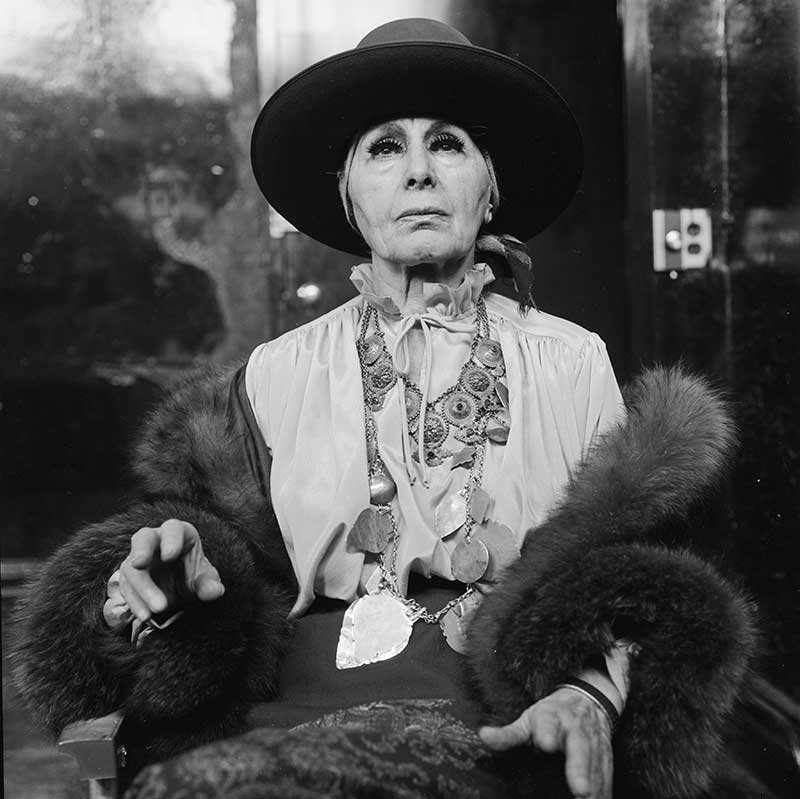
Perhaps it was her way of asserting herself, of claiming a place in a largely male artistic world that did not always look kindly on a free and independent spirit – an artist who, moreover, helped lay the groundwork for what contemporary art would later call environments or installations. One had to be well armed to withstand the often ferocious criticism.
Leah Berliawsky was born in Pereiaslav in 1899, a small town near Kyiv, at a time when Ukraine was still part of the Russian Empire. She was just four and a half when she left her homeland with her family to join her father, who had emigrated two years earlier to Rockland, Maine. The uprooting was deeply traumatic; she did not speak for an entire year. Her parents Americanised her name, and Leah became Louise – yet another upheaval that helped forge her character.
At nine, when a librarian asked what she wanted to be when she grew up, she replied without hesitation: “I will be an artist.” Then, quickly correcting herself: “No – I want to be a sculptor. I don’t want colour to help me.” A child’s declaration that would seal her destiny.
Yet the path was far from linear in the America of the early twentieth century. Marriage presented itself as a way out — an opportunity to leave her milieu and take flight. In 1920, she married Charles Nevelson and moved to New York, a city that would profoundly shape her and with which she quickly fell in love. She studied art at the Art Students League and later in Munich with the painter Hans Hofmann during a trip to Europe. At the same time, she pursued voice training with Estelle Liebling, studied theatre with Princess Matchabelli — founder of the International Theater Arts Institute in Brooklyn — and practiced dance, particularly eurythmy, with movement teacher Ellen Kearns.
As exhibition curator Anne Horvath explains:, “Eurythmy is an anthroposophical practice created in Europe by Rudolf Steiner in 1912 that became popular in the United States in the 1920s and 1930s. The discipline seeks to connect bodily movement with the expression of emotional content, in a gesture of both physical and psychological liberation.” While Nevelson’s artistic approach was spiritual, expansive, and multidisciplinary, dance remained essential to her. It was part of her daily life well into the 1950s, and she became so deeply involved that she eventually served as Ellen Kearns’s right hand. The two shared the same artistic and metaphysical reflections, as she also did with her gallerist and friend, Colette Roberts.
Louise Nevelson’s artistic life truly began in the early 1940s. She left her husband. “For me, life could not be a system in which master and slave complete one another,” she explained. Entrusting her son Mike, born in 1922, to her parents, she moved among the Surrealists who had taken refuge in New York, including André Breton, Marcel Duchamp and Max Ernst.
The exhibition “Circus: The Clown Is the Center of His World”, which she presented in 1943 at the Norlyst Gallery run by Jimmie Ernst – the son of Max Ernst and Peggy Guggenheim – proved a failure, accompanied by sharply misogynistic criticism. Yet it was at this moment that she made her first attempts at reusing found objects – a bull assembled from a headboard and the back of a chair – and conceived an immersive scenography, placing her figurines on a ring of sand. She destroyed everything.
Only after a period of experimentation with anthropomorphic sculptures in painted clay – including the series “Moving-Static-Moving Figure”, reflecting her fascination with the choreographer Martha Graham – did she finally discover her sculptural language, her signature.
Cornices, banisters, bedposts, chair legs, door handles, wooden slats, fragments of fencing, mouldings, balustrades, clothespins… The variety of objects she gathered during her wanderings through her Manhattan neighbourhood was dizzying. As New York underwent rapid transformation, Louise Nevelson salvaged discarded wooden objects and staged them in boxes stacked one atop another.
Black – which she considered “the essence of the universe” – would remain her absolute colour, the one that ultimately came to dominate her work.
She ordered and tamed this chaos, unifying it through a neutral monochrome and structuring it along vertical and horizontal axes. She created walls, altars, retables, sculptures, totems and environments. Rather than circling them, as one would with traditional sculpture, viewers experienced them – even passed through them.
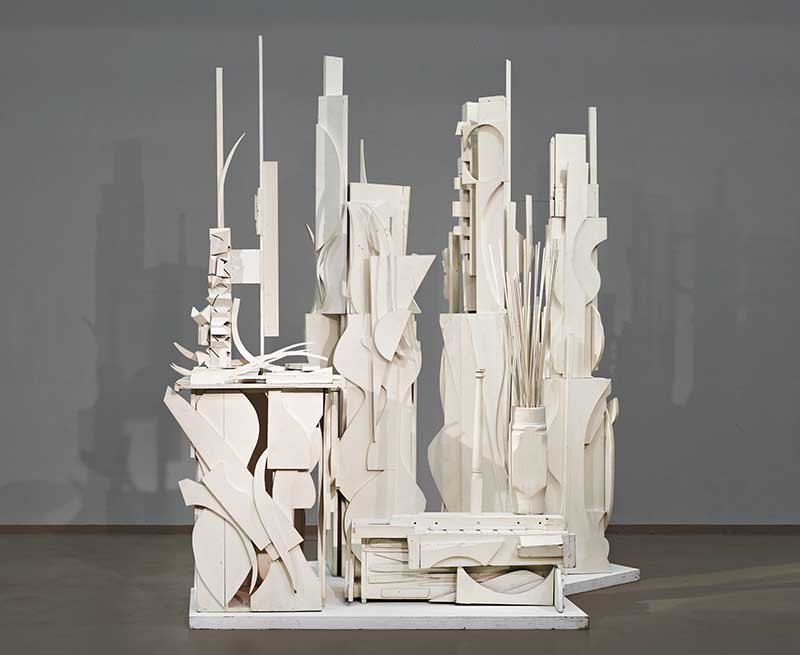
The first of these, Moon Garden + One, inaugurated in 1958 her collaboration with gallerist Colette Roberts at the Grand Central Moderns gallery. If black became her defining colour, she briefly experimented with white in Dawn’s Wedding Feast, created for the exhibition “Sixteen Americans” at the Museum of Modern Art in New York in 1959 – where her work appeared alongside that of Jasper Johns, Ellsworth Kelly, Robert Rauschenberg and Frank Stella – and later with gold in The Royal Tides, presented at the Martha Jackson Gallery in 1961.
She brought these explorations together at the 1962 Venice Biennale, where she represented the United States: “I was given the three large galleries. I painted the entrance room, which was circular, gold – it was the first environment. In the two largest galleries, the one on the right was white and the one on the left was black. I covered the glass ceilings, which were like skylights, with fabric in the colour of each environment.”
Black, which she considered “the essence of the universe”, would remain her absolute colour, the one that ultimately came to dominate her work.
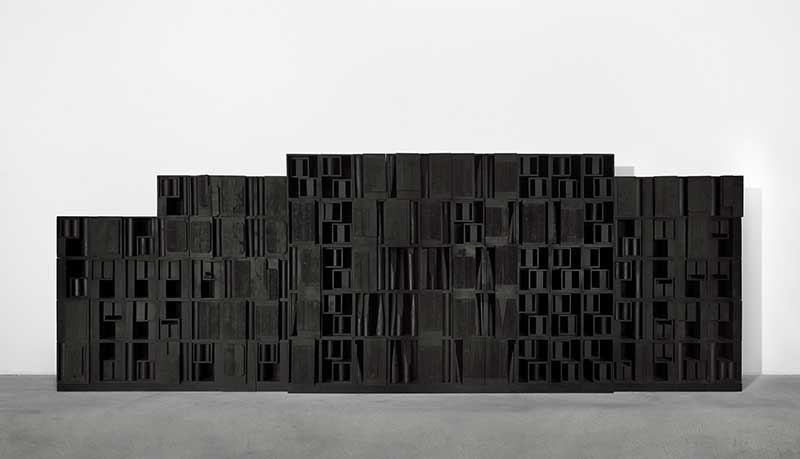
At first, nothing is fixed: she continually reconfigures the arrangement of the boxes, just as she allows collectors the freedom to do so. There is something organic about this body of work, with its capacity to generate itself. What interests her is positioning herself as an “architect of shadow”, as she once described herself. She plays with shifting light so that certain details recede, allowing shadow itself to become a material, creating the conditions for access to a fourth dimension – that of creation. The very foundation of her art lies in her conception of space. “I think the meaning of space is often underestimated. We imagine it as empty. Yet in our perception of the three-dimensional world, space plays an essential role. The way we inhabit a space creates another.”
Her works become points of contact with the invisible, with that fourth dimension capable of transfiguring both object and space. One understands that the materiality of the work is not what matters; its constituent elements are merely a means of immersing the viewer, of generating emotion and drawing them into her world. She combines a Cubist approach – expressing viewpoints that cannot be directly perceived – with a spiritual dimension. “It is not simply a sculpture; it is an entire universe coming to life.”
Since I could not have the world I wanted, I knew I had to create one of my own.
Louise Nevelson
Nevelson often expressed regret that she was unable to preserve most of the environments she created, having had to sell them in separate parts for economic reasons. It was not until 1977 that she gave the Metropolitan Museum of Art Mrs N’s Palace, which the Italian art critic Germano Celant described as a “sculpted autobiography.” The description could apply to many of her series, in which her own story appears, treated with a certain distance, as suggested by their titles: her childhood in Ukraine in Ancient Games and Ancient Places, her departure for America in The Royal Voyage of the King and the Queen of the Sea, her marriage in Dawn’s Wedding Feast, the death of her parents in Moon Garden + One. In the end, she became inseparable from her art. “Since I could not have the world I wanted, I knew I had to create one of my own.”
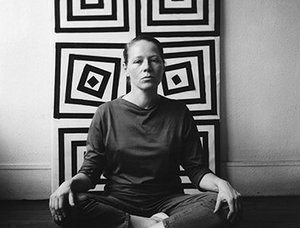
There are no longer any boundaries between art and life – something made clear in photographs of her home, where her sculptures spill into every room, even into the bathtub. The idea of the house also evokes domesticity and the postwar feminist struggles that addressed it, including those of the philosopher Silvia Federici who, in her manifesto Wages Against Housework (1975), called for domestic labour to be recognised and paid. Louise Nevelson was not politically engaged, yet her choices in life, her “Dream Houses” series (1972), and her fiercely independent spirit speak for themselves.
The exhibition at the Centre Pompidou-Metz, along with the accompanying catalogue, brings renewed attention to an artist still little known in France, where she was represented by the gallerist Daniel Cordier (who died in 2020), thanks to whom the Centre Pompidou holds several of her works. An opportunity to acknowledge the work of this pioneer, who died in 1988 at the age of eighty-eight. ◼
Related articles
Portrait of the sculptor Louise Nevelson, 1978
Photo © Cecil Beaton / Condé Nast via Getty Images
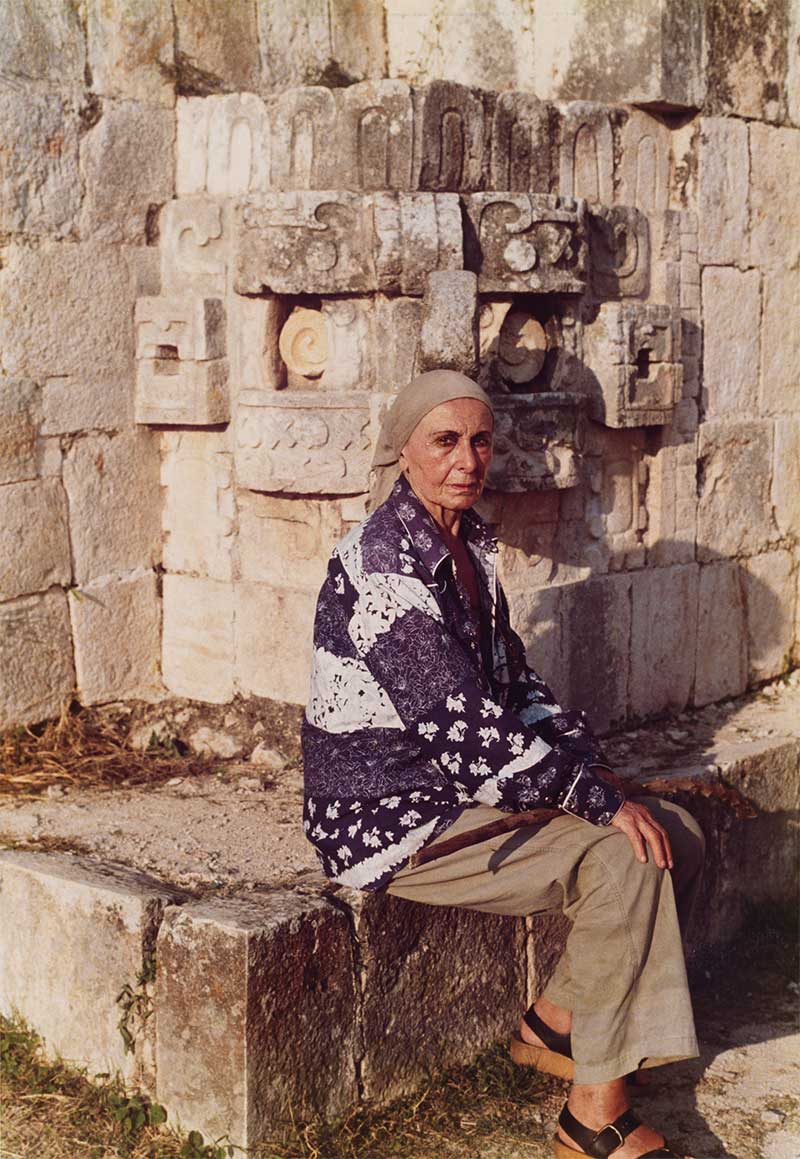
Louise Nevelson photographed by Diana MacKown at Uxmal, Yucatán, 1981
Photo © Digital image Whitney Museum of American Art / Licensed by Scala / Diana MacKown
Louise Nevelson, Dawn’s Presence II, 1969–1975
Painted wood, 247.7 × 198.1 × 144.8 cm
Private collection
Photo © Estate of Louise Nevelson. Licensed by Artist Rights Society (ARS), NY / ADAGP, Paris
Louise Nevelson, Homage to the Universe, 1968
Painted wood, 284.5 × 862.5 × 30.5 cm
Private collection, courtesy Gió Marconi, Milan
© Estate of Louise Nevelson. Licensed by Artist Rights Society (ARS), NY / ADAGP, Paris
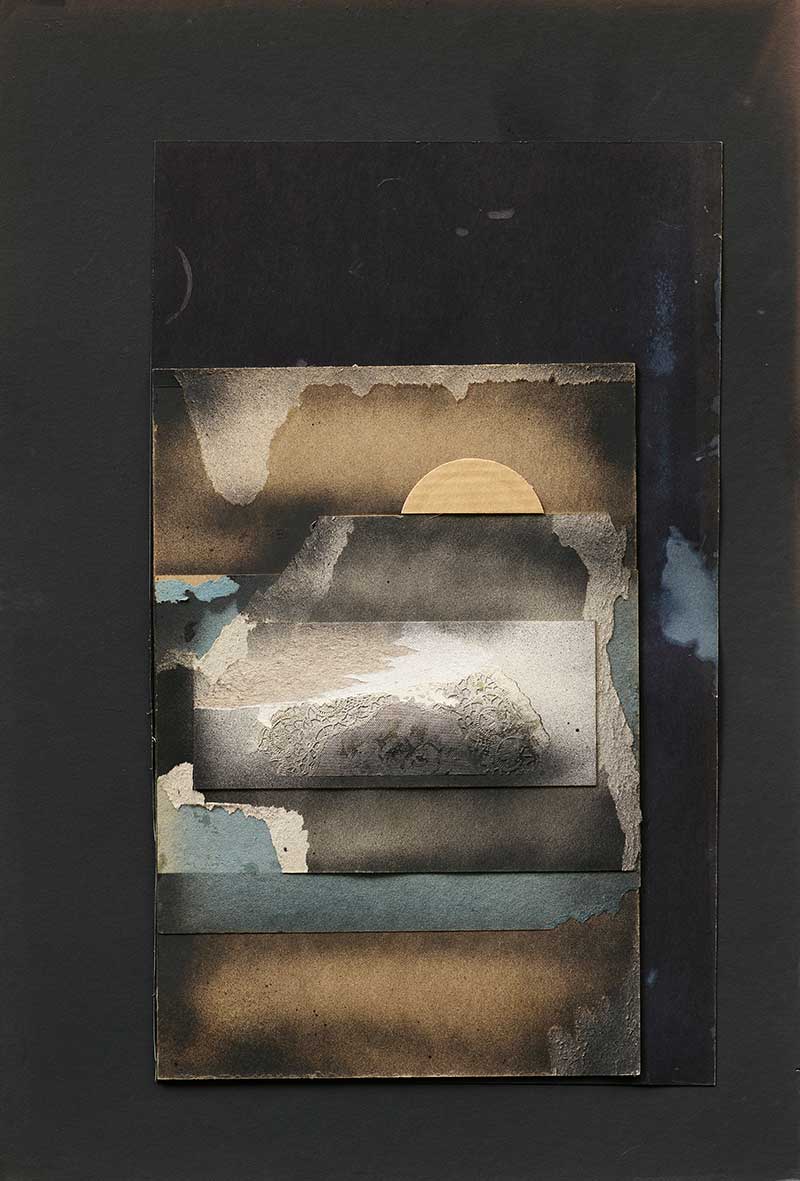
Louise Nevelson, Untitled, 1980
Cardboard, paint, and paper on cardboard, 76.2 × 50.8 cm
Zurich, Galerie Gmurzynska
© Estate of Louise Nevelson. Licensed by Artist Rights Society (ARS), NY / ADAGP, Paris
Photo © Courtesy Galerie Gmurzynska
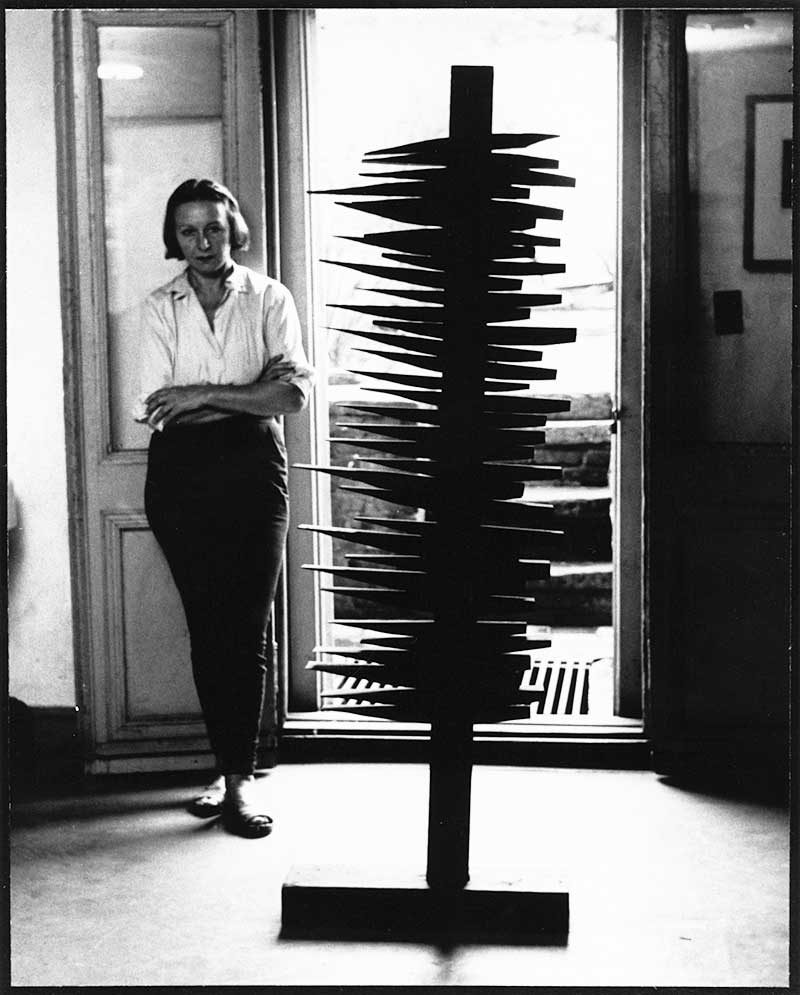
Louise Nevelson at home with First Personage, 30th Street, New York, c. 1954
© Estate of Louise Nevelson. Licensed by Artist Rights Society (ARS), NY / ADAGP, Paris
Photo © Archives of American Art, Smithsonian Institution