![[Translate to English:]](/fileadmin/user_upload/bandeau_lalanne_ok.jpg "[Translate to English:]")
The Lalannes: A Love Story in Sculpture
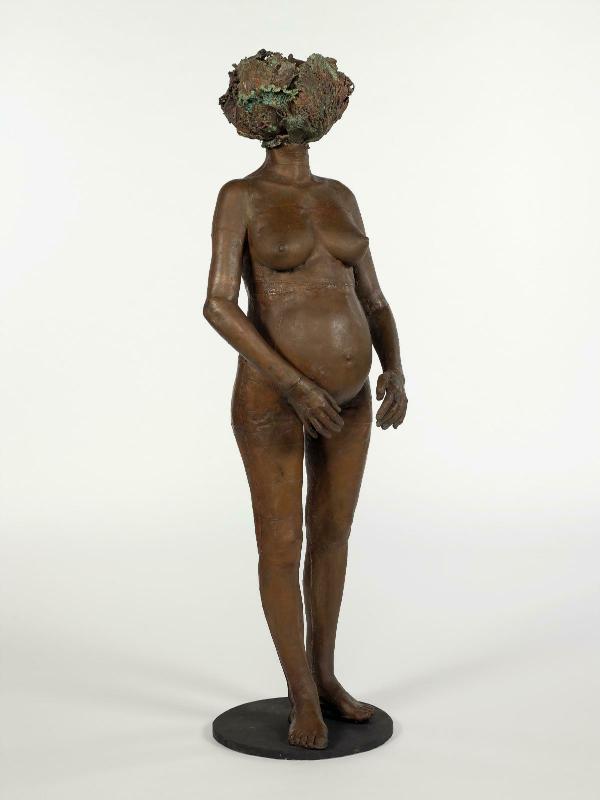
Saint-Germain-des-Prés, Paris, 1968. A few streets from home, Serge Gainsbourg stops dead in front of a strange bronze sculpture in a gallery window: a seated figure, stark naked, its head replaced by… a cabbage. Magnetised by the work, he buys it on the spot. This extraordinary “half-cabbage, half-man” sculpture — “moitié-légume, moitié-mec,” in Gainsbourg’s words — soon begins to whisper to him the tragic tale that would unfold across the twelve tracks of L’Homme à la tête de chou. Released in 1976, the concept album — its cover showing the sculpture in the garden of Gainsbourg’s own townhouse on rue de Verneuil — has since passed into legend.
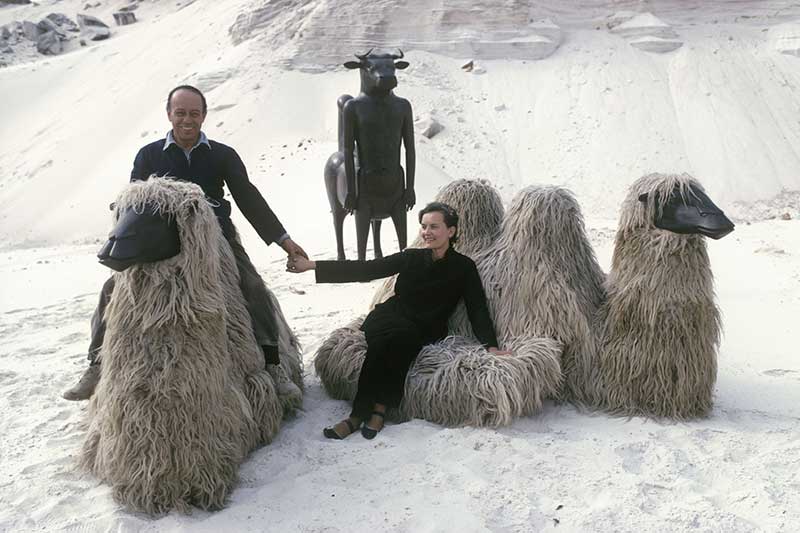
Claude’s realm was one of organic forms and the imprints of living things; François-Xavier’s, a playful, monumental bestiary.
But L’Homme à la tête de chou is more than an ambitious musical project. It is also a work by the artist Claude Lalanne (1925–2019), and a perfect distillation of the poetic, surreal universe she shared – in art as in life – with François-Xavier Lalanne (1927–2008). Still known simply as ‘Les Lalanne’, as though the two had fused into a single entity, they each nevertheless developed, over a career spanning some fifty years, an individual and unmistakable body of work: distinct from, yet complementary to, that of the other. Claude’s realm was one of organic forms and the imprints of living things; François-Xavier’s, a playful, monumental bestiary. Far from the Paris crowds, in the idyllic setting of their studio in Ury – Claude Lalanne’s birthplace – on the edge of the Fontainebleau forest, this intensely close couple worked in direct contact with nature and the elements that so powerfully inspired them.
An artistic coup de foudre
It was in 1952, at the Galerie Cimaise, during François-Xavier Lalanne’s first painting exhibition – he was just 25 years old at the time – that the two artists met. Very soon afterwards, the woman still known as Claude Dupeux, a name she would keep until their marriage in 1968, was invited to share her partner’s studio, just as he was laying down his brushes to devote himself entirely to sculpture.
From 1956 onwards, in their magnificent studio on Impasse Ronsin, in Paris’s Montparnasse district, the couple began working together almost as a matter of course. In 1964, Claude and François-Xavier presented their first joint exhibition at Galerie J. Specialising in Surrealism and Nouveau Réalisme, the gallery was run by Jeannine Goldsmith, the first wife of art critic and historian Pierre Restany. Titled “Zoophites”, the exhibition launched the Lalannes’ career – not least thanks to a decisive encounter with the celebrated gallerist Alexandre Iolas, who fell instantly and passionately for their work.
From 1956 onwards, in their magnificent studio on Impasse Ronsin, in Paris’s Montparnasse district, the couple began working together almost as a matter of course.
Their collaboration with Iolas began two years later, with an exhibition that also marked the start of their international rise, and continued until the gallerist’s death in 1987. But already, two signature works featured in the ambitious, four-handed exhibition “Zoophites”: Claude’s Choupatte, a cabbage set on chicken legs, and François-Xavier’s copper Rhinocrétaire, a desk housed inside the body of a rhinoceros.
Both drew inspiration from nature, but also from childhood, with mischievous humour, wordplay and flights of fancy never far in the background. Flora lies at the heart of most of Claude Lalanne’s works, whether sculptures, jewellery, or furniture: ivy, vast Ginkgo biloba leaves, bamboo stems, brambles, apples, and cabbages all seem to transform before the viewer’s eyes. Her tableware series, made from the imprints of real leaves, was created especially for Alexandre Iolas and shown in 1966 at the Lalannes’ first exhibition in his gallery on Boulevard Saint-Germain – and was no exception. The same spirit runs through the jewellery Claude began making in the 1960s for those close to her, before going on to collaborate with Yves Saint Laurent from 1969.
I borrow from the plant world to inspire my creations. I bring together the vegetal and the mineral. I use a very particular process: electroplating. I take leaves, place them in a bath, and the metal is deposited onto them, giving me the imprint of a real leaf.
Claude Lalanne
Alive with a sense of vitality, her sculptures, accessories and jewels reveal the influence of the Renaissance – notably the ceramicist and glassmaker Bernard Palissy – of Art Nouveau, through the architect, decorator and landscape designer Emilio Terry, and of Surrealism, all brought together in a baroque profusion that hints at her training at the École des Arts décoratifs.
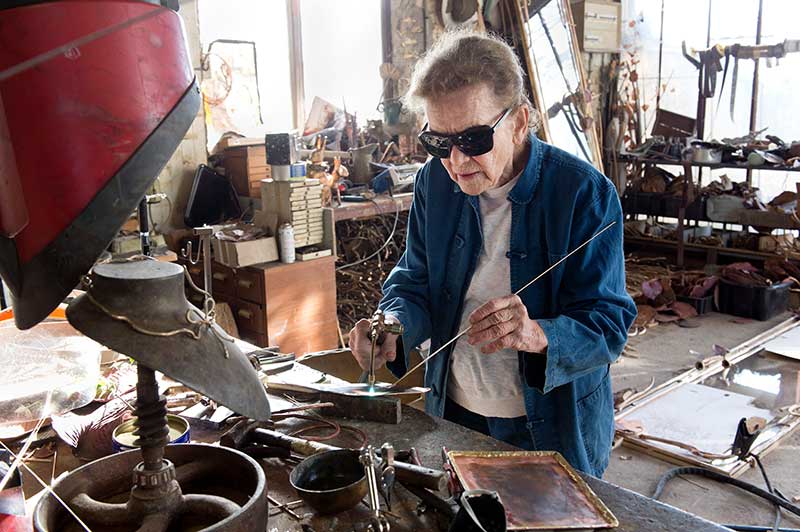
It was there that the American sculptor James Metcalf introduced her to the techniques of imprinting and electroplating through metal deposition. As she explained in an interview: ‘I borrow from the plant world to inspire my creations. I bring together the vegetal and the mineral. I use a very particular process: electroplating. I take leaves, place them in a bath, and the metal is deposited onto them, giving me the imprint of a real leaf’ (France Culture, 1993).
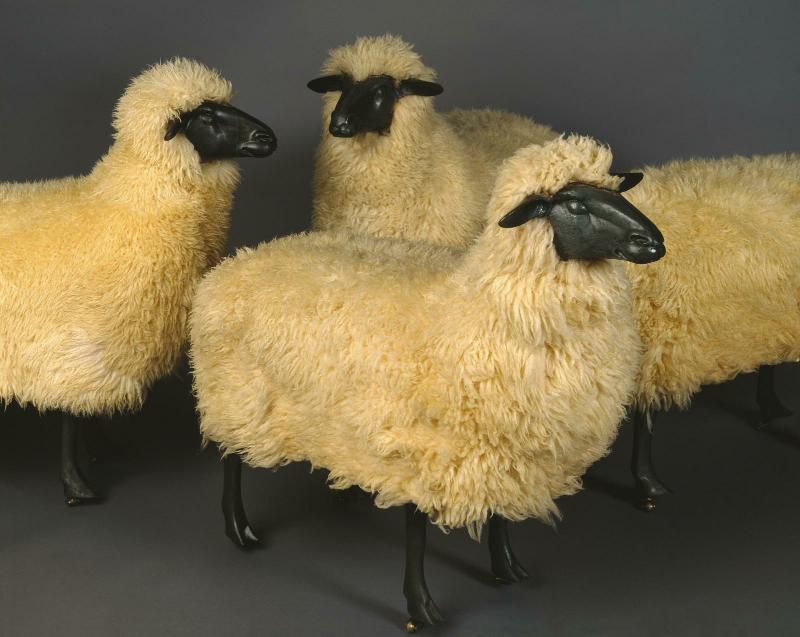
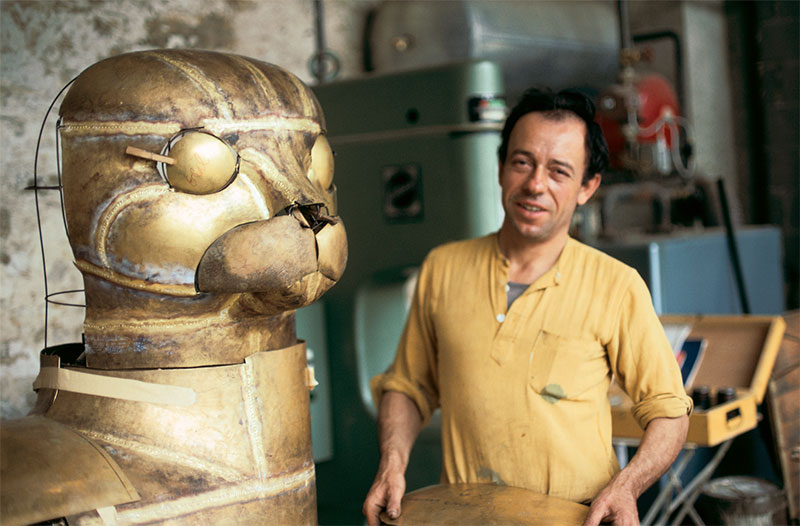
As for François-Xavier Lalanne, working in a somewhat more pared-back register than Claude, he turned his attention to fauna. His repoussé metal sculptures revive both the 19th-century tradition of animalier art and the 18th-century taste for transforming furniture. A flock of sheep, for instance, is in fact a series of seats in wool, bronze, and concrete; a hippopotamus conceals a bathtub in its belly and a sink in its mouth; two ostriches hold between their beaks a shelf bearing an egg-shaped ice bucket; and a giant fly hides, beneath its wings, a lavatory.
François-Xavier Lalanne's repoussé metal sculptures revive both the 19th-century tradition of animalier art and the 18th-century taste for transforming furniture.
This keen interest in the animal world also echoed a personal connection: François-Xavier Lalanne’s first wife was the great-grandniece of the sculptor François Pompon (1855–1933). It also bears the imprint of his time at the Louvre in 1948–49: while financing his studies in painting and sculpture at the Académie Julian, he worked as a gallery attendant in the Department of Near Eastern Antiquities. There, he sharpened his eye and became captivated by age-old masterpieces, amongst them the small Egyptian hippopotamus in blue faience, dating from more than 2,000 years BCE – the work that would inspire his hippopotamus-bathtub.
At the heart of the Paris art scene
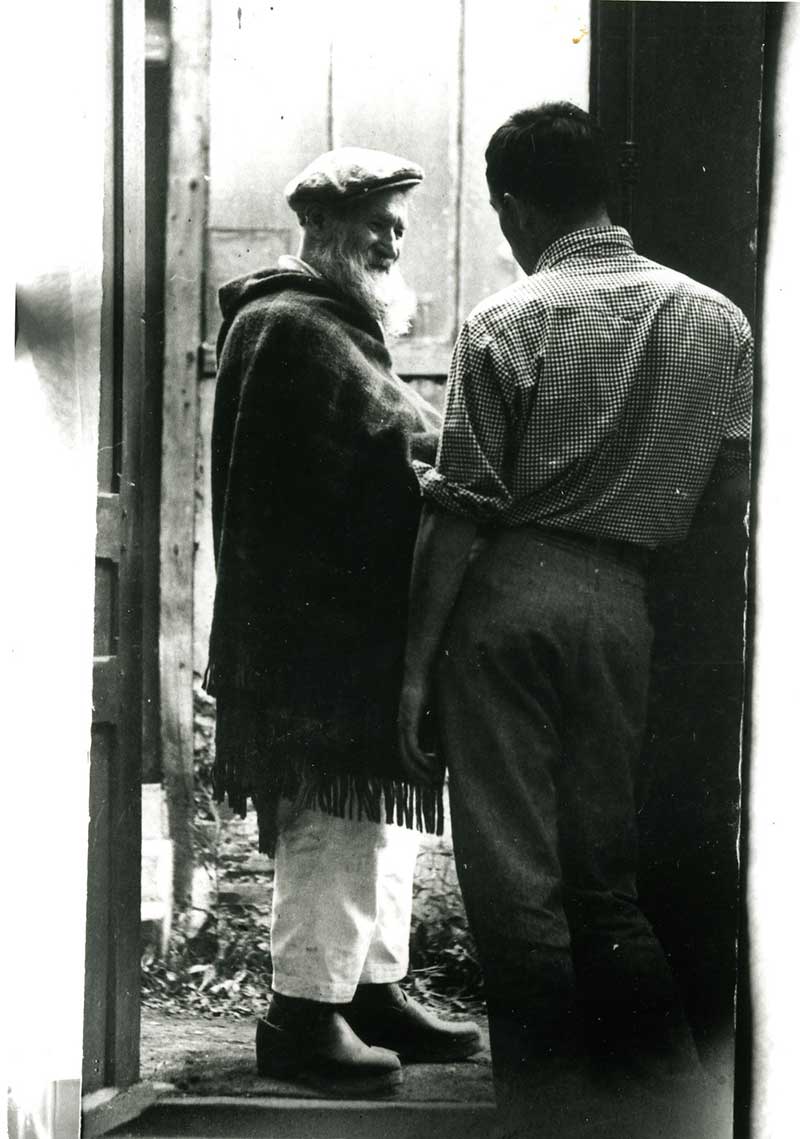
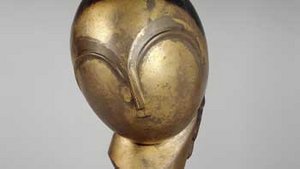
In the heady artistic ferment of post-war Paris, Impasse Ronsin was a creative hothouse, home to the likes of Jean Tinguely, Niki de Saint Phalle, Eva Aeppli and Daniel Spoerri, as well as Man Ray and Max Ernst. Not to mention the Lalannes’ next-door neighbour: the celebrated Romanian sculptor Constantin Brancusi, whom François-Xavier Lalanne visited regularly. The young artist’s admiration for his elder was palpable. Between glasses of vodka and curls of smoke from Sobranie’s multicoloured cigarettes, the doyen of the impasse introduced the couple to the Surrealist circle.
Ariane Coulondre, curator at the Centre Pompidou and curator of the exhibition “Brancusi”, explains: ‘François-Xavier Lalanne moved to Impasse Ronsin in 1949. Brancusi died in 1957, so these were the sculptor’s final years. In his recollections, François-Xavier Lalanne does not speak specifically of Brancusi’s influence, but rather of his admiration for his work, and for his studio – an extraordinary place that drew a great many artists. By then, Brancusi was very old and barely working any more. But he received many visitors.’
There is a certain influence of Brancusi here, but not necessarily from an aesthetic point of view. It has to do with a search for highly synthetic, pared-down forms – something one also sees, for example, in the animal sculpture of François Pompon.
Ariane Coulondre, curator
Did Constantin Brancusi directly influence François-Xavier Lalanne? Coulondre is careful to qualify the point: ‘There is a certain influence, but not necessarily from an aesthetic point of view. It has to do with a search for highly synthetic, pared-down forms – something one also sees, for example, in the animal sculpture of François Pompon. At the same time, Brancusi was after something else: he was pursuing the idea. He was working with symbol. How does one symbolise a bird, for instance? Where the Lalannes are far more figurative, engaged with forms that are much more recognisable and embodied, Brancusi is really moving towards something more abstract.’
On Impasse Ronsin, the days were studious and the evenings alive with fertile exchange. Shortly after their first exhibition with Alexandre Iolas on Boulevard Saint-Germain, Claude and François-Xavier officially became ‘Les Lalanne’. They soon took flight with a show at the prestigious Art Institute of Chicago, heralding other major destinations to come: Geneva; Düsseldorf; Zurich; London, at the Whitechapel Gallery; Edinburgh, at the Royal Scottish Academy; and Rotterdam, at Museum Boijmans Van Beuningen.
Yves Saint Laurent’s key role
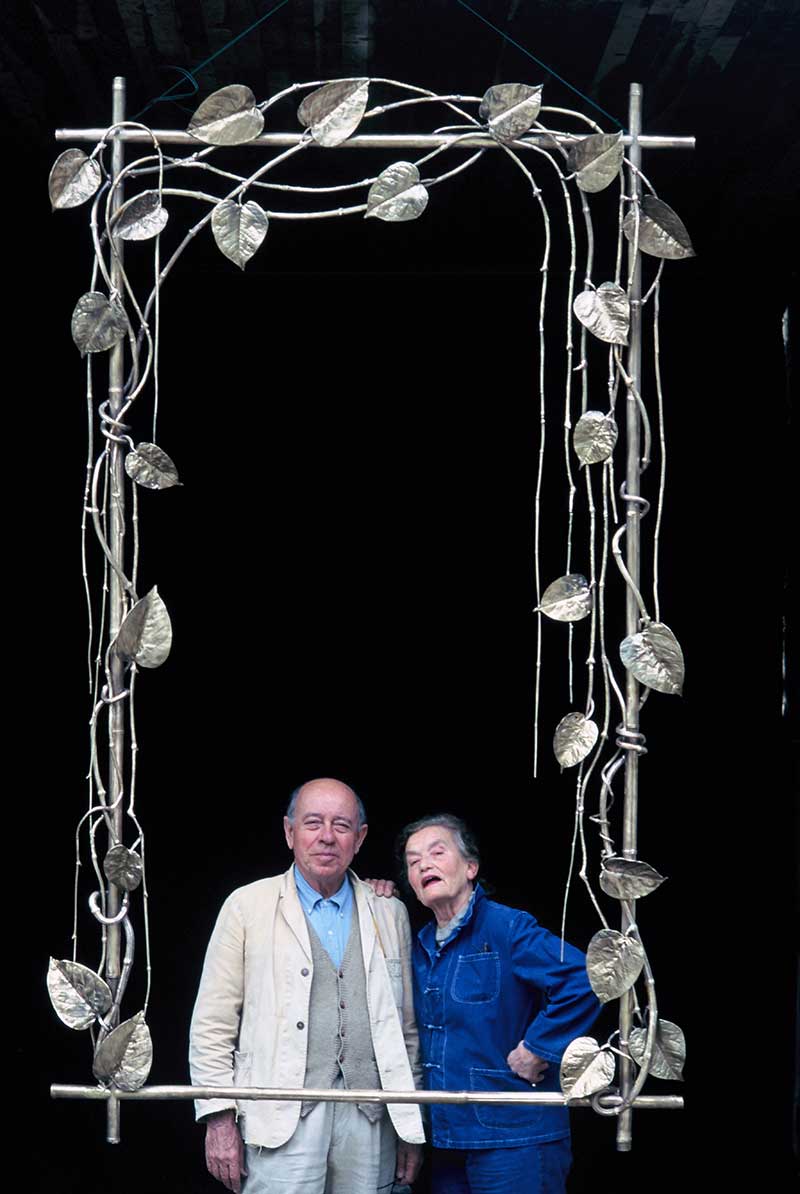
The 1960s marked a true turning point in the artists’ career, as their ties to the world of fashion deepened through the Saint Laurent–Bergé couple. The Lalannes first met Yves Saint Laurent in 1957, when he was still Christian Dior’s young assistant and they had been commissioned to design the window displays for the Avenue Montaigne boutique. After visiting the exhibition “Zoophites” in 1964, and admiring Rhinocrétaire, Yves Saint Laurent and Pierre Bergé placed an order with François-Xavier. For their Paris apartment on Place Vauban, they acquired a sleek living-room bar whose trays were pierced by a cornucopia-shaped shaker, a spherical ice bucket and an ovoid bottle rack. And for the salon de musique of their celebrated apartment on rue de Babylone, in Paris’s 7th arrondissement, they commissioned Claude to create a series of 15 mirrors in patinated and gilded bronze and copper, their surfaces alive with a tangle of leaves treated in galvanic baths.
A work of astonishing poetry and precision, begun in 1974 and requiring more than ten years of work, the ensemble became one of the major lots in the celebrated ‘sale of the century’, when the Bergé–Saint Laurent collection was dispersed in 2009. Acquired at the time by an American collecting couple for around $2m, the lot broke records at Sotheby’s in April 2026, reaching $33.5m.
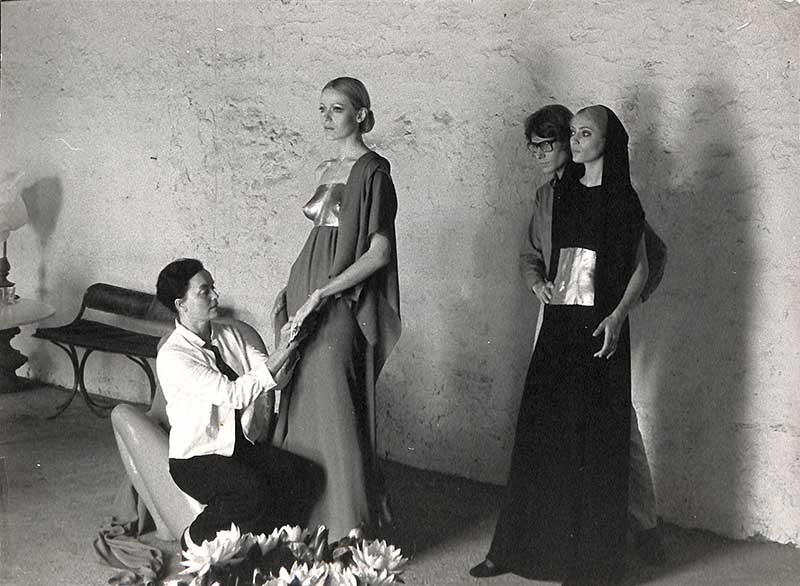
The friendship between Saint Laurent and Claude Lalanne was such that, in 1969, the artist collaborated on the couturier’s autumn–winter collection, casting the neck, breasts and belly of Veruschka, the house’s iconic model.
The friendship between Saint Laurent and Claude Lalanne was such that, in 1969, the artist collaborated on the couturier’s autumn–winter collection, casting the neck, breasts, and belly of Veruschka, the house’s iconic model. Somewhere between sculpture, talisman, and jewel, these delicate metallic skins gave structure to dresses in airy chiffon. Claude Lalanne continued her collaboration with Saint Laurent until the mid-1980s, creating jewellery collections that included bramble necklaces and lip bracelets.
Beloved by Tout-Paris
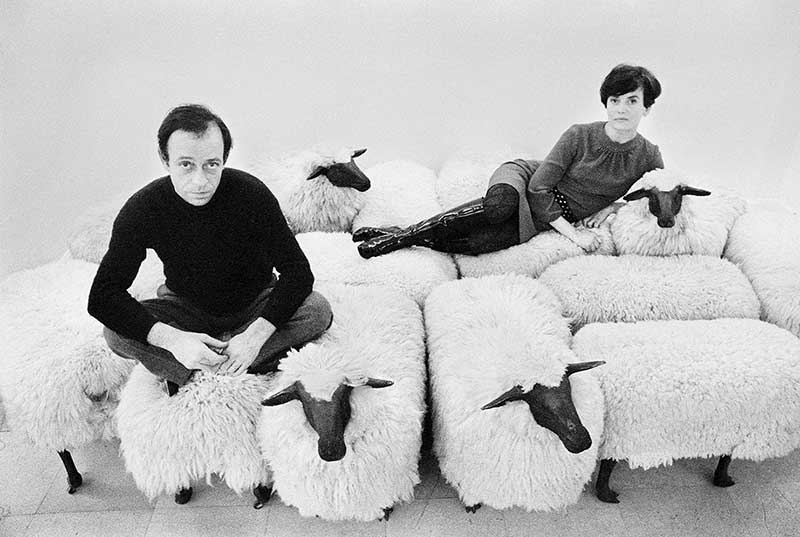
At Alexandre Iolas’s gallery in 1966, François-Xavier Lalanne conceived one of the most emblematic works in his bestiary, Troupeau de moutons, an installation made up of 24 sheep on castors, 14 of them headless. Moving, once again, between art and furniture, the artist delighted in sowing confusion – and these seats, covered in real sheepskins, drew every eye. ‘It is easier to have a sculpture in your living room than a real sheep, and better still if you can sit on it,’ the artist liked to say, with characteristic wit. In 1969, Günther Sachs, Brigitte Bardot’s German ex-husband and heir to the Opel fortune, as well as Gianni Agnelli, heir to Fiat, each acquired a version of the installation. Tout-Paris began clamouring for their work.
The Lalannes also took part in the “Bal surréaliste”, a high-society event hosted by Marie-Hélène and Guy de Rothschild at the Château de Ferrières, in Seine-et-Marne, in December 1972. Claude Lalanne tended to the adornments worn by several of her friends, amongst them Charlotte Aillaud – Juliette Gréco’s sister and the wife of architect Émile Aillaud, father of the artist Gilles Aillaud. Onstage, the Lalannes had been collaborating on sets for Maurice Béjart’s operas since 1964. In 1983, Claude created Mata Hari’s jewellery for Bob Wilson’s opera Civil Wars in Rotterdam.
The Lalannes in the Centre Pompidou collection
Over time, the couple attracted an ever more illustrious circle of collectors, from Charles and Marie-Laure de Noailles and the Rothschilds to decorators Jacques Grange and Peter Marino, and designers Karl Lagerfeld and Tom Ford. Georges Pompidou himself championed the Lalannes: in 1972, a bar in the shape of a giant grasshopper, made of Sèvres porcelain and brass, was presented to Queen Elizabeth II. The work remains in the Royal Collection today.
Georges Pompidou himself championed the Lalannes: in 1972, a bar in the shape of a giant grasshopper, made of Sèvres porcelain and brass, was presented to Queen Elizabeth II.
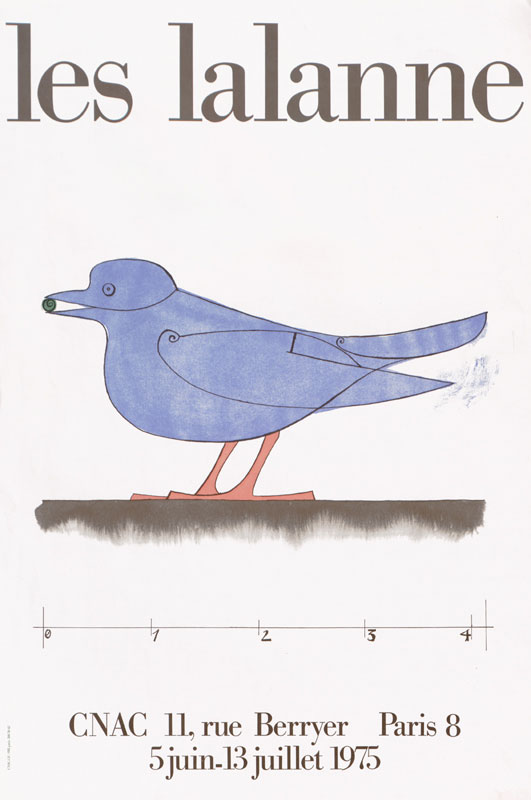
In 1975, a major solo exhibition devoted to the Lalanne duo was held at the Hôtel Salomon de Rothschild, on rue Berryer, in the premises of the Centre national d’art contemporain. The exhibition celebrated, in particular, the institution’s recent acquisition of two works by the couple, foremost amongst them François-Xavier Lalanne’s brass model L’Oiseau bleu. The work also featured on the poster, holding a seed in its beak and advancing like a symbol of universal peace.
Moreover, Pontus Hulten, a key figure of the European avant-garde, closely connected to Jean Tinguely and Niki de Saint Phalle, would play a decisive role in the Lalannes’ destiny. While still director of Stockholm’s Moderna Museet, he made frequent visits to the studios of Impasse Ronsin. Then, in 1973, he was officially appointed director of the Musée national d’art moderne at the future Centre Pompidou – a position he would hold until 1981. It was in this context that, in the late 1970s, he brought two works by the Lalannes into the collections of the newly founded Centre Pompidou: François-Xavier Lalanne’s Troupeau de moutons and Claude Lalanne’s Caroline (1969).
Ariane Coulondre explains: ‘Troupeau de moutons (1965) is a major work, shown at the Salon de la jeune sculpture shortly after it was created. It literally takes over the space, without confining itself to a decorative or purely functional dimension. It belongs, then, more to the field of sculpture – even installation. As for Claude Lalanne’s sculpture Caroline (1969), it is a cast of the body of her daughter Caroline, who was pregnant at the time, with a real cabbage in galvanised copper in place of the head. There is a visual play here that recalls the legend of babies being born in cabbages […] Pontus Hulten therefore favoured emblematic, powerful works by both artists, in consultation with them.’
In the 1980s, the City of Paris entrusted Claude Lalanne with an ambitious project: an adventure playground for children, set on 3,000 square metres in the Jardin des Halles, just a stone’s throw from the Centre Pompidou. Inaugurated in 1986, this magical, colourful world – with footbridges, mazes, snake-shaped slides, a volcano to climb and a ball pool to dive into – ‘was off-limits to adults, because everything was scaled for children,’ the artist recalled. Sadly, this hugely popular children’s paradise was destroyed in 2011 during the redevelopment of Les Halles.
In the 1980s, the City of Paris entrusted Claude Lalanne with an ambitious project: an adventure playground for children, set on 3,000 square metres in the Jardin des Halles, just a stone’s throw from the Centre Pompidou.
The loss is all the more regrettable as the art world has continued to reassess the Lalannes’ work, which has been the subject of major retrospectives since the 1990s: at the Château de Chenonceau in 1991, the Parc de Bagatelle in 1998, and finally the Musée des Arts décoratifs in 2010.
Claude Lalanne died in 2019, 11 years after François-Xavier. As the couple’s market continues to flirt with world records at auction, the Lalannes leave behind a generous body of work that continues, endlessly, to reconcile art and the decorative. ◼
Related articles
![[Translate to English:]](/fileadmin/_processed_/b/d/csm_iolas-vignette_ff5bf2bee3.jpg "[Translate to English:]")
François-Xavier and Claude Lalanne, 1976
Photo © Pierre Boulat
© Adagp, Paris
François-Xavier and Claude Lalanne in Paris, 1965
Photo © Willy Rizzo
Courtesy Galerie Mitterrand
Claude Lalanne, née Claude Dupeux, known as Claude Lalanne, Caroline, 1969
Electroplated copper/wax, elastomer cast, brass soldering, polyurethane foam, 165 × 62 × 44 cm
© Adagp, Paris
© Centre Pompidou, Mnam-Cci/Dist. GrandPalaisRmn
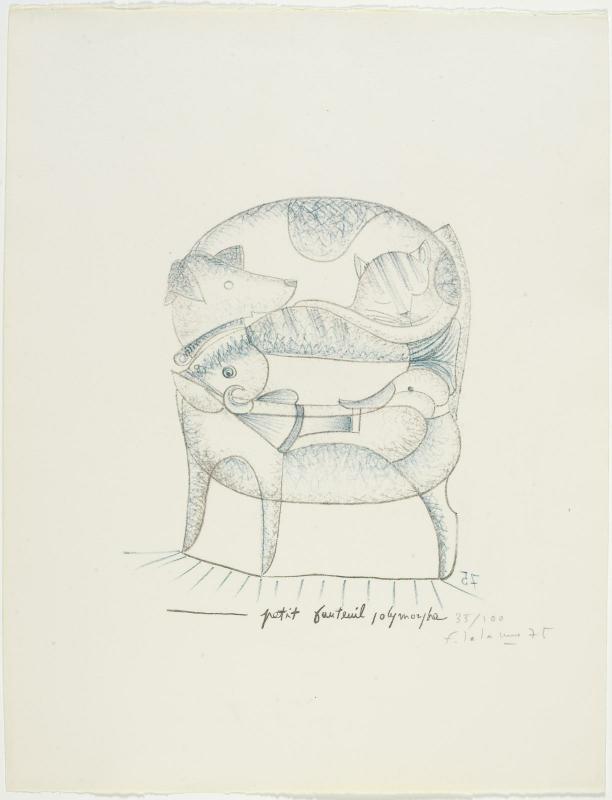
François-Xavier Lalanne, Petit fauteuil polymorphe, 1975
Lithograph on paper, 65.5 × 50.3 cm
© Adagp, Paris
© Centre Pompidou, Mnam-Cci/Dist. GrandPalaisRmn
François-Xavier Lalanne, Troupeau de moutons (Flock of Sheep) (1965 / 1979)
Sheepskin, metals, wood
© Adagp, Paris
© Centre Pompidou, Mnam-Cci/Dist. GrandPalaisRmn
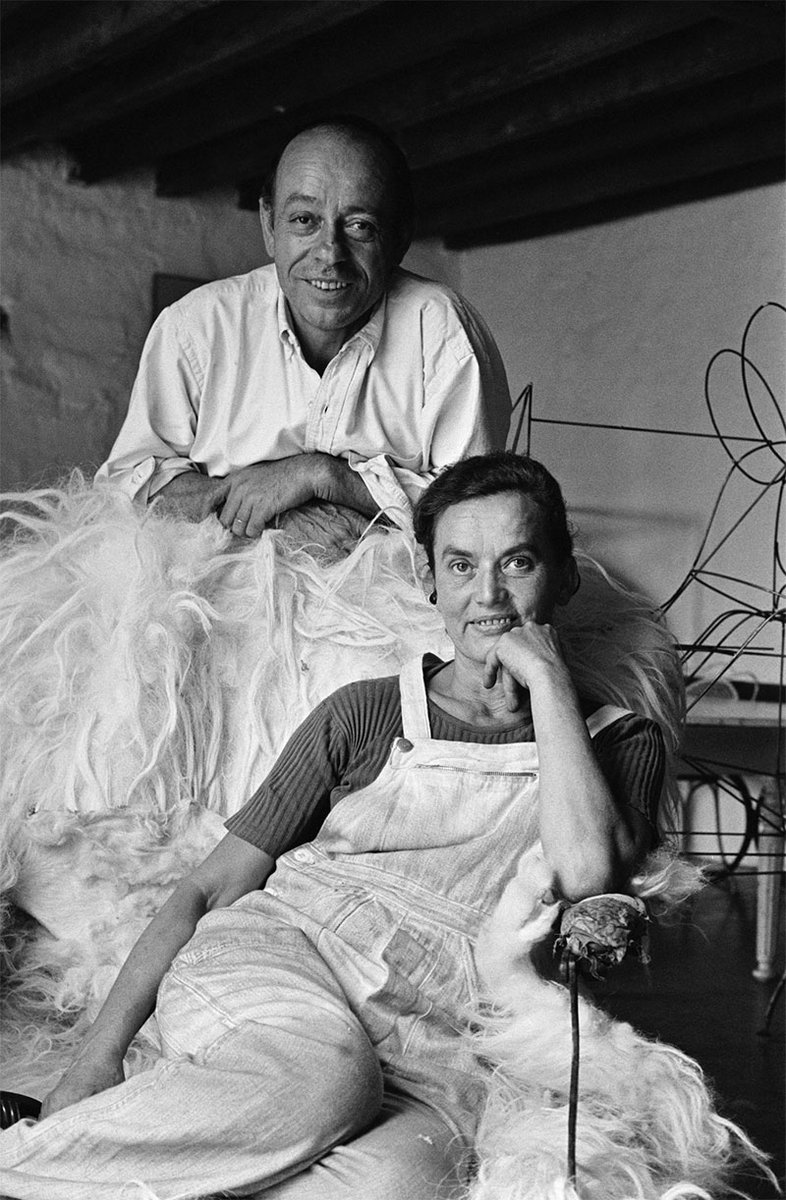
François-Xavier and Claude Lalanne at home in Ury, 1974
Photo © Succession Édouard Boubat
© Adagp, Paris
François-Xavier Lalanne at work in his studio in Ury
Photo © Succession Édouard Boubat
© Adagp, Paris
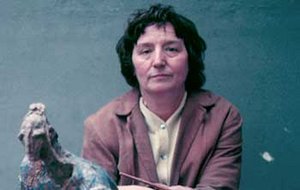
Claude Lalanne at work in her studio
Courtesy Galerie Mitterrand
Exhibition poster
© Centre Pompidou Archives
Brancusi and François-Xavier Lalanne
Photo © JP Lalanne
Courtesy Galerie Mitterrand
The artist couple
Photo © Capucine Kling
Courtesy Galerie Mitterrand