Matisse: Color in the Modern Interior
To imagine a new way of living—and to share it with as many people as possible. To open artistic practice to the realm of everyday life—architecture, painting, sculpture, metalwork, ceramics, glass—and to foster collaborations across disciplines. Such was the ideal pursued by modern artists, architects, and decorators in the early years of the twentieth century.
In his own work, Henri Matisse wrote of his desire to “create a possible space for the mind… empty like a room in an apartment,” “analogous to a comfortable armchair,” “like a bouquet of flowers in an interior,” spreading “joy through colour.”
The rupture he initiated echoed that undertaken by decorators and architects of the same moment. Together, they sought to invent spaces that were at once rational and sensorial—spaces designed for those who would inhabit them.
Colour, space, mathematical proportion: these are the terms that resonate with Matisse’s own vocabulary. In his work, as in that of Francis Jourdain, Eileen Gray, or Robert Mallet-Stevens, the eye encounters—borrowing Le Corbusier’s words—“something that expresses a thought,” “a sensorial rhythm,” the very language of modern creation.
From the late nineteenth century onward, architects, decorators, and artists began to collaborate closely in salons and exhibitions. Among those who crossed paths in these spaces were some of the most radical figures of their time—from Francis Jourdain to Georges Seurat, from Le Corbusier to Henri Matisse. In these encounters, the defining contours of a modern decorative movement began to emerge, in dialogue with the broader European scene.
Across industrial Europe, exhibitions and publications multiplied, seeking to articulate the new principles on which the living environment of a machine-age world might be built. At the intersection of art and industry, the decorative arts became central to debates within industrial nations, which sought to assert their power both economically and symbolically.
Modernity gradually reorganised itself around the notion of “social art”. Artists, architects, decorators, critics, and historians came together in response to the growing aspiration for an engaged art. The galleries of Siegfried Bing (L’Art nouveau, 1895) and Julius Meier-Graefe (La Maison moderne, 1899) offered Parisian visitors, for the first time, the experience of entering fully reconstructed interiors—featuring furniture by Henri Van de Velde, plates painted by Édouard Vuillard, and paintings by Georges Seurat, Maurice Denis, or Paul Ranson. In 1901, the society L’Art pour Tous was founded with the participation of Roger Marx and Frantz Jourdain, who would later establish the “Salon d’Automne” in 1903. Architects Henri Sauvage and Charles Plumet, together with the young painter and decorator Francis Jourdain, also joined forces within a movement known as L’Art dans Tout.
Rejecting the fashionable historicist eclecticism of the time, architects, decorators, and artists sought to reinvent the very notion of ornament. Their aim was to identify the immutable principles underlying the production of forms. As early as the mid-nineteenth century, combining mastery of drawing with theoretical reflection and encyclopedic knowledge, Owen Jones published The Grammar of Ornament (London, 1856; Paris, 1865). The writings of the French theorist Charles Blanc (Grammaire des arts du dessin, Paris, 1860–1867; Grammaire des arts décoratifs, Paris, 1882), as well as Eugène Grasset’s Méthode de composition ornementale (Paris, 1910), played a decisive role in this search for origins.
These authors identified what Jules Michelet, in La Bible de l’humanité (1864), described as “an eternal art, foreign to all fashion, older and newer than our own (which are old at birth)” in Indian artisanal productions shown at the Great Exhibition in London in 1851, and later in Islamic arts from what was then called the “Orient”. Western designers adopted these simple geometric and chromatic elements—infinitely combinable—“in accordance with the laws that govern the distribution of form in nature” (Owen Jones, The Grammar of Ornament, 1856).
![Édouard Vuillard, Le Grand Teddy [The Large Teddy], 1918–1919 Oil on canvas, 150 × 290 cm Collection Association des Amis du Petit Palais, Geneva](/fileadmin/_processed_/7/9/csm_202010_Edouard_Vuillard___Le_Grand_Teddy_37377156db.jpg)
As the decorator of the Crystal Palace in 1851, Jones drew inspiration from the ornament of the Alhambra and placed particular emphasis on colour. As the critic Lothar Büchner observed that same year: “I had the impression that the raw material with which architecture works was completely dissolved by colour. The building is not decorated with colour, but constructed by colour.”
In the 1890s, exhibitions of Islamic art followed one another in Paris, culminating in the exhibition held at the Pavillon de Marsan in 1903.
In 1910, Matisse visited the major exhibition of “Mohammedan art” in Munich. Looking back on the experience in an interview with the art critic Jacques Guenne, he later recalled: “I felt within myself the passion for colour begin to grow.” That same year, while travelling in Germany, Le Corbusier attended the Secession exhibition in Berlin, where he noted that there were “two things” by Matisse (including Marguerite au chat noir) that appealed to him, “because of their beautiful colour, their synthesis.” During the winter of 1911 and the spring of 1912, the painter settled in Tangier, while the architect embarked on his journey to the Orient.
Colour had by then become an instrument of modern rationalism. In 1896, Frantz Jourdain invited the architects Henri Sauvage, François Garas, and Henri Provensal to exhibit at the Galerie Le Barc de Boutteville, known for its focus on Post-Impressionist and Nabi painting. The exhibition he organised, titled “Impression d’architectes”, presented no architectural projects as such, but rather spaces created through intense colour. Early rationalist architects, such as Auguste Perret, likewise played with the colour of construction materials while simplifying decorative motifs.
In 1903, Frantz Jourdain founded the Salon d’Automne, whose exhibitions accompanied the artistic ruptures then underway. Henri Matisse served on its governing committee, alongside several former students from Gustave Moreau’s studio at the École des Beaux-Arts. Charles Plumet was responsible for the overall scenography of the Salon.
When Julius Meier-Graefe published The Development of Modern Art in 1904, five years after opening his gallery, he titled the final chapter “The New Rationalism”, which he defined as a movement seeking to “modernise the old through the abstraction of ornament”. He then listed the most significant figures of the decorative arts, among them Plumet and the protagonists of L’Art dans Tout. Meier-Graefe also reproduced Matisse’s La Dame au chapeau vert, a work barely completed, shown at the 1905 Salon d’Automne at the centre of Plumet’s scenography—a Fauvist manifesto, a “pot of paint thrown in the public’s face”.
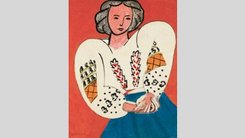
When Matisse painted Interior with Eggplants in 1911, the lattice of ornamental floral motifs and the matte tempera colours created the effect of wallpaper, of the “wall decoration” the painter himself sought. He travelled to Morocco, Spain, and Russia. He collected fabrics, fragments of tapestry, toile de Jouy, Persian carpets, Arab embroideries, African hangings, cushions, curtains, shawls, costumes, and screens. He referred to this collection as his “working library”.
Alongside paintings and sculptures, the Salon d’Automne also presented furniture, textiles, and wallpaper designed by French decorators. Charles Dufresne, André Groult, Jean-Louis Gampert, Louis Süe, André Mare, Paul Follot, and Édouard Bénédictus drew on the national tradition of the seventeenth and eighteenth centuries, borrowing its qualities of clarity and order as well as its recurring motifs—baskets of fruit and garlands of flowers. The path was thus opened for the naïve, brightly coloured floral designs of the Atelier Martine, founded in 1911 by Paul Poiret. It was in the couturier’s workshop, moreover, that Matisse designed an emperor’s coat, a stage costume commissioned by Serge Diaghilev. Floral motifs were everywhere, forms simplified, and colour took precedence. Decorators displayed “an attachment to pictoriality [that] asserts itself through the use of vivid, vehement colours… They are more concerned with impression than with form; they create what might be called an atmosphere for the interior.” (Léandre Vaillat, “L’art décoratif au SA”, 1911).
The Salon d’Automne affirmed the collaborative dimension that shaped the creation of modern interiors. In 1911, André Mare exhibited works by Raymond Duchamp-Villon, Jacques Villon, and Fernand Léger within his interior installations. The Maison cubiste, presented in 1912, invited visitors to step into a bourgeois salon. Against Gampert’s floral wallpapers hung the Cubist canvases of Léger and Jean Metzinger.
Intense colours—vivid orange, brilliant green, cobalt blue—covered the walls of these rational interiors. In 1910, Frantz Jourdain invited members of the Munich Werkbund to present their work at the Salon d’Automne. No décor: colour.
The German displays triggered a reaction among French decorators. More than anyone else at the time, Francis Jourdain pushed the idea of interior design to its most radical simplicity with his “interchangeable furniture”, a combinatory system of modular elements—economical pieces produced and distributed by the Ateliers modernes (1911).
![Robert Mallet-Stevens, Hall pour Une ambassade française [Hall for a French Embassy], Pavillon de la Société des artistes décorateurs, Exposition de 1925 Published in René Chavance, « Une ambassade française » [A French Embassy], Paris, Charles Moreau, 1925, pl. 46 © Centre Pompidou, Mnam-Cci, Bibliothèque Kandinsky](/fileadmin/_processed_/e/2/csm_202010_Robert_Mallet-Stevens__Hall__publiee_dans_Une_ambassade_francaise__Paris_b366df4ad5.jpg)
Published in René Chavance, « Une ambassade française » [A French Embassy], Paris, Charles Moreau, 1925, pl. 46
© Centre Pompidou, Mnam-Cci, Bibliothèque Kandinsky
![Noémie Skolnik-Hesse, Chambre d’enfant [Children’s Bedroom], n.d. Design for the private residence of Eric Allatini, built by Robert Mallet-Stevens, rue Mallet-Stevens, Paris, 1925–1927. Plate published in Répertoire du goût moderne, vol. 3, Albert Lévy, 1929, pl. 27 © Centre Pompidou, Mnam-Cci, Bibliothèque Kandinsky](/fileadmin/_processed_/8/1/csm_202010_Noemie_Skolnik-Hesse__Chambre_d_enfant_944e95c0f6.jpg)
Design for the private residence of Eric Allatini, built by Robert Mallet-Stevens, rue Mallet-Stevens, Paris, 1925–1927. Plate published in Répertoire du goût moderne, vol. 3, Albert Lévy, 1929, pl. 27
© Centre Pompidou, Mnam-Cci, Bibliothèque Kandinsky
In 1913, he published in Les Cahiers d’aujourd’hui, the journal edited by George Besson, “Ornament and Crime”, the French translation of the text in which Adolf Loos envisions a pure spiritual fulfilment for humanity. Le Corbusier would later reproduce the essay in L’Esprit nouveau in 1921.
A few years before Matisse painted the portrait of their mutual friend, Francis Jourdain designed the interior of Georges Besson’s living room, furnishing it with a suite of vivid blue pieces that clad the wall and freed up the space—for, as he wrote, “the greatest luxury is to de-furnish”.
When questioned by Guillaume Apollinaire in 1907, Matisse declared: “I have colours, a canvas, and I must express myself with purity, even if I must do so summarily—for example, by placing four or five patches of colour, by drawing four or five lines that carry a plastic expression.”
The artist consistently praised the decorative dimension of his painting, in the process transforming the very status of the image. To paint, he believed he had to remain as close as possible to his own emotion. The motif mattered less than the effect produced on the viewer, who must “allow himself to be carried away without being aware of it.” (Georges Duthuit, Les Fauves, 1949).
In painting as in architecture, colour structures a sensorial approach to space. In 1921, Le Corbusier published in L’Esprit nouveau the objective foundations of a physiology of sensations, as analysed by Eugène Chevreul and Charles Henry, whose research would influence both architects and artists.
Illustrated albums with pochoir plates attest to the importance of the colours used by architects: yellow ochre, red ochre, natural ochre, burnt ochre, raw sienna, burnt sienna, chrome yellow, English green, ultramarine blue, coachman’s blue, ivory black—tones that renewed the interior space.
To Le Corbusier’s words, describing the function of polychromy in architecture—“Colour modifies space”—echo those of Matisse: “The characteristic of modern art is that it participates in our lives. A painting within an interior spreads around it a joy through its colours, which lightens us.” ◼
This presentation owes much to the work of Rémi Labrusse, as well as to the research carried out for the exhibition « UAM, une aventure moderne », at Centre Pompidou in 2018.
Related articles

In the calendar
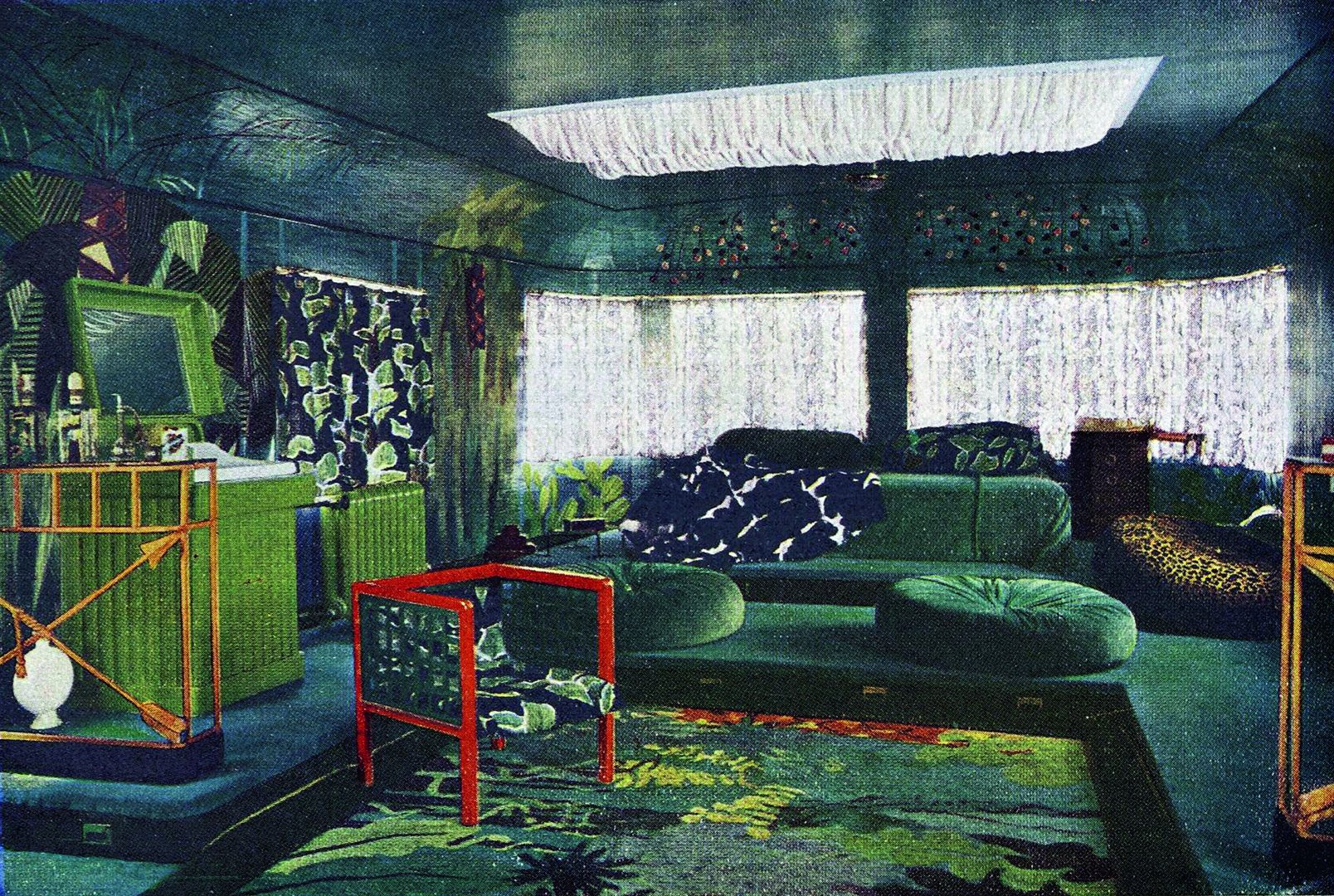
Paul Poiret, Atelier Martine, Interior design for a barge on the Seine, Exposition internationale des arts décoratifs et industriels modernes, Grand Palais, Paris, 28 April–8 November 1925
Photograph: L’Illustration (detail)