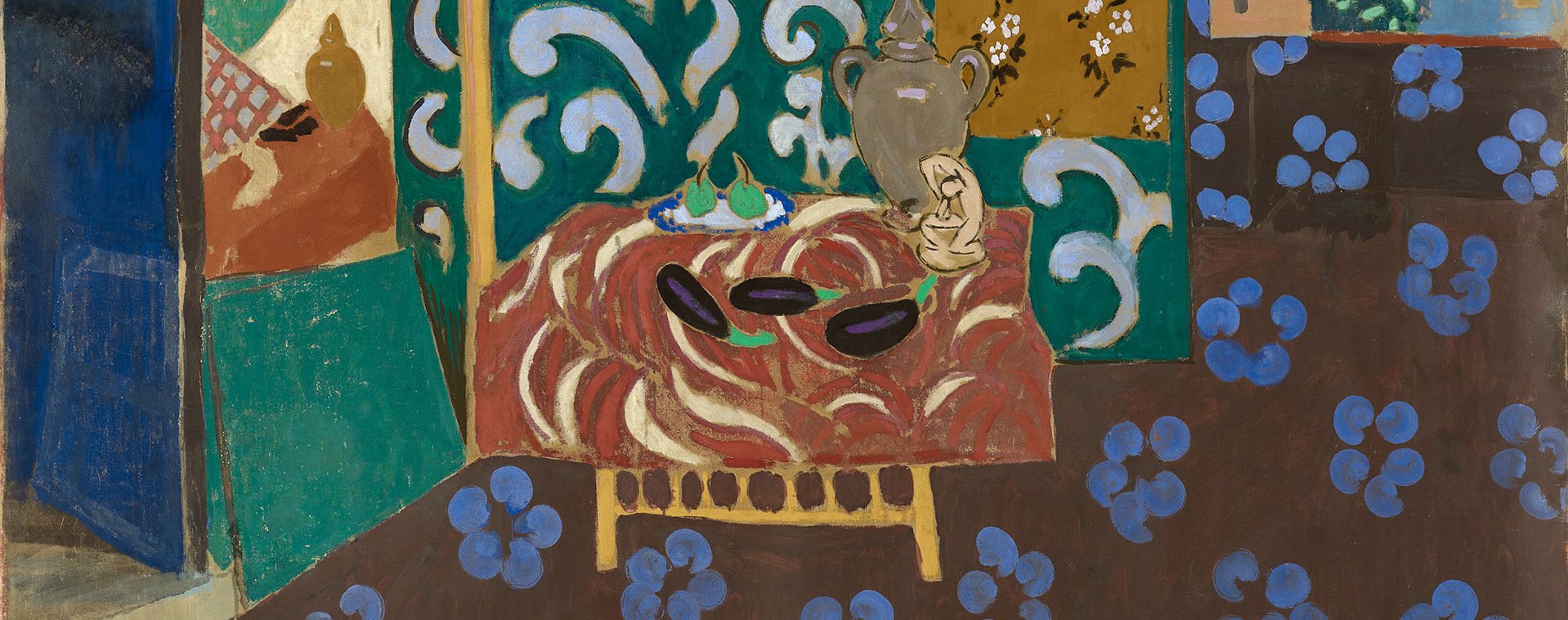
Focus on… “Intérieur aux aubergines” by Henri Matisse
Seeing Intérieur aux aubergines by Henri Matisse on the walls of the Centre Pompidou – even briefly – is an event of real consequence. On loan from the Musée de Grenoble, the painting was executed in a fragile glue-based tempera that almost never leaves its home and has not been shown in Paris for nearly three decades. Its last appearance here dates back to 1993, in the landmark exhibition Henri Matisse 1904–1917. Yet rarity alone does not account for the excitement. This interior ranks among Matisse’s most pivotal works – arguably the most important painting held today in a French public collection, as the poet and critic Dominique Fourcade once wrote to Clement Greenberg.
There are compelling reasons for such claims. Painted in 1911 – a decisive year for Matisse – the work appears at the moment when his art snaps into focus, reaching its most concentrated and incisive form. It belongs to the quartet Alfred Barr would later call the “Symphonic Interiors”, and Interior with Aubergines is among their most audacious. Its scale alone – exceptional for Matisse – reads like a manifesto. The composition teems with ideas: painting reflecting on painting, an image probing the future of images themselves. And then comes the sensory charge – a lavish outpouring of form and colour, of symphonic accords both explosive and hushed, of supple and sensual flesh tones. Everything seems to surge forward with exuberance, an unfiltered burst of youthful energy.
Everything pointed to the canvas asserting itself as a major milestone of modernity. When Matisse described it as an “important decorative work”, he meant it in the strongest sense. Decorative was not a mild qualifier but the rallying cry of a revolution – one that sought to bind life and images more intimately, more intensely, or rather to rethink the very act of image-making. The painting quickly became a magnet. Artists, critics, and collectors made their way to Matisse’s studio – first in Collioure, then in Issy-les-Moulineaux. Among them were Sarah and Michael Stein, who acquired the work in the autumn of 1911 and soon displayed it in their rue Madame salon.
Yet uncertainty lingered. Matisse added a floral border, removed it, introduced another, then stripped it away again when he repurchased the painting from the Steins, probably around 1917. Did something about this long-pursued work – into which he had poured both affection and tenderness (one thinks of Baudelaire confronting Les Fleurs du mal), but also a measure of unease – give him pause? Nothing ever seemed fully resolved, as if the painting provoked alternating impulses of attraction and resistance.
Even the handling of paint conveys urgency, almost a kind of agitation. There is an insistent drive to load the surface with material presence: using distemper to saturate the image with matte substance, to anchor ornamental form in matter – in short, to wrest the image from unreality, even at the risk of its erosion.
Then, in 1922, Matisse sent the painting to the Musée de Grenoble. It was an honour: at the time, it was the only French museum to own one of his works – albeit a minor one – thanks to the young curator Andry-Farcy. The donation of the large Intérieur was therefore both a bold gesture and a sign of gratitude. Yet it was also, in a sense, a form of relegation. Permanently stripped of its border, the painting’s fragile surface remained constantly vulnerable.
As a result, the work slipped into relative obscurity in Grenoble: rarely reproduced, seldom shown elsewhere. It remained largely overlooked until 1974, when Dominique Fourcade published a striking essay in the journal Critique entitled Rêver à trois aubergines. The article proved decisive, orchestrating the return of Intérieur aux aubergines to the forefront of the modernist canon.
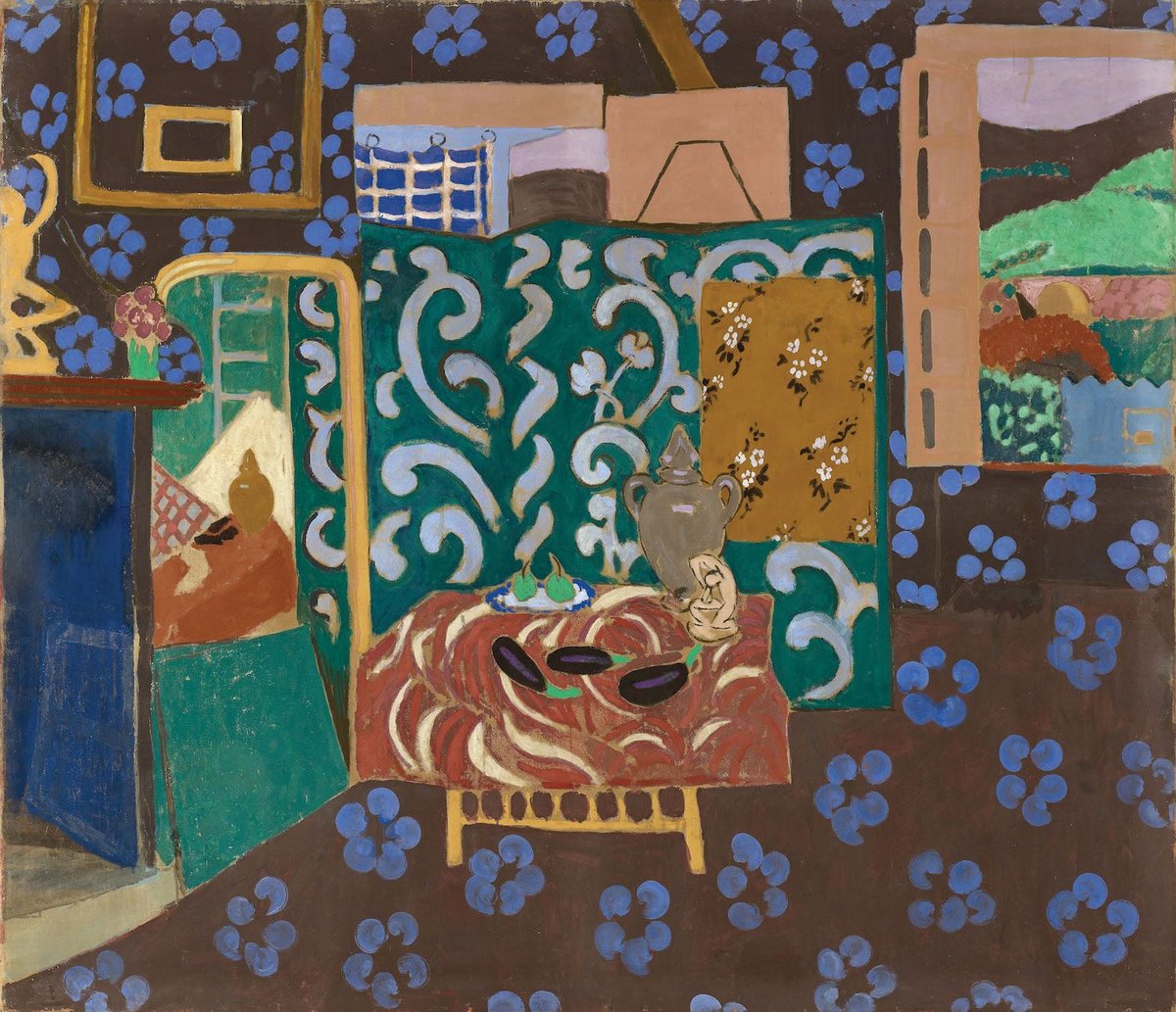
An interior in Collioure. Three eggplants dance on a table. Behind them, a folding screen seems to float, enveloping the scene in sweeping floral arabesques. To the left, a mirror captures impossible reflections whose logic borders on vertigo: a drawing board, in its lower section, intrudes directly into the glass. The ghost of a canvas stretcher leans against the wall of an ultramarine-blue fireplace. Above, two windows open onto a landscape built entirely of colour; the sky is pink. Frames on the wall enclose nothing but emptiness. Another, strangely unsettling frame is scratched into a crenellated patch of sky-blue wall glimpsed through the right-hand window. Everywhere, spaces overlap and interpenetrate. And across it all sweeps a broad violet flight of flower-like brushstrokes drifting far beyond the limits of the picture.
What is at stake here? The thickness and lightness of reality; the way images take root in life while dissolving into it; the act of making, which matters more than the finished fact; the slow experience of looking; the layers of images that must be shaken off; movements that shift lines, their blind rebounds rising from the body and claiming their freedom. On the canvas everything unfolds both very quickly and very slowly, in depth and on the surface, vertically and horizontally.
Across time, and beyond the twists and turns of art history, Intérieur aux aubergines calls on us – here and now – to plunge into the bottomless question of representation, while at the same time giving us everything we need to turn that plunge into a source of pleasure. We walk a narrow ridge: on one side the iridescence of dream, on the other the grit of matter. The painting wavers between them at every moment, in every square centimetre, reminding us that, to resist the rising tide of spectacle, we must once again learn how to see. Nothing could feel more urgent today. ◼
Related articles

In the calendar
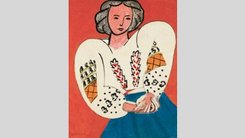
Henri Matisse, « Intérieur aux aubergines », 1911 (détail)
Détrempe à la colle sur toile, 212 × 246 cm
Musée de Grenoble
Photo © Ville de Grenoble/Musée de Grenoble- J.-L. Lacroix
Commissariat de l'exposition « Matisse, comme un roman »
Aurélie Verdier
Conservatrice, Musée national d'art moderne