In Their Hands: Poetry and Possibility in the Cinema of Céline Sciamma
In the middle of Céline Sciamma’s short film, This Is How a Child Becomes a Poet (2022), we learn: So this is how a child becomes a poet. When Kim Novak claps. When Kim Novak claps, a door opens into your heart. When she claps, you fall in love. Sciamma is speaking these lines in English, over a clip from the film Picnic (Joshua Logan, 1955), in which Kim Novak walks slowly down shallow outside stairs to a dance floor, clapping a beat as she descends each step. It was this cinematic moment, Sciamma tells us, that sent Patrizia Cavalli home to write her first poems. Sciamma’s films show, over and over, the moment that a watchful, lonely young person feels a door blow open in their hearts, at the dancing movement of another’s hands.
In an interview with UK distributor Peccadillo Pictures about Tomboy, Sciamma says ‘I’m obsessed with faces, and how we can share someone’s loneliness through a face. And with choreography.’ In between the luminous faces of her protagonists – which evoke the essence of classical cinema as celebrated by Roland Barthes in ‘The Face of Garbo’ – and their moving feet, Sciamma offers the poetry of hands, their clap like a thunderclap to which your heartbeat echoes.
In between the luminous faces of her protagonists – which evoke the essence of classical cinema as celebrated by Roland Barthes in ‘The Face of Garbo’ – and their moving feet, Sciamma offers the poetry of hands, their clap like a thunderclap to which your heartbeat echoes.
Sciamma’s first film Naissance de pieuvres (2007) began as her graduation project from La Fémis’s screenwriting programme and won the Prix Louis-Delluc for Best First Film. It opens on girls’ hands smoothing hair and applying make-up; turning this way and that, rehearsing synchronised swimming choreography. Into this disciplined world comes Marie (Pauline Acquart), who watches one swimmer with such intensity that another audience member tells her to sit down. Marie will get to lacquer Floriane’s hair, and even to touch her intimately, and will find she is no longer a watcher: her heart opened in the moment Floriane wrote her address onto her open palm.
Marie’s awakening is repeated, differently, in Mickäel (Zoé Héran), the protagonist of Sciamma’s second film Tomboy (2011), who looks with lonely longing, pushing his fingertips, like his gaze, through the white wire of the balcony of his family’s new apartment – only to find that Lisa (Jeanne Disson) has been looking back up at him. This early scene repeats at the end of the film, after Mickäel and Lisa have danced, played, kissed – and after Mickäel’s mother has outed him as assigned female at birth, after Mickäel has fought with another boy to defend his little sister Jeanne (Malonn Lévana). Jeanne is a gleeful artist: she draws Mickäel’s portrait, dances while he plays the keyboards, and makes Play-Doh spaghetti while Mickäel makes something for himself. What is it, Jeanne asks thrice, and thrice she is denied: Nothing. None of your business. I already told you I’m not telling you.
This nothing is the thing that Mickäel thinks he needs to convince Lisa that he is like other boys: a plasticine packer that fills out the profile of his hand-cut Speedo. After the swimming session, he places the packer in a memento box, which also holds his baby teeth. ‘It is a human thing to do to put something you want, because it’s useful, edible, or beautiful, into a bag, or a basket… or… shrine’, writes Ursula K. Le Guin in her essay ‘The Carrier Bag Theory of Fiction’, her feminist rethinking of story as the work of hands, containers and quiet making.
What matters is not that the box is closed, but that it takes care of what it holds. Mickäel may take the memento box out of his closet, but he doesn’t hide it away again. Sciamma’s protagonists use their hands to make a home out in the world. When Floriane opens up to Marie about the sexual harassment she faces, they aren’t in a bedroom but sitting on the grand stone steps of les étangs de Cergy, looking down to the lake and its pyramidal folly, which will reappear in Petite Maman (2021).
In an interview for The Dial, Sciamma told her fellow Cergoise Annie Ernaux:
‘I grew up here, in Cergy, a city “without a bourgeois heart”, as you put it so well. I spent my early years in this new city, inhabited by youth – as it was so often young parents who came to settle here. Cergy’s approach to urban planning, separating pedestrians from cars, meant that children, myself included, had a lot of freedom to move through the city. But at the same time, limits to that freedom arrived very early, when I began to feel strongly attracted to girls: a forbidden desire.’
The young Black women of Bande de filles (2014), Marieme/Vic (Karidja Touré), Lady (Assa Sylla), Adiatou (Lindsay Karamoh), Fily (Marietou Touré), and Marieme’s little sister Bébé (Simina Soumaré), face racist hostility as well as sexism in taking on the city. In its face, they dance, most memorably in their lip sync to Rihanna’s ‘Diamonds’ during a stolen night in a hotel room, but also in laughing groups in the open spaces of Les Halles.
This experience of youthful togetherness gives Marieme/Vic the strength to take up space: having rung her mother’s doorbell then moved her hand away from opening the door, she has nowhere to go. The film appears to end without her, the frame filled with impossible gleaming distant white towers. But Marieme/Vic steps back into the frame, into focus, into the world. No longer connected to Bébé by their gripped hands between their beds at night, Marieme/Vic wears braids that are a reminder of their time spent caring for each other’s hair, shaping each other’s possibility.
Touch, click: a door opens into your heart, and in dances love, opening the closet so you can take another’s hand. What a queer experience, an exhilaration! This is the poetry of Céline Sciamma’s cinema, the possibility that she offers to us all.
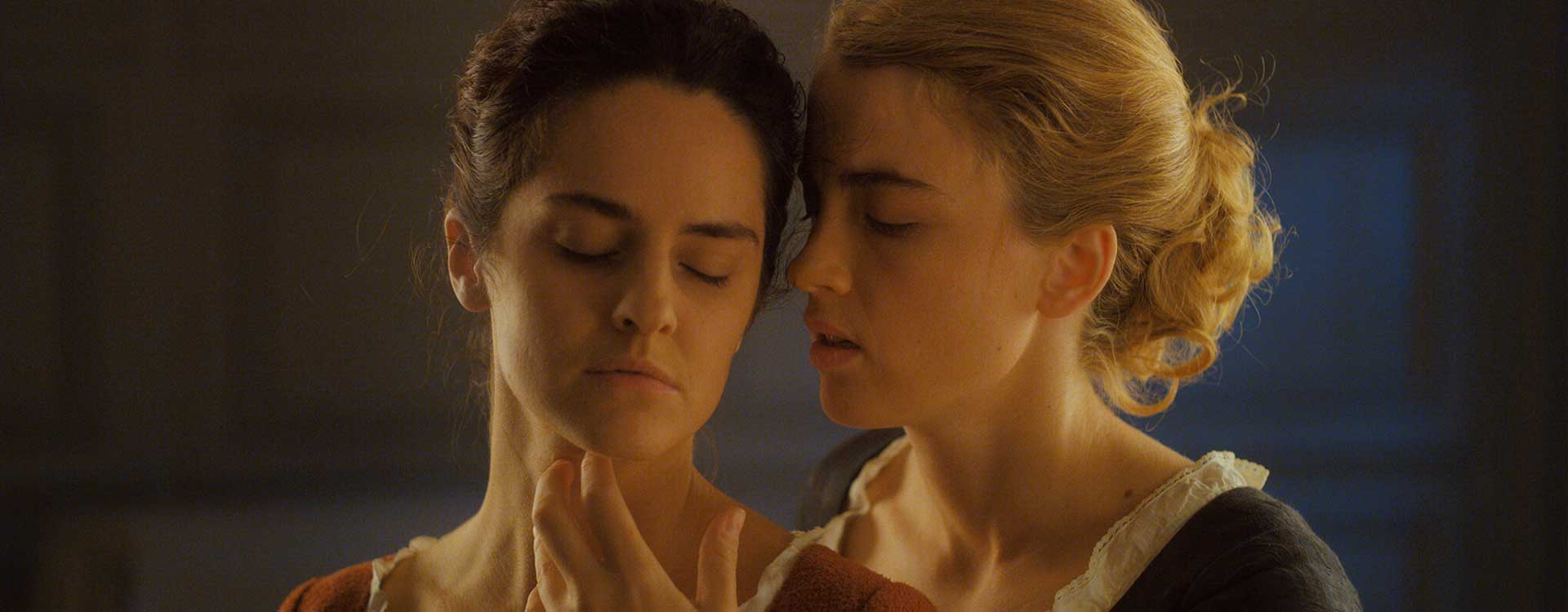
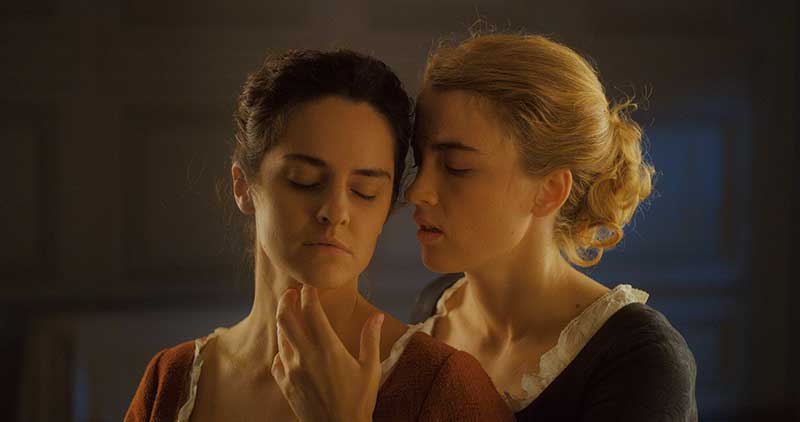
In Portrait de la jeune fille en feu (2019), the first film by a woman to win the Queer Palme at Cannes, we see most clearly how Sciamma’s protagonists shape each other’s possibility through what the artist Carolee Schneemann, in ‘Interior Scroll’ (1975), called the ‘hand-touch sensibility’ of feminist art. Charged with painting a marriage portrait, working artist Marianne (Noémie Merlant) falls in love with the bride-to-be, Héloïse (Adèle Haenel), named for one of the most famous students and lovers in history. As Marianne sketches and paints, we are achingly aware that she touches the canvas as if it were her beloved. They become lovers – but in the controlling, patriarchal world of the late eighteenth century, Héloïse must marry. In a later portrait by another artist, she makes an erotic gesture that only Marianne can read: her fingers are placed between the pages of a book, both marking the page on which Marianne has drawn herself nude, and recalling the sex scene in which Marianne had thrust her fingers into Héloïse’s armpit. A doubly hand-touch sensibility.
The film opens with a sequence of quick cuts between a blank canvas and hands sketching sinuous lines: the hands of Marianne’s students. Although Marianne’s name implies the freedoms vaunted by the Revolution, her teaching reminds us that the work of resistance is required from every generation. In Petite Maman, there is intergenerational healing through the play of hands: Nelly (Joséphine Sanz), lonely at her grandmother’s house which her parents are clearing out after the elder’s death, whistles into an acorn cup held between her hands, and the next day in the woods, she finds Marion (Gabrielle Sanz), her mother as a child, and they play together making forts, crêpes and drama. When Nelly is exploring her grandmother’s house, her clever hands find a hidden closet that clicks open, and it’s this same door in Marion’s house that will cue her to the magic of being in the same place, but in the past, a handmade time travel as simple as the editing that makes film move.
Touch, click: a door opens into your heart, and in dances love, opening the closet so you can take another’s hand. What a queer experience, an exhilaration! This is the poetry of Céline Sciamma’s cinema, the possibility that she offers to us all. ◼
Related articles


In the calendar
Noémie Merlant and Adèle Haenel in Portrait de la jeune fille en feu, by Céline Sciamma (2019)
© Pyramide Distribution