Pedro Almodóvar: Design, Desire, and Décor
Seven years after Pain and Glory, – which earned Antonio Banderas the Best Actor prize at Cannes, – Pedro Almodóvar returns to the main competition with Bitter Christmas (Amarga Navidad ), a film that may finally win him the Palme d’Or. Deeply autobiographical, the new feature interweaves two storylines: Elsa’s, as she struggles to come to terms with the loss of her mother while rediscovering her voice as a writer in a villa in Lanzarote; and Raúl’s, a filmmaker. In one scene, he is shown writing at his desk. A trained eye will spot a Cornaro sofa by Carlo Scarpa, Alvar Aalto’s A809 floor lamp, Gio Ponti’s iconic Superleggera chair, and another elegant classic, Arne Jacobsen’s Series 7.
I’ve always lived surrounded by art and design. It’s something I need in order to work, but also to live. To me, furniture and objects are just as important as the actors.
Pedro Almodóvar
In Almodóvar’s cinema, design pieces form part of an instantly recognisable visual language, every bit as essential as the saturated colours of his costumes. ‘I’ve always lived surrounded by art and design. It’s something I need in order to work, but also to live,’ the filmmaker recently told the Spanish magazine Manera. ‘To me, furniture and objects are just as important as the actors.’.
Antxón Gómez, Almodóvar’s Design Insider
From his earliest films, Almodóvar incorporated standout pieces of modern design, – among them Marcel Breuer’s Wassily chair in Women on the Verge of a Nervous Breakdown (1988). But one encounter would prove decisive in shaping the director’s interiors, that with Antxón Gómez. Live Flesh, released in 1997, marked the beginning of a long and fruitful collaboration between the filmmaker and the production designer, who was born in San Sebastián in 1952.
Originally trained as a chemist before turning to design, his passion, Gómez, also an obsessive collector, is deeply versed in both design history and the Barcelona scene. Reached by phone for this interview, he explains: ‘My role was to harmonise the atmospheres and bring a sense of calm. Not visual calm – there’s none of that, everything is always slightly excessive – but narrative coherence.’
The collaboration unfolds hand in hand: Almodóvar arrives with intuitions, mental images and often objects picked up while travelling; Gómez, meanwhile, gives shape and names to those ideas, proposing pieces that sharpen the film’s visual identity. ‘The process is actually very simple,’ the designer says. ‘We often use pieces by Gae Aulenti, Carlo Mollino, Mario Bellini… Gio Ponti always works! Italian designers are the kings, aren’t they?’ Many of them, incidentally, are represented in the Centre Pompidou’s extraordinary design collection.
We often use pieces by Gae Aulenti, Carlo Mollino, Mario Bellini… Gio Ponti always works! Italian designers are the kings, aren’t they?’
Antxón Gómez, production designer for Pedro Almodóvar’s films
For Marie-Ange Brayer, curator and head of the Design and Industrial Prospective Department, this recurring Italian presence is no coincidence: ‘Italian design emerged at the crossroads of industrial design and major early twentieth-century artistic movements such as Futurism and Metaphysical painting. Objects are never reduced to pure function – they carry emotion.’
Painting with Objects
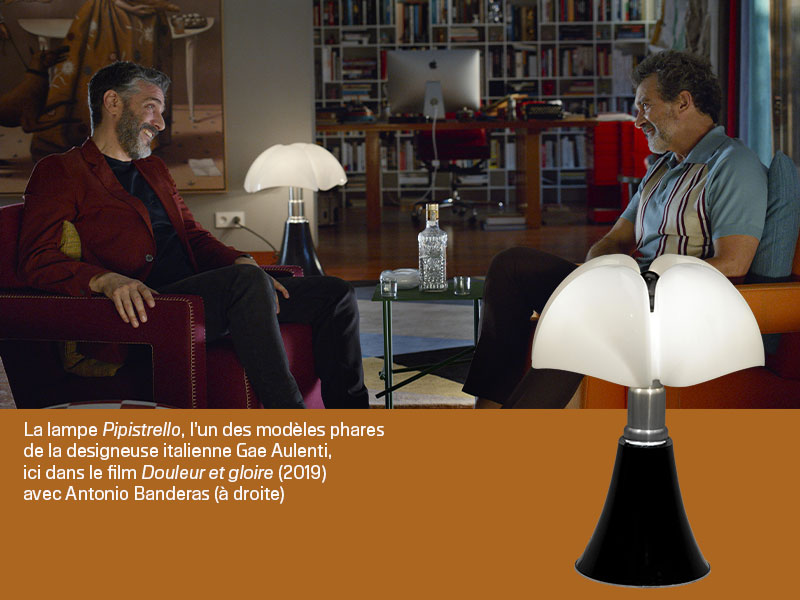
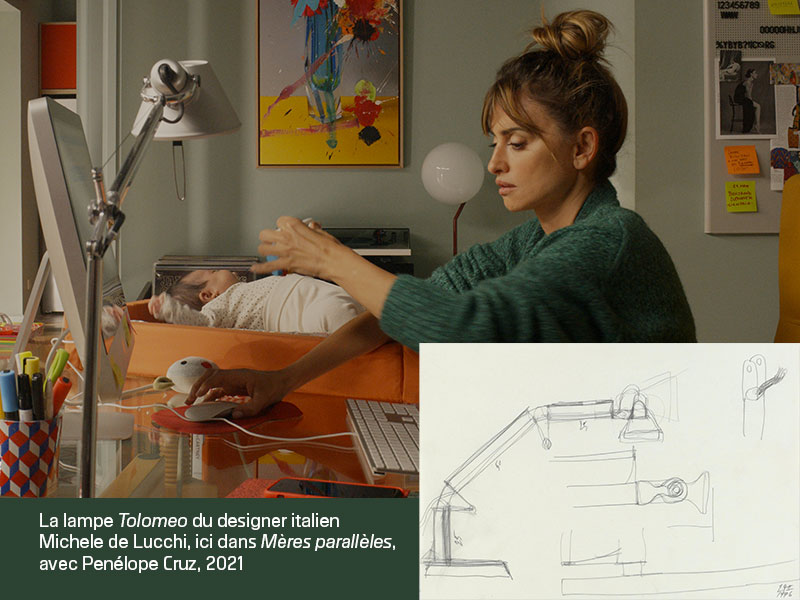
‘I work like a painter, except that instead of painting with colours, I paint with objects,’ Almodóvar has said. In his films, every design piece plays a part in the meticulous composition of the frame. Lamps, in particular, are central to the director’s visual dramaturgy. ‘They’re my weakness,’ laughs Antxón Gómez, who admits to owning close to 1,200 of them. ‘We use them constantly. There are a few that reappear from one film to another: Gae Aulenti’s Pipistrello, Cesta by the Spanish designer Miguel Milá or Michele De Lucchi’s Tolomeo.’
In Almodóvar’s cinema, design objects form part of an instantly recognisable visual language, as vital as the bold colours of the costumes.
These lamps guide the viewer’s eye, create symmetries within the frame, and heighten moments of revelation. In Pain and Glory – whose set recreates a version of Almodóvar’s own Madrid apartment – the nocturnal reunion between Salvador (Antonio Banderas) and his former lover unfolds in the glow of the Pipistrello lamp, whose name, fittingly, means ‘bat’.
The Secret Language of Interiors
‘In Almodóvar’s films, sets are entirely narrative,’ Antxón Gómez continues. ‘They tell the story too. How do our characters inhabit a space? What do they read? What objects surround them? Sometimes there’s a subliminal language at work. In Bitter Christmas, for instance, the protagonist’s headboard is split into two distinct halves, like a divided world.’
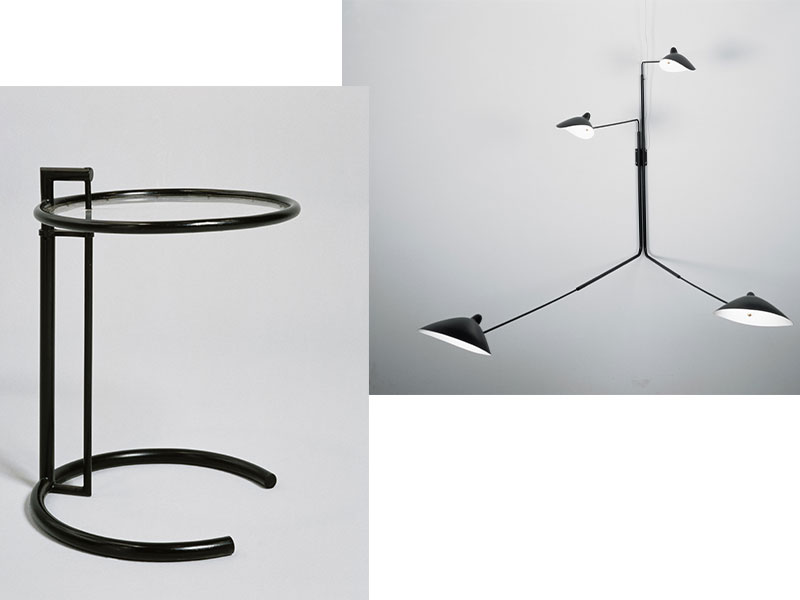
In Parallel Mothers (2021), the Madrid apartment of Janis, played by Penélope Cruz, reveals more about her than dialogue ever could. Together, Almodóvar and Gómez sketch the portrait of a woman deeply attached to history and ancestry. The interiors combine artworks, flea-market finds and objects brought back from travels with iconic design pieces: a Serge Mouille pendant lamp, the Snoopy lamp by Achille and Pier Giacomo Castiglioni, Cesca chairs by Marcel Breuer…
Sets also chart the evolution of the characters themselves. In Julieta (2016), Emma Suárez’s heroine leaves behind a neutral, almost clinical apartment, before returning to the building from her past – and to an interior lined with wallpaper drawn from Antxón Gómez’s own personal collection. As she attempts to reconnect with her daughter, the décor gradually draws her back into her former life.
Sets as a Reflection of Almodóvar Himself
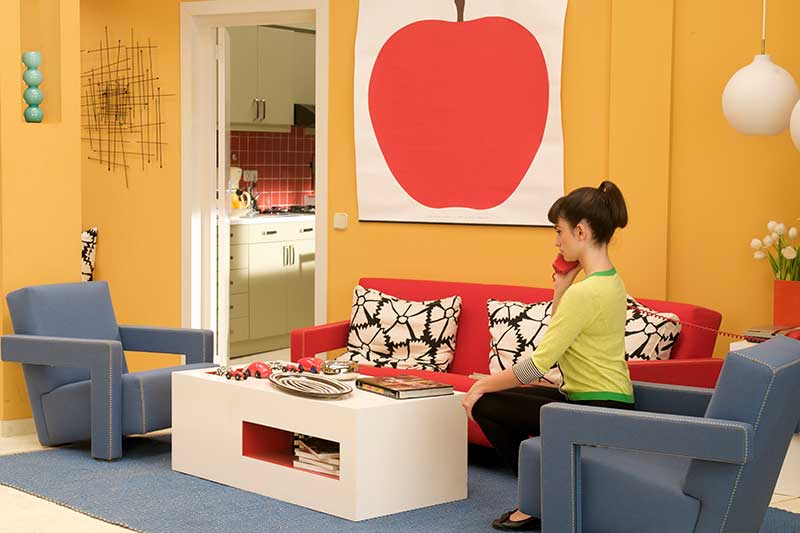
In Almodóvar’s films, objects also embody the filmmaker’s own presence, as he recently told the Spanish press: ‘I often buy a piece of furniture, a lamp or an object I have no immediate use for, simply because I like it and know it will eventually find its way into one of my films.’ Such was the case with La Mela and La Pera by the Italian designer Enzo Mari. Dating from the 1960s, the two posters belong to his Serie della Natura and are striking in their graphic simplicity. ‘Almodóvar saw them in a museum and bought them,’ Gómez explains. ‘They appear in Broken Embraces and later in Pain and Glory.’ He adds: ‘Enzo Mari is a designer we’ve always been drawn to. We even recreated one of his tables for a film.’
I often buy a piece of furniture, a lamp or an object I have no immediate use for, simply because I like it and know it will eventually find its way into one of my films.
Pedro Almodóvar
The sets become even more autobiographical in Pain and Glory. Gómez recalls that from the outset, Almodóvar told him: ‘I wrote this film with my apartment in mind. I’d like us to recreate its layout.’ Salvador’s apartment – Antonio Banderas’s character and Almodóvar’s onscreen alter ego – was therefore closely modelled on the director’s own home, though never conceived as an exact replica. The kitchen, however, was rebuilt identically in the studio, down to the glass partition designed by the contemporary Spanish designer Patricia Urquiola. ‘Urquiola explores ideas of transparency and reflection here,’ notes Marie-Ange Brayer. ‘Her work belongs to the lineage of Italian designers such as Ettore Sottsass and Alessandro Mendini. She experiments with an extraordinary range of materials – the Centre Pompidou has, in fact, acquired several of her textile-based works for its collection.’
Design as Grand Theatre
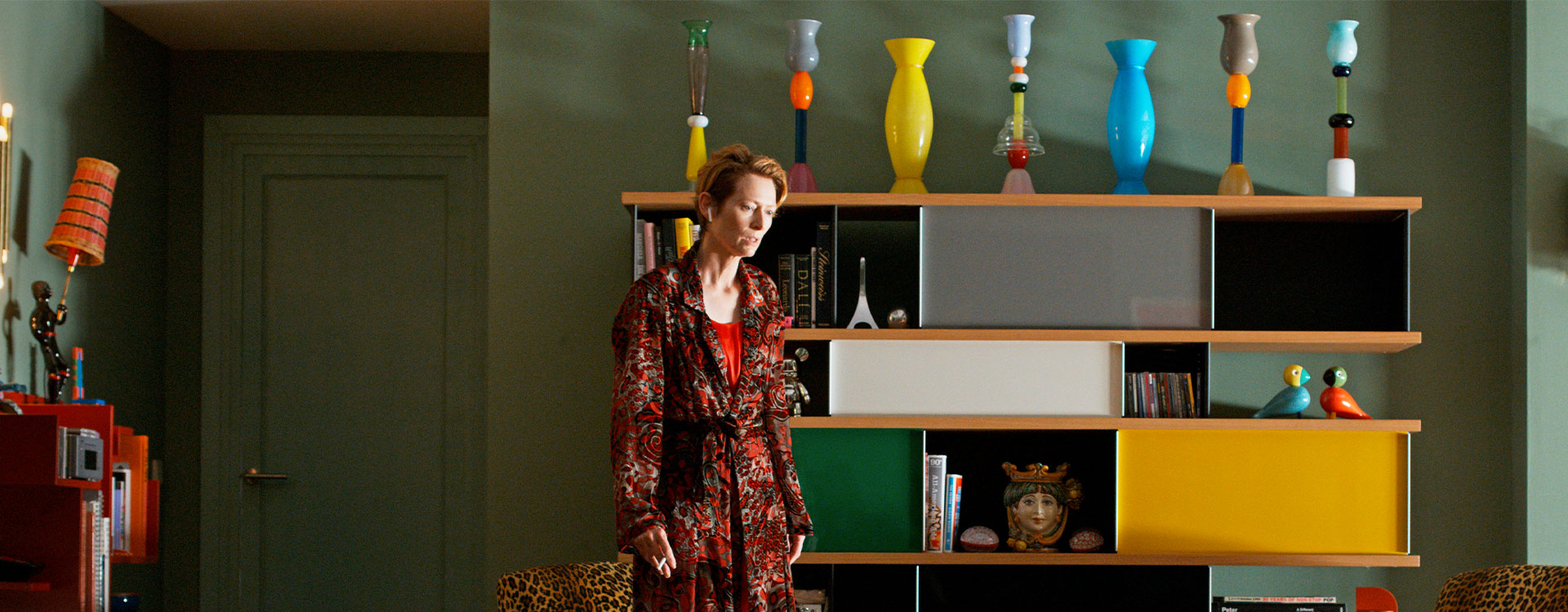
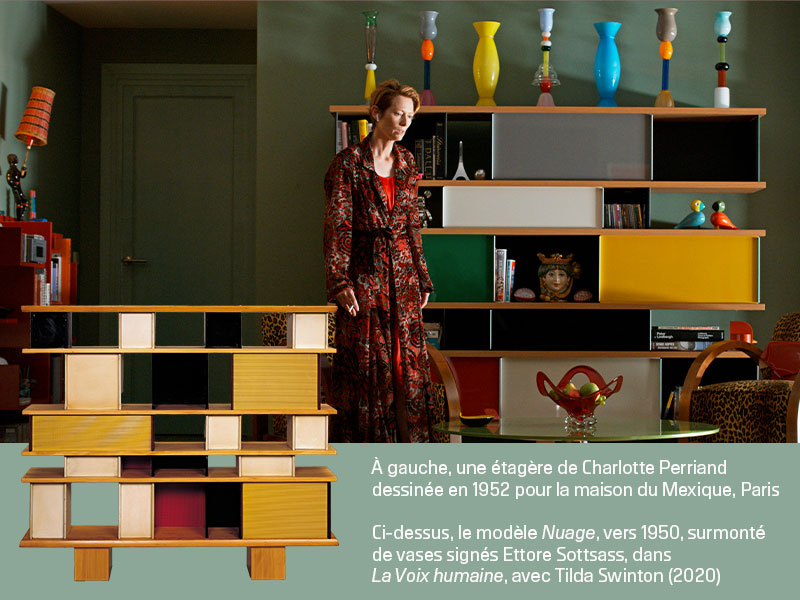
Vivid colours, artworks, expressive costumes — in Almodóvar’s cinema, everything, including the design pieces, belongs to the realm of theatricality. Nowhere is this more explicit than in *The Human Voice* (2020), the director’s freely adapted version of Jean Cocteau’s monologue starring Tilda Swinton. The set is artificial, oversaturated, populated by objects that become true scene partners in their own right.
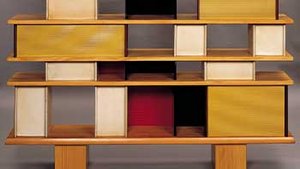
At its centre stands Charlotte Perriand’s *Nuage* bookcase, displaying Almodóvar’s personal collection of Ettore Sottsass vases. “It’s a fascinating shot because it brings together two approaches — Sottsass and Perriand — that don’t usually intersect,” observes Marie-Ange Brayer. “And yet they share the same interest in architecture, colour, and the interplay of solid and void in the structuring of space.”
When Objects Become Magical
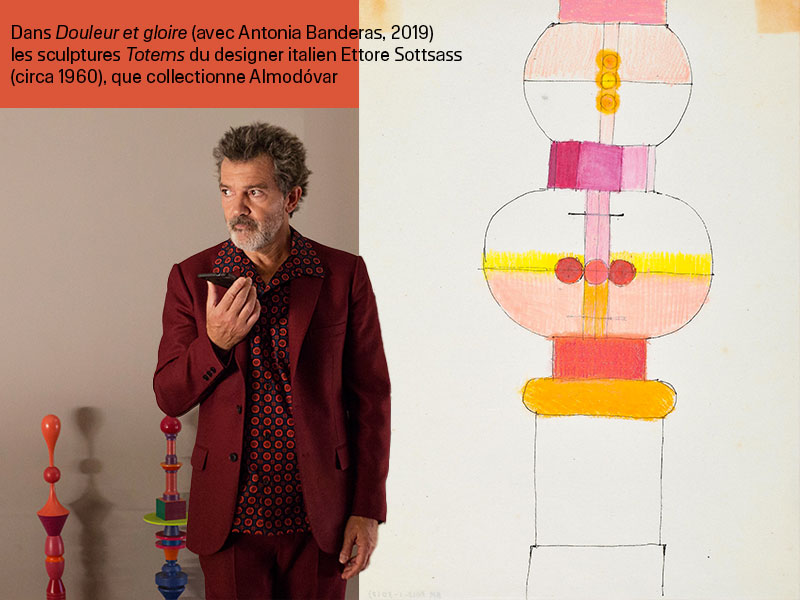
Ettore Sottsass, founder of the Memphis Design Group, is a recurring presence in Almodóvar’s films. In Pain and Glory, his totem sculptures appear throughout Salvador’s apartment, where a monograph on the designer can also be glimpsed on the bookshelves. ‘Pedro is a compulsive buyer – he has an incredible collection of Sottsass pieces,’ Gómez confirms.
With Memphis, Sottsass championed the idea that objects could transcend their function, carry an emotional – almost ritualistic – charge and become something akin to magical objects. ‘Sottsass’s vases are like characters in themselves; there’s something deeply anthropomorphic about them,’ Marie-Ange Brayer explains. ‘Bringing objects to life, allowing them to tell stories of their own, is intrinsic to the Memphis ethos – and it resonates profoundly with Almodóvar’s cinema.’
To revisit Pedro Almodóvar’s films is to travel through a century of design history. But it is also to see how objects can slip beyond the realm of décor and enter the narrative itself. As a child, the filmmaker imagined living inside a furniture store. In the end, he did something better: he gave the furniture a life of its own. ◼
Related articles

In the calendar
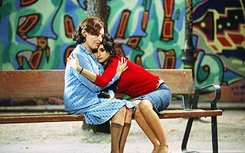
Tilda Swinton in Pedro Almodóvar’s The Human Voice (2020)
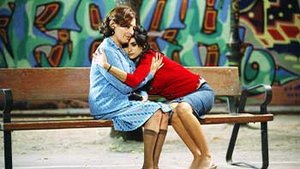
Penélope Cruz in Pedro Almodóvar’s Broken Embraces (2009)
Film stills © El Deseo
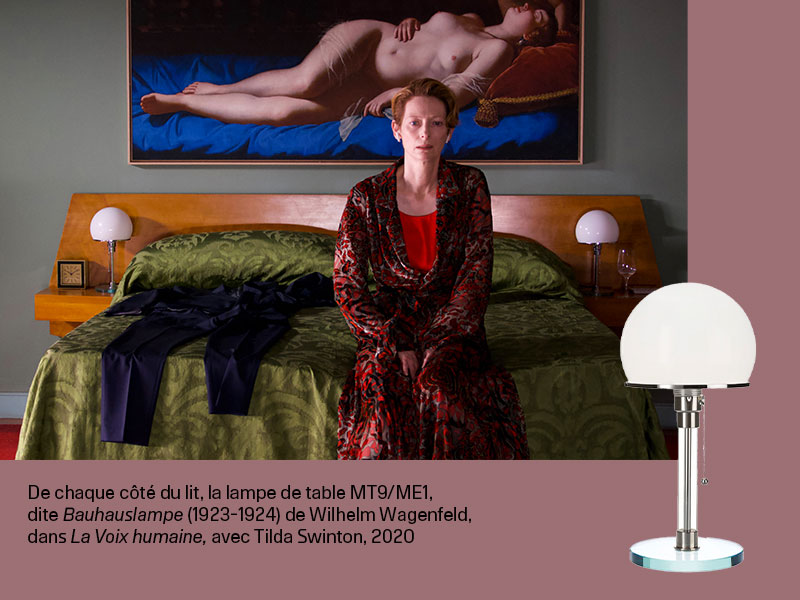
Wilhelm Wagenfeld, MT9/ME1 Table Lamp, known as the Bauhauslampe, 1923–24
Opaline glass globe and glass base, nickel-plated brass structure
Height: 42 cm; diameter: 20 cm; base diameter: 16 cm
Weight: 1.8 kg
© Centre Pompidou, Mnam-Cci / Dist. GrandPalaisRmn
Gae Aulenti, Pipistrello, 1965
Lacquered aluminium base, methacrylate shade
Height: 66 cm; diameter: 55 cm
Base diameter: 30 cm
© Gae Aulenti
© Centre Pompidou, Mnam-Cci / Dist. GrandPalaisRmn
Charlotte Perriand, Bibliothèque de la Maison du Mexique, 1952
Wood, lacquered steel, embossed aluminium
161 × 183 × 30.5 cm
Wooden feet (2): 20 × 20 × 26.7 cm (h × w × d)
© Adagp, Paris
© Centre Pompidou, Mnam-Cci / Dist. GrandPalaisRmn
Michele De Lucchi, Drawing for the Tolomeo Lamp, 1996
Pencil and coloured pencil
19.8 × 29.2 cm
© Michele De Lucchi
© Centre Pompidou, Mnam-Cci / Dist. GrandPalaisRmn
Serge Mouille, Applique, 1953–58
Hammered aluminium
240 × 150 × 30 cm
© Adagp, Paris
© Centre Pompidou, Mnam-Cci / Dist. GrandPalaisRmn