Anthony McCall: When Light Takes Form
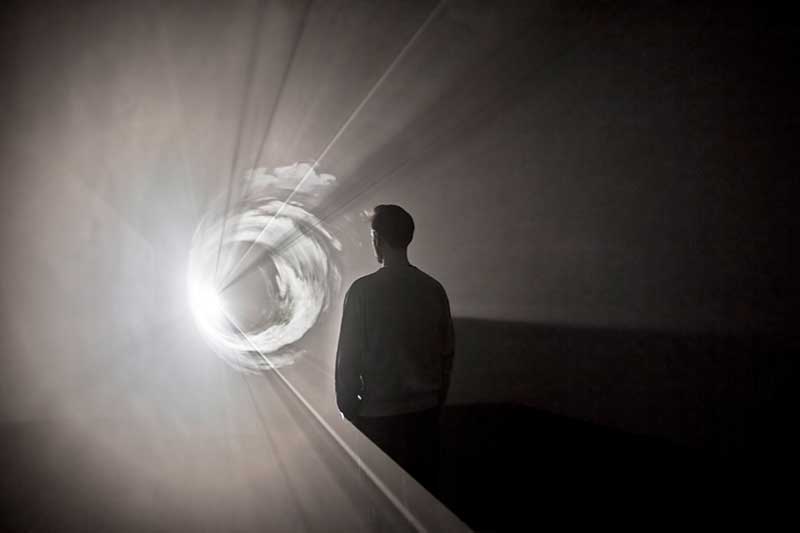
A major figure in contemporary art, Anthony McCall occupies a territory all his own, at the intersection of experimental cinema, minimalist sculpture and installation. Born in England in 1946 and based in New York from the early 1970s, he developed a radical practice that profoundly reshaped our relationship to cinema. Where the traditional cinematic apparatus relies on the illusion of fictive depth, McCall replaces it with a real projective space: the event no longer takes place within the projected image, but within the projection itself.
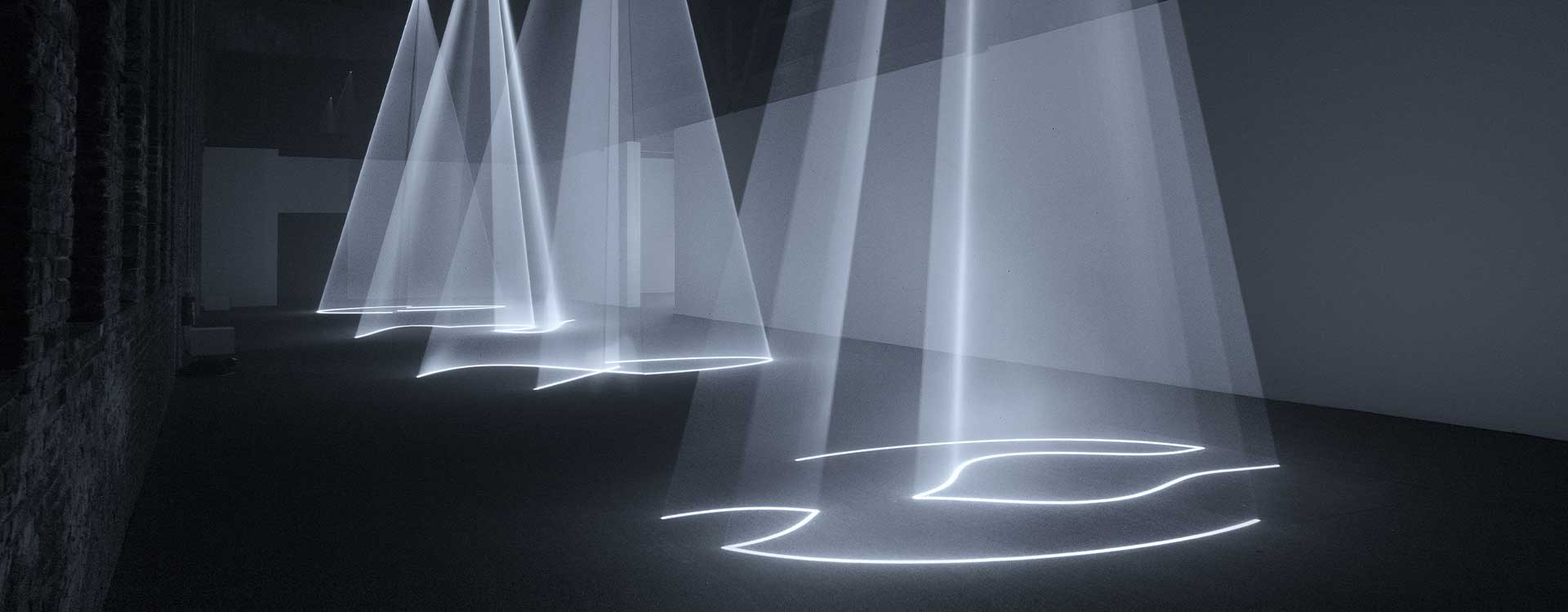
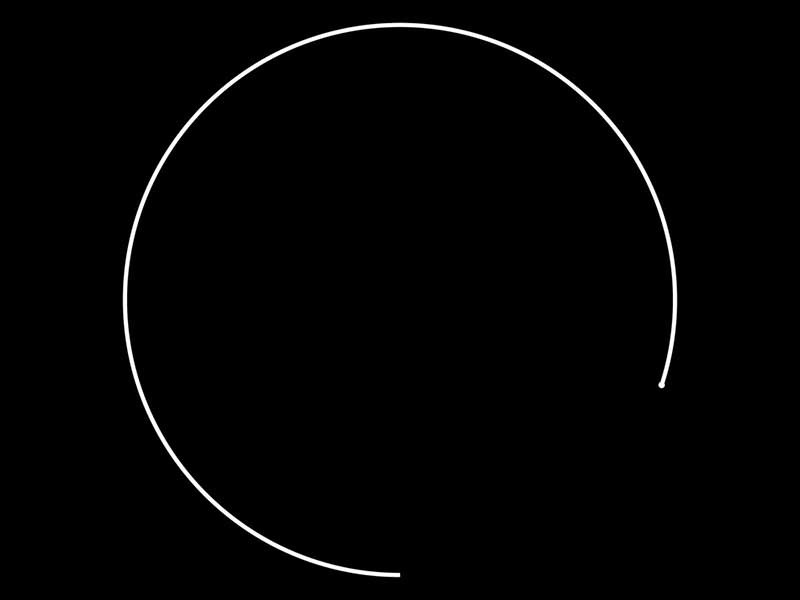
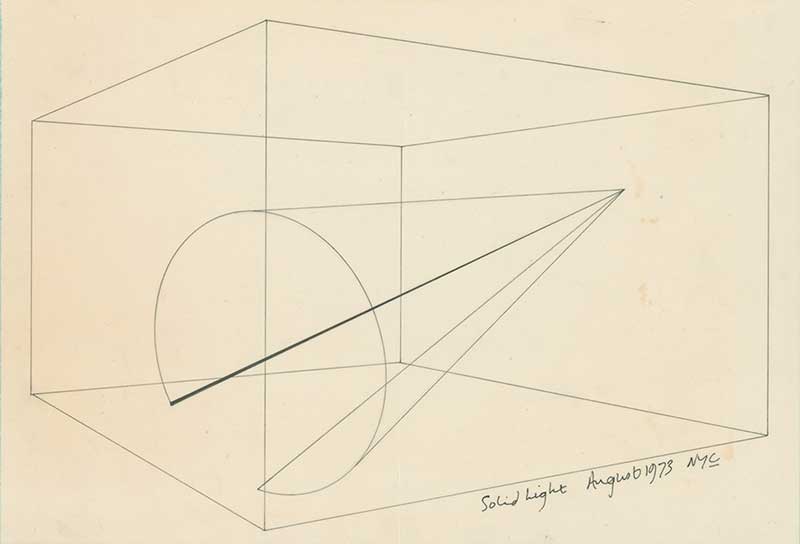
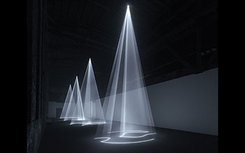
This foundational break took form as early as 1973 with Line Describing a Cone, an iconic work now held in the Centre Pompidou collection. Using a simple circular line projected into a smoke-filled room, McCall brings a tangible volume of light into view: a cone of light that slowly unfolds in space and time. The beam becomes matter; light becomes sculpture.
This ‘solid light film’, in the artist’s own words, marked a decisive turning point: representation broke free of the frame, and space itself became the site of the work. The methods McCall used at the time were deliberately rudimentary: gouache drawings on black paper, photographed frame by frame onto 16 mm film. Made visible by smoke, the luminous volume evolves almost imperceptibly, revealing a shifting geometry in constant transformation. Projection is no longer a medium of support, but a performance, endlessly renewed.
Anthony McCall’s approach is firmly rooted in the legacy of the neo-avant-gardes of the 1960s and 1970s, from structural film and happenings to intermediality and the dematerialisation of art. McCall conceives the work as a shared situation, a common present in which the viewer does not merely look, but coexists with form. Light becomes an autonomous medium, a field of experience where space, time and perception converge.
McCall conceives the work as a shared situation, a common present in which the viewer does not merely look, but coexists with form. Light becomes an autonomous medium, a field of experience where space, time and perception converge.
Here, stillness is not required. Visitors are invited to move, to interact with the beams and to observe the forms unfolding from different angles. The body becomes an instrument of perception. Each movement alters the relationship to the work; each human presence inflects the experience.
The power of McCall’s work lies in this subtle tension between immateriality and physical sensation. Although light cannot be grasped, it has density; it feels almost palpable. In contact with air, dust or smoke, it reveals its plasticity. Each installation strikes a fragile balance between technical control and unpredictability, between formal rigour and apparition. Nothing is ever entirely the same: the work lives, reconfigures itself and reinvents itself with each projection.
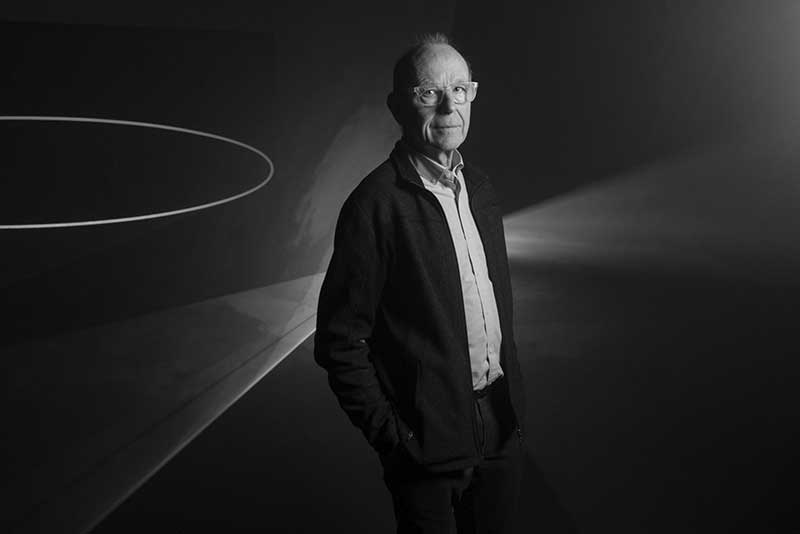
Jonathan Pouthier — With your work Line Describing a Cone, made in 1973, you redefined our relationship to cinema by shifting our attention from the screen to the beam of light itself. Nearly fifty years later, how does that initial investigation continue to resonate in your work?
Anthony McCall — Transforming light into a sculptural volume still fascinates me, as I continue to find new ways to develop the original idea. With Line Describing a Cone, I was trying to answer the following question: how do you transform cinema into something that unfolds in a continuous present, shared with the audience? Later, I realised that the finished film raised questions worth pursuing, around the notions of ‘performance’ and ‘sculpture’. It is this dynamic – where each new work unexpectedly generates new questions – that still drives my practice today. In recent years, it has even led me to develop a series using mirrors and a sound series, while retaining ‘solid light’ as the central aesthetic principle.
Could one say that your works, unlike narrative cinema, actively engage the entire body? How do you conceive of this physical dimension of your work, and the role of the audience participating in these installations?
AMC — Narrative cinema invites the audience to discover an imaginary ‘elsewhere’: a moment fixed in the past, a distant place. My ‘solid light’ films offer a sensuous interaction with real sculptural forms, where the act of looking (the path, the duration and the positioning of the gaze) belongs entirely to the viewer. There is also a question of scale: the flat, diaphanous forms of light have dimensions that exist within real space, and are shaped by the dimensions of the human body.
Your early ‘solid light’ films used a horizontal projection system, close to the conventional cinematic apparatus. Since 2003, you have been developing vertical works in which the projector, fixed to the ceiling, creates cones of light descending towards the floor. Why this reversal?
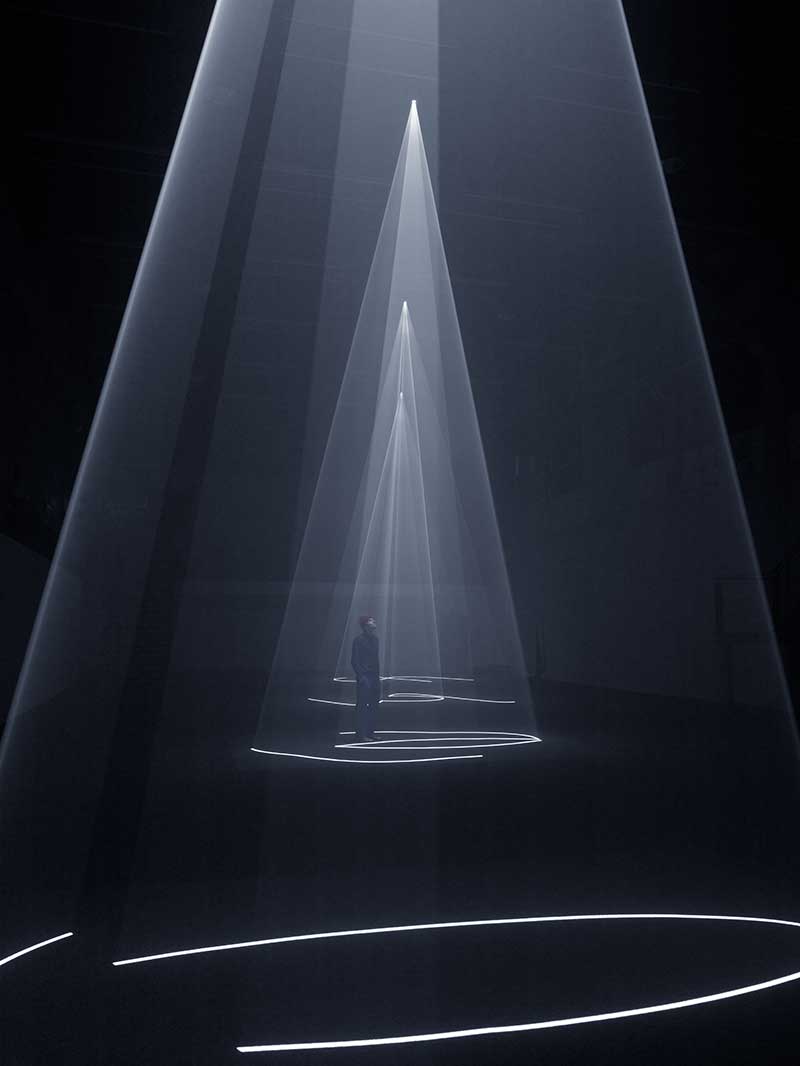
AMC — This shift came from a desire both to explore other spatial and perceptual possibilities, and to move away from the cinematic frame. There is no question that the vertical works distance themselves further from cinema, and perhaps even carry a reference to architecture. What interests me in this change of orientation is that the physical scale remains the same: a projection of around 9 metres connecting the lens and the image, and an image projected onto the wall or floor of approximately 4.3 metres wide. But as forms to explore, the horizontal and vertical versions could not be more different: whereas one is close and enveloping, the other is distant and rises above our heads. It is also worth noting that vertical projection only became feasible with the advent of digital projectors. Even though I had envisioned verticality years earlier, I came to realise that mounting a 16 mm projector with two reels running to the ceiling, at a height of 10 metres, was simply not possible.
This project with Ircam establishes a dialogue between your work and that of other artists, such as the composer Morton Feldman, whose pieces seem to share with yours a minimalist and sculptural aesthetic. To what extent has music influenced your work?
AMC — As a young artist in the 1970s, I was of course drawn to new work across artistic disciplines: music, dance, theatre, but also events and happenings… Crucial and deeply conceptual discussions revolved around music. I was particularly fond of John Cage’s work, and had the opportunity to attend the performance of HPSCHD in London in 1972, which was a genuine source of inspiration – particularly in the way it inhabited space, and the central place given to the audience, who were in constant movement. I was also drawn to composers of my own generation, such as Steve Reich, La Monte Young, Alvin Lucier and Stockhausen… At that time, I was living in London with Carolee Schneemann, until we moved to New York in 1973.
You have also created sound installations, such as Traveling Wave (1972), presented at KANAL–Centre Pompidou in Brussels in 2018. How does this work fit into your broader thinking, and what was your experience of working with sound?
AMC — Traveling Wave was one of my earliest works. What interested me was the idea of using white noise to draw three-dimensional sound volumes moving through space. It was around that time that I began exploring the concept of ‘solid light’, in which projected light serves to define volumes suspended in space. Between 1972 and 1974, I was also producing pyrotechnic performances organised around a grid system, directly within the landscape. I did not return to sound until 2009, with Leaving (with two-minute silence), a horizontal work with two projectors, made in collaboration with David Grubbs. I returned to it again in 2013, with a digital remake of White Noise Installation (1972), which I renamed Traveling Wave (a new version of the 1972 original). Sound, light, fire: three immaterial mediums that exist in time.
For the Nuit Blanche 2026 in Paris, you will be presenting Skylight, a ‘solid light’ piece accompanied by a sound work by David Grubbs evoking a storm. Can you tell us about the genesis of this work, and how the collaboration unfolded?
AMC — Skylight evokes an imaginary storm, emanating from a solid, vertical cone of light. It is part of a body of work I have been developing since 2020, exploring the possible interactions between sound, silence and visual form. I presented the finished visual work to composer David Grubbs, asking for his help in creating the impression of a storm. We worked in stages, in constant dialogue. David brilliantly captured the sensation of the storm drawing closer, then receding. The last element we added was rain. As for lightning, it manifests in a way I particularly appreciate: through flashes of light that, for a fraction of a second, illuminate not only the localised volume of the cone, but the entire installation space.
This project with Ircam also includes a concert featuring three artists – Kali Malone, Stephen O’Malley and Lucy Railton – who will perform in dialogue with your works. What do you expect from this encounter, where music and light coexist simultaneously?
AMC — Being an admirer of their work, I am very much looking forward to their performance. I love the idea that they will perform not on my works, but alongside them; a very interesting concept. Perhaps the best way to answer this question is to describe the approach David Grubbs took for my Solid Light Works installation at Pioneer Works in Brooklyn in 2018. By naming the musical performances staged during the installation Four Simultaneous Soloists, he chose to treat the projections as fully autonomous works, ordinarily presented in silence. They required no musical accompaniment, though the presence of music created a new artistic opportunity. A few simple compositional rules governed the improvisation: each performer was to play for half the duration of the performance and listen for the other half, and the performance was to unfold organically as a series of solos, duets, trios and a quartet, with no further predetermined structure. The performers remained stationary, while the audience was free to move through the space. The result: each of the four evenings of musical performance constituted a unique and complete concert in its own right: the product of an encounter between two art forms, blending and separating. ◼
Related articles
In the calendar
Anthony McCall, Line Describing a Cone, 1973
16 mm black-and-white film, silent, 30 min.
© Centre Pompidou, Mnam-Cci / Dist. GrandPalaisRmn
Anthony McCall, Solid Light, 1973
Installation drawing for Line Describing a Cone
Ink on paper
© Anthony McCall
Courtesy of the artist and Sprüth Magers
Anthony McCall, installation view, Pioneer Works, Brooklyn, New York, 2018
Photo © Dan Bradica
Image Pioneer Works