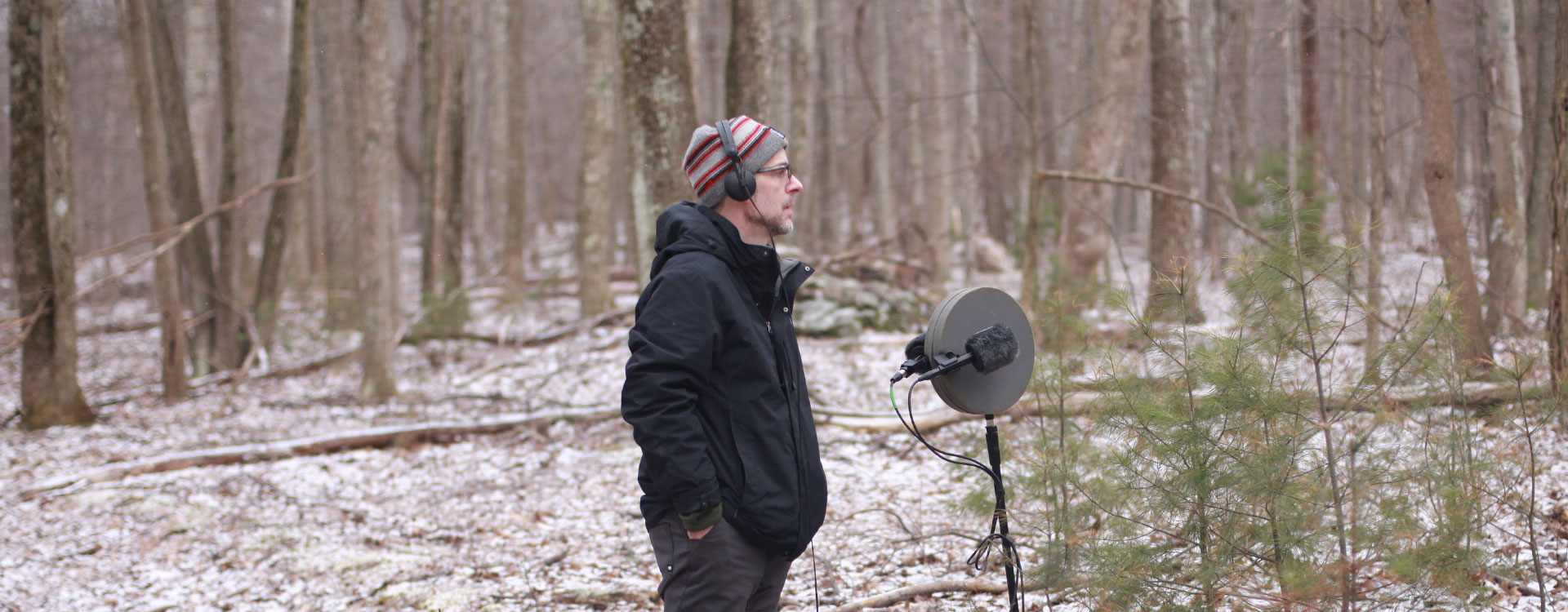
Stephen Vitiello, the Sound Artist Listening to Skyscrapers
Since the early 1990s, artist Stephen Vitiello has developed a practice at the intersection of composition, installation and site-specific recording, centred on the material and perceptual conditions of sound. Initially trained in film and then in experimental music, his work operates across disciplines, as well as through the use of specific recording devices – home-built contact microphones, sensors and electronic systems. His residency at the World Trade Center in 1999 marked a decisive moment: by recording the building’s vibrations, he shifted attention away from the sonic landscape towards infra-perceptual phenomena, revealing dimensions that are normally inaccessible to hearing.
Vitiello explores the thresholds of listening, rendering perceptible sonic phenomena situated at the very edge of audibility.
Building on these experiences, Vitiello explores the thresholds of listening, rendering perceptible sonic phenomena situated at the very edge of audibility. By employing specific recording and broadcasting devices, he redefines listening as an active practice involving both the body and space. His work situates acoustic experience within a close relationship between physical phenomena, technologies and perceptual attention.
This interview revisits the key stages of his trajectory, from his earliest experiments to his more recent projects, examining the transformations of his practice and the aesthetic, technical and perceptual issues that run through it.
Nicolas Ballet – Your compositions invite the listener to hear differently, to engage with sound and the space from which it emerges. How did this attention to situated listening develop within your practice, especially in its early stages?
Stephen Vitiello – A lot of my development came from collaborations with artists more advanced than myself as well as curatorial opportunities. Growing up, listening to music was so important to me. Thinking back, I feel like I was drawn more to the sound of certain records, where friends may have been listening to the same records but drawn to lyrics or musicianship. Just as an example, Marquee Moon (1977) by Television had a distinct sound and texture that I was drawn to. In later years, I was listening to the same album, noting the great intricate interplay of guitars, but that focus on the melody and craft wasn’t my immediate connection. I feel the same about albums by The Clash and more.
A lot of my development came from collaborations with artists more advanced than myself as well as curatorial opportunities.
Stephen Vitiello
In 1989, the artist Tony Oursler asked me to create the soundtrack for a multi-screen, multi-object installation for a festival in The Hague. It was the first time I worked spatially and it was one of my first soundtracks. He encouraged me to make different pieces for different parts of the room and to have varying lengths, avoiding any synchronisation. I’m pretty sure he mentioned the way the loops revolve in Brian Eno’s Music for Airports (1978) as a reference.
Many years later, it was meeting and playing with Pauline Oliveros, and being encouraged to listen and feel sound in the moment, that led to learning to improvise. I met and played with Pauline at the same time that I met Robin Rimbaud (Scanner), Frances-Marie Uitti and Anthony Moore (1998 in Cologne, Germany, at the KHM). Soon after, Chrissie Iles at the Whitney Museum of American Art gave me the opportunity to help organise the sound programme for the exhibition “The American Century: Art & Culture Part II, 1950–2000” (1999–2000), and I had to do a lot of catching up, learning about and listening to historic milestones in sound art and experimental music. With that show, the focus was from an American perspective, but I was also starting to read about and experience the histories of musique concrète as well as Stockhausen, Japanese composers and artists, while still being drawn back to John Cage, Fluxus and what was happening in the moment with early laptop music and more.
Collaborating on soundtracks for video makers, filmmakers and choreographers continued (and still continues) to teach me a lot. Especially in the early days, I was attentive to how a filmmaker like Jem Cohen used his camera to collect images and then to construct a work in the editing process. I found myself looking for a sympathetic sonic approach, not to illustrate, just to find a way to produce or collect sounds and bring them together in the studio, aiming for my own rhythms and textures that could share the space of the other person’s images.
Collaborating on soundtracks for video makers, filmmakers and choreographers continued (and still continues) to teach me a lot.
Stephen Vitiello
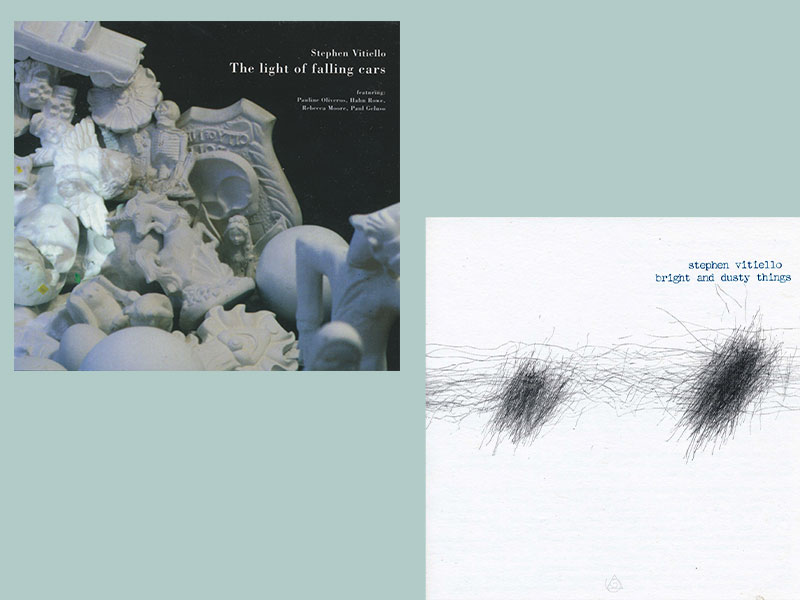
My first solo installation was a four-channel piece included in Musiques en Scène at the Museum of Contemporary Art in Lyon in 1998. My first CD that wasn’t self-released was The Light of Falling Cars (1998), and then I feel like Bright and Dusty Things (2001) was a real development compositionally and conceptually. Pauline played on both of those records. Really, any time I asked, she was there, which is such a gift to a younger developing musician/artist.
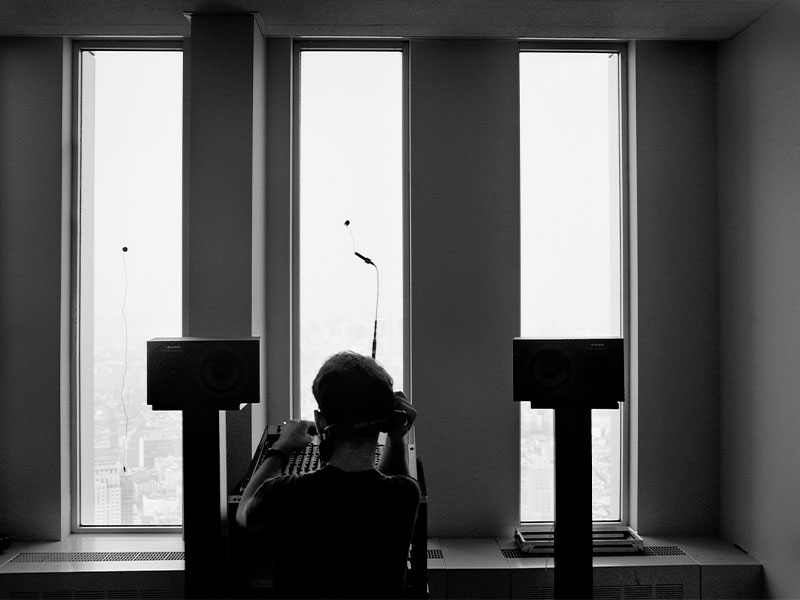
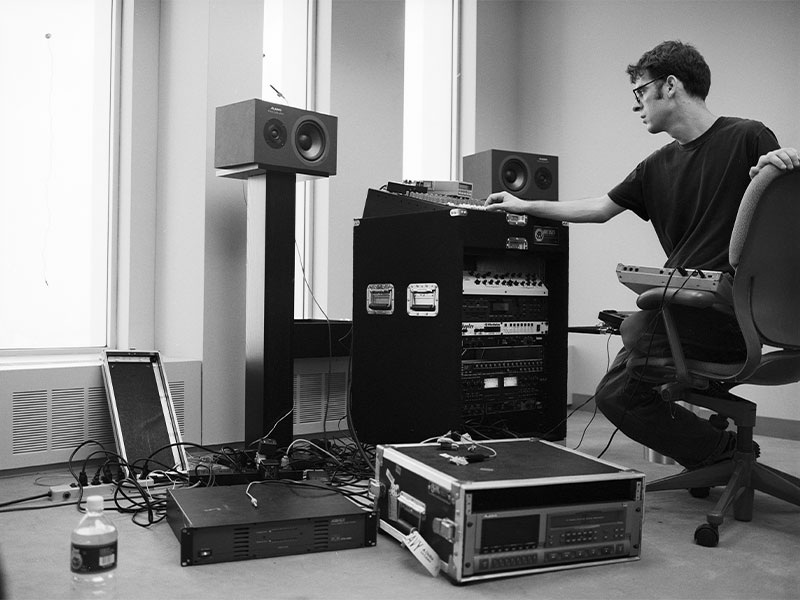
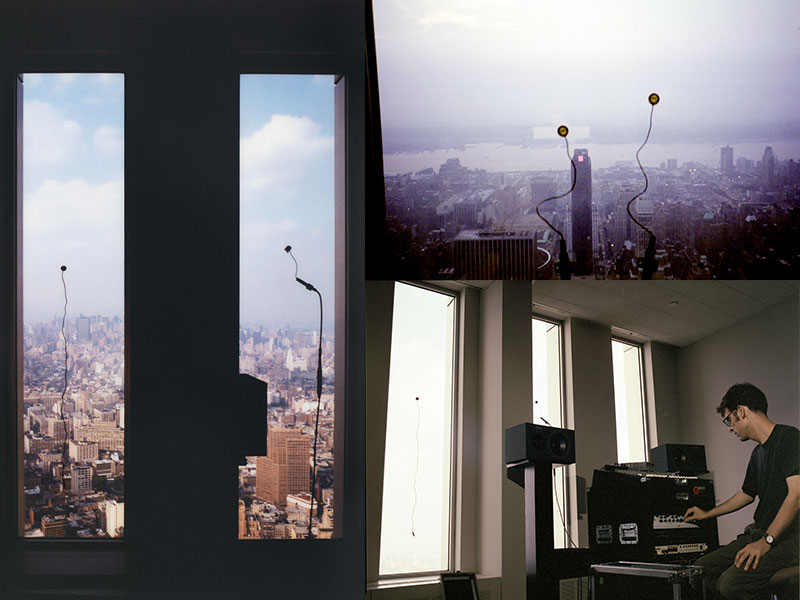
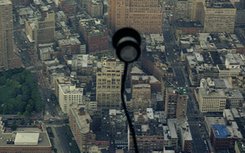
In 1999, you undertook a six-month residency on the 91st floor of the World Trade Center, where you recorded the creaks and oscillations of the building’s very structure using contact microphones and photocells that you had built yourself. With hindsight, and considering the now highly charged history of this site, how do you perceive this work today, its conditions of production and its different versions, and how did this experience transform the way you experiment with sound?
Stephen Vitiello – The WorldViews Residency was transformative for me, even before the towers fell. It’s the first time I had a studio; it was really a period where I was connecting to site-specific work under my own identity (rather than as a collaborator). It’s where I became acutely aware of how much power sound has to change one’s perception of space and of vision. When the towers fell, the associations of course changed. It became seen as a kind of historic record – a sound that would not be heard again.
The WorldViews Residency was transformative for me, even before the towers fell. It’s the first time I had a studio; it was really a period where I was connecting to site-specific work under my own identity.
Stephen Vitiello
I have always tried to be careful with the work in relation to 9/11. I did hear airplanes and helicopters passing. I did feel the building moving and have a sense of vulnerability through hearing through the glass and steel. On the other hand, I wasn’t consciously pointed towards danger, where an artist such as Michael Richards did make work that might fall into that framing only a few years later.
In your work, you pay particular attention to respecting sonic material, sometimes to the point of not adding any intervention. How did this ethical relationship to sound develop and how does it influence your work today?
Stephen Vitiello – When I started the World Trade Center residency, I had the idea to mix those sounds with electronics, but the more I listened, the more I felt that the filters and the rest were detracting from the raw sound. So, it became more a matter of framing what were really field recordings, choosing a beginning and end and, in some cases, spatialising for 5.1. The sounds themselves were so strong. I came to understand that I couldn’t improve them.
The WTC Recordings brought me to the attention of Paul Virilio and the Cartier Foundation. After being in a show there curated by Virilio (which in the end was a photocell work, not WTC), they invited me to be in the next show focused on travel to the Brazilian Amazon, and to stay among a Yanomami tribe for about eight days. With those sounds too, it felt disrespectful to manipulate the recordings beyond edits and possibly a bit of layering. I was taking note of the sounds themselves while also reading statements from Chris Watson and others who were critical of mixing field recordings with music.
I’ll say that, on certain projects, I’ve broken that rule. In one case I’m still fond of, Taylor Deupree and I were at the Rauschenberg Residency in Captiva, Florida. We recorded guitars and synths while keeping the windows open so that the osprey and other birds could be heard in real time as we played and as we listened. There was also a hydrophone going out the window and down into the water, which also came into the mix. That spot sometimes had dolphins, sometimes had manatees in the water. I don’t really know what came up through the hydrophone beyond the sound of water and the microphone cable knocking against the dock.
Your career spans cinema, experimental music and visual arts. You have collaborated with many artists working across these fields – including Lawrence English, Tony Oursler, Pauline Oliveros, Nam June Paik and Robin Rimbaud. You were also trained in film before turning towards sound. To what extent has this interplay between image and sound influenced your approach to sound experimentation?
Stephen Vitiello – Collaboration brings the opportunity to put something out and to respond. With visual work, the other artist generally has a theme in mind, some images, perhaps an edit with a kind of rhythm, an aesthetic. With the best film, video and dance projects, I’ve been part of the projects from early on, so I could develop my part as the other was working and also listening to what I was coming up with (rather than me coming in at the end to a finished edit, for example). I never want to copy or illustrate the other’s contribution, but to find my own sonic response and find the spaces that the sound can inhabit.
Nam June Paik taught me by example, just to be around him, to watch him edit in a very musical fashion, watch him spontaneously pull together materials and ideas for a performance…
Stephen Vitiello
Similarly, playing with Robin or Pauline or Lawrence, there’s a give and take. One of us starts, the other responds, we weave in and out of a shared space. With Nam June Paik, it’s a bit different, as sometimes I was shooting or editing for him, sometimes doing research. Still, he taught me by example, just to be around him, to watch him edit in a very musical fashion, watch him spontaneously pull together materials and ideas for a performance… he credited me on some projects like the big atrium installation at the Guggenheim, sometimes he didn’t.
He was a mentor in many ways, as was Pauline. Just to be around such people has been such a privilege, and each was very generous in their own way.
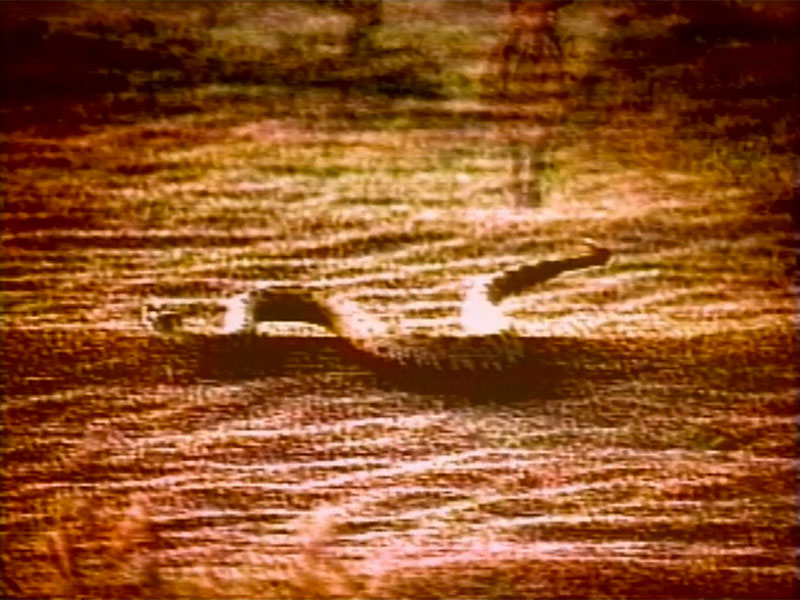
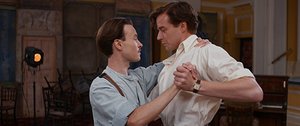
You have also worked with the artist Eder Santos to design the sound for some of his videos, including Janaúba (1993), which is part of the Centre Pompidou collection. Could you tell us more about this specific collaboration?
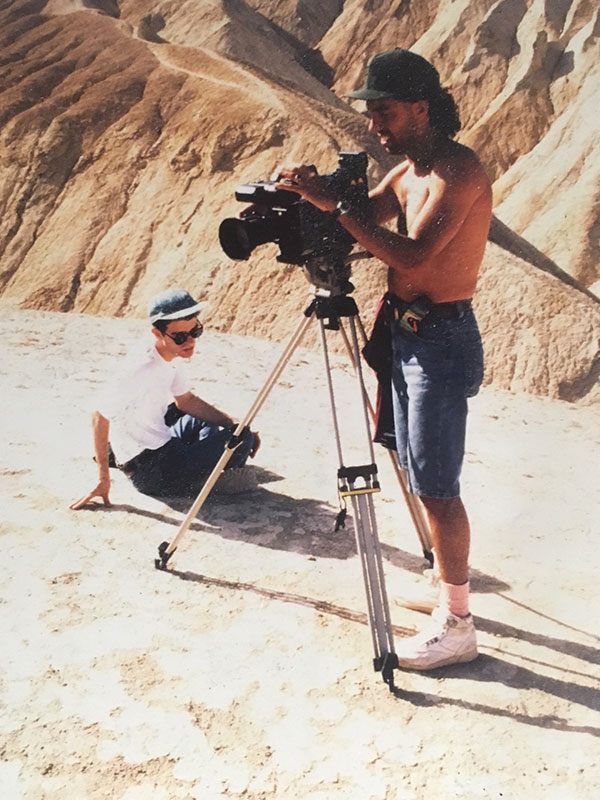
Stephen Vitiello – I first met Eder in the late 1980s. The artist Joan Logue invited him to New York. I ended up working on many of his projects. We went to Death Valley, California, in the early 1990s. Eder was shooting images for an installation but also gathered some footage that went into Janaúba. Other images from that work were shot in Brazil.
I created the foundation for the music and recorded it live with a group of other excellent musicians in a performance on the roof of the Dia Center for the Arts (now Dia Art Foundation), with images projected onto a screen just in front of the Dan Graham sculpture. The volume swells are me on guitar. The atmospheric sounds are primarily Knox Chandler (a session musician who played with the Psychedelic Furs and others) on cello. We were performing to a live audience under a full moon and it was a special energy. There were also films and videos by Jem Cohen and Adam Cohen.
Could you elaborate on your relationship to image through projects such as Sounds Found (onestar press, 2003)? This book compiles excerpts from press articles that refer to sounds. How does this type of work fit into your reflection on listening and its mediations?
Stephen Vitiello – I have a memory that I ordered a Max Neuhaus book from the nice people who run onestar press in Paris. They wrote back and said they were fans of my work and asked whether I would consider making something for them. I’ve always been deeply influenced by literature and, in that case, just wanted to collect bits of language, mostly from The New York Times as well as other sources, that described sounds (generally staying away from descriptions of music).
At the time, I was living just outside New York City, so I’d rip parts of the paper out as I was on the commuter train, put them in my bag or pocket and collect all these fragments that I thought made a kind of collage about sound in the end.
In the current context, marked by a high density of sonic flows and increasingly individualised listening devices, your work seems to offer another mode of attention. Would you say that your practice engages a form of existential, or even political, gesture, particularly in the way it reconfigures our relationship to the environment and the conditions of perception?
Stephen Vitiello – I would love to think that’s true. I don’t know that I’d ever say that about my intentions, but it’s more a pleasure if it is in the results for some listeners. I’m in no way alone in this path or history of encouraging others to listen to the beauty and power of everyday sounds, sounds from nature, alternative ways of playing and listening to instruments, but I’ll say I’m proud to be following this path that traces back to John Cage, Pierre Schaeffer and hundreds of others I have learned from and admired.
I’ve been teaching for 22 years. The most important thing I do – and many of my students think of themselves as visual artists – is to encourage them to listen and to take note of the ways that sound can help shape their experiences of the world, but also their approaches to art-making. ◼
Related articles
In the calendar
World Trade Center studio, 1999
Photo © Johnna MacArthur
Stephen Vitiello, World Trade Center Recordings: Winds After Hurricane Floyd, 1999-2002
Photo © Johnna MacArthur
Stephen Vitiello, Empire State Building, 2001, microphones de contact installés sur les fenêtres du 82e étage de l’Empire State Building
Stephen Vitiello, The Light of Falling Cars, 1998, JDK Productions, couverture de l’album
Stephen Vitiello, Bright and Dusty Things, 2001, New Albion, couverture de l’album
Stephen Vitiello et Eder Santos, vers 1991
Photo © Bob Kaputof
Eder Santos (réal.), Stephen Vitiello (musique), "Janaúba", 1993, vidéo, son, couleur
© Centre Pompidou.
© Stephen Vitiello