Focus on... « Macaroni Dress » by Yayoi Kusama
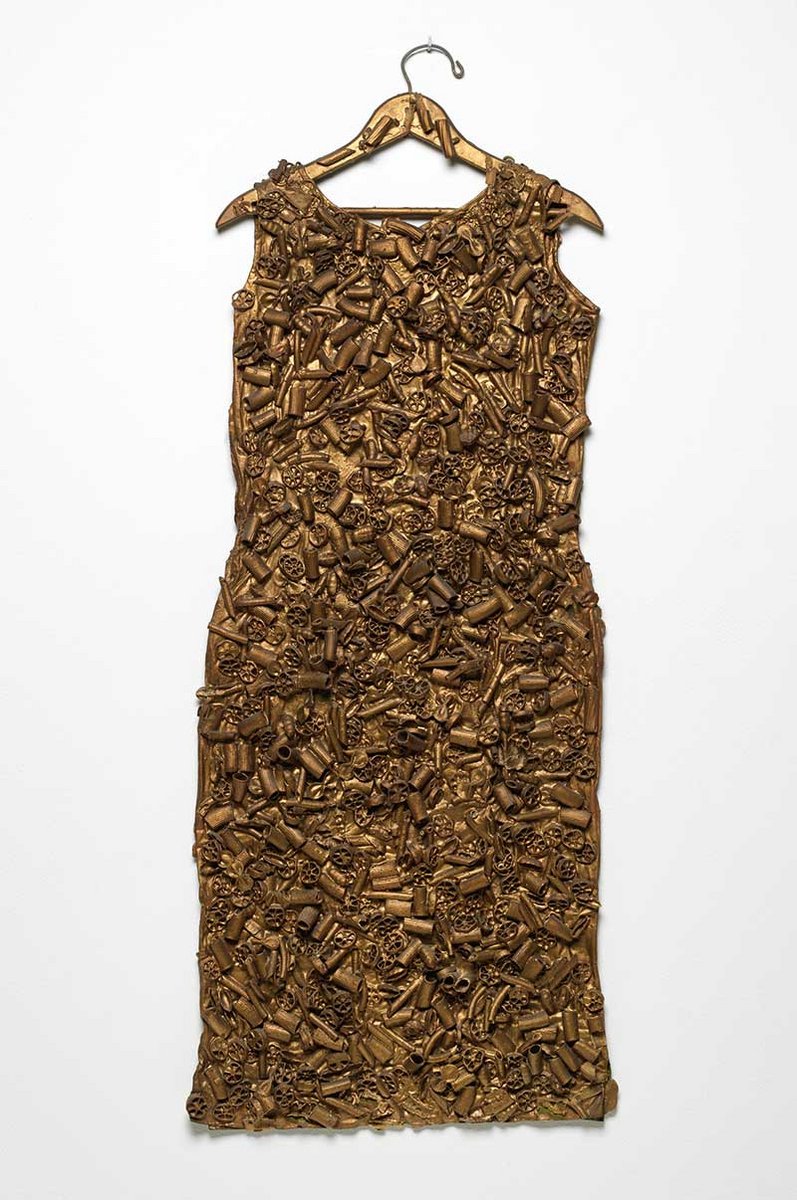
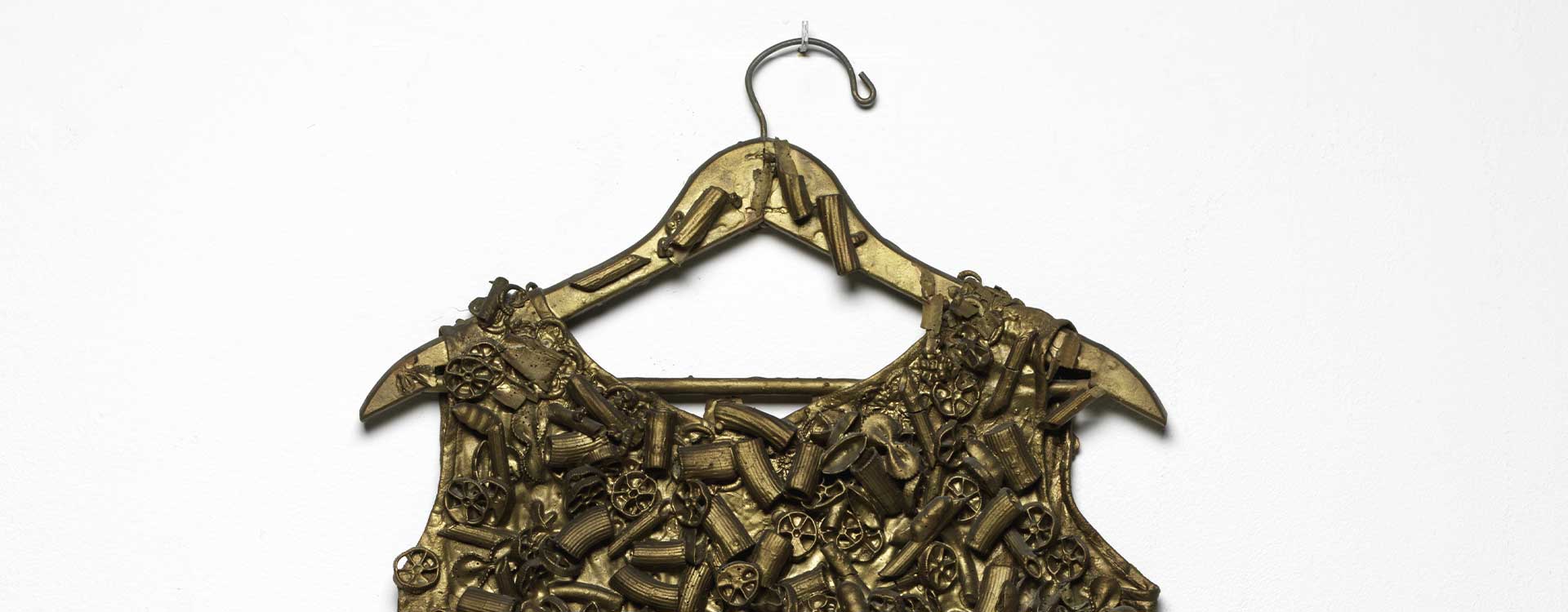
Suspended from a simple wooden hanger is a dress. Its cut is plain, almost ordinary, yet its fabric is all but concealed beneath an incongruous profusion of pasta: macaroni, tubes, and other familiar shapes, painted a golden bronze and glued across its surface. Together, they form a second skin, at once seductive and faintly repellent. Created in 1964, Macaroni Dress transforms a garment designed to clothe the body into a strange object, engulfed by a material that seems to multiply endlessly. Acquired by the Musée national d’art moderne in 2023 as part of the Jean Chatelus collection, donated by the Fondation Antoine de Galbert, the work dates from a pivotal moment in Yayoi Kusama’s career.
Created in 1964, Macaroni Dress transforms a garment designed to clothe the body into a strange object, engulfed by a material that seems to multiply endlessly.
Having settled in New York in 1958, the Japanese artist was searching for a visual language that would set her apart from the Abstract Expressionism then dominating the art scene. She painted vast Infinity Nets, their surfaces covered in intricate networks of repeated motifs, while also turning her attention to the most ordinary objects. In the early 1960s came her “obsessional objects”: armchairs, shoes, clothes and boats smothered in stuffed fabric phallic forms or, as in her Food Obsessions of 1963–1966, pasta. Sexuality, food, the domestic sphere: Kusama subjected them all to the same relentless process of accumulation, repeating a single form until the familiar became strange.
With Macaroni Dress, this proliferation symbolically reaches the body itself. The dress might be wearable, were it not for the accumulation that renders it impractical. Here, a domestic object and an everyday foodstuff merge into something almost organic. This unsettling metamorphosis already points to one of the central principles of Kusama’s work: the dissolution, through repetition, of the boundaries between the self and the world. The pasta of 1964 is not so far removed from the polka dots that would later spread across bodies, walls and landscapes, or from the multiplying reflections of her Infinity Mirror Rooms. Kusama would give this disappearance of the self, through the endless multiplication of a motif, a name: “self-obliteration”.
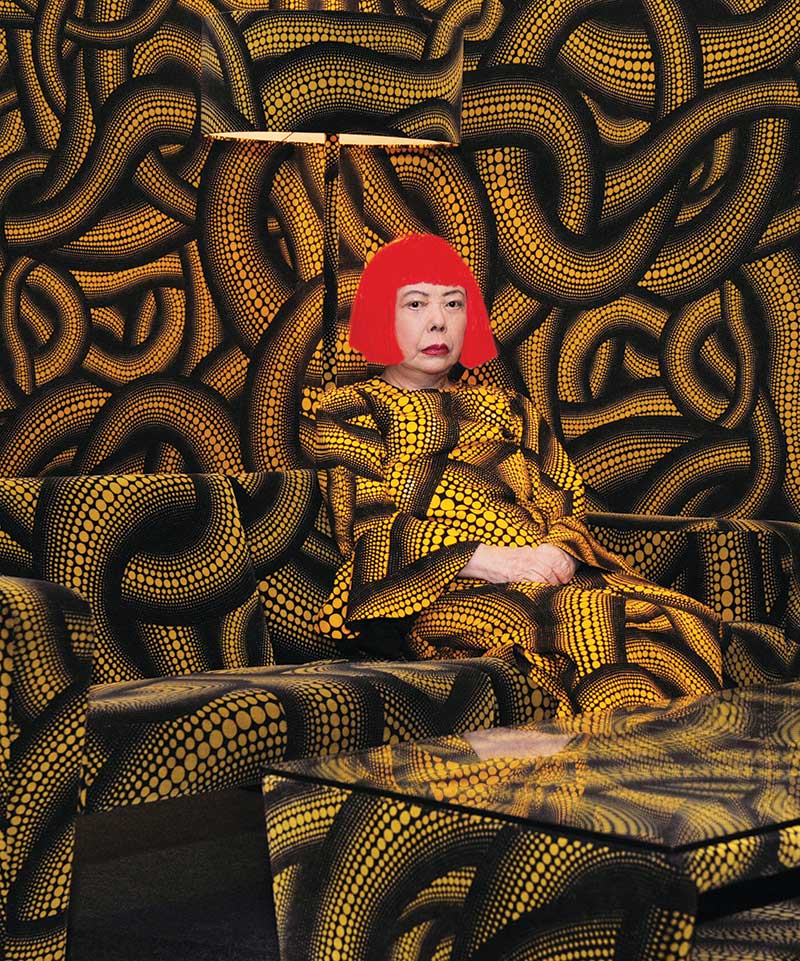
Born in Matsumoto in 1929, Yayoi Kusama recalled experiencing hallucinations from childhood, in which flowers, dots and patterns would engulf her field of vision. After studying art in Kyoto, an exchange of letters with Georgia O’Keeffe encouraged her to leave for the United States. In 1960s New York, she emerged as a distinctive figure on the avant-garde scene, producing paintings, soft sculptures, installations, films and happenings at a relentless pace. She returned to Japan in 1973 and, a few years later, chose to live in a psychiatric hospital in Tokyo, while continuing to work every day in her nearby studio. From the 1990s onwards, her international reputation soared, ultimately making her one of the most celebrated artists of her time.
Painting was a fever born of desperation, the only way for me to go on living in this world.
Yayoi Kusama
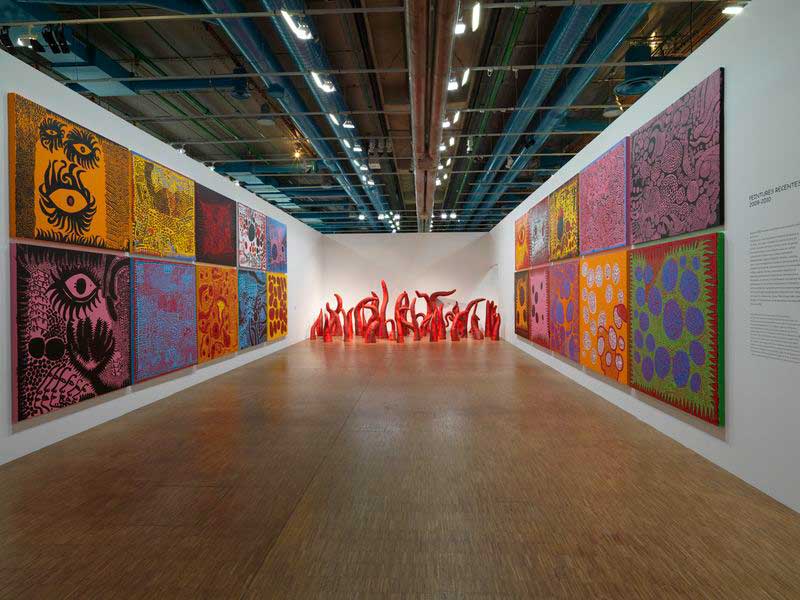
From 10 October 2011 to 9 January 2012, the Centre Pompidou staged the first major French retrospective of her work, bringing together nearly 150 pieces created between 1949 and 2011. The exhibition revealed how, beneath the exuberance of dots, mirrors and colour, the same obsession had coursed through more than six decades of her art: repetition as a means of giving form to infinity—and perhaps dissolving into it.
Yayoi Kusama died in Tokyo on 14 August 2026, aged 97. She continued to paint until her final days. Modest yet extravagant, Macaroni Dress takes us back to one of the wellsprings of her vast body of work: a simple everyday object on which repetition alone is enough to conjure an entire world. ◼
Related articles
Yayoi Kusama, Macaroni Dress (1964), detail
© Yayoi Kusama
Painted pasta glued onto fabric, passementerie, wood, metal, newspaper
120.5 × 47 × 3.5 cm
Jean Chatelus Collection, donation of the Fondation Antoine de Galbert, 2023
© Centre Pompidou, Mnam-Cci/Dist. GrandPalaisRmn
Portrait of artist Yayoi Kusama in Yellow Tree Furniture (2002), at the Aichi Triennale, 2010
Courtesy of Yayoi Kusama Studio, Tokyo
Photo © Hal Reiff
Installation view
© Centre Pompidou